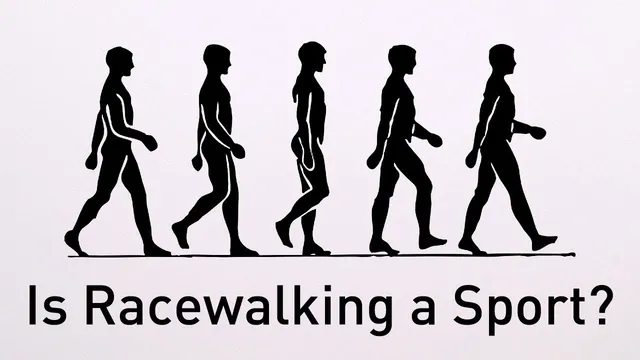
Is Racewalking a Sport?
Based on minutephysics's video on YouTube. If you like this content, support the original creators by watching, liking and subscribing to their content.
Racewalking’s defining rules require continuous ground contact and a straight front leg, but judging relies on side-of-course visual observation rather than measurement.
Briefing
Racewalking’s defining rule—one foot must stay on the ground while the front leg remains straight—creates a judging problem that modern technology could, in principle, solve. Yet officials are restricted to watching competitors from the side of the course and making calls by eye, with explicit limits on tools like binoculars, mirrors, or ground-level viewing. The result is a sport whose rules are technically precise but enforced in a visibly low-tech way.
The tension becomes clearer when slow-motion footage and photographs are examined. They show that many racewalkers appear to leave the ground on a large fraction of strides, not just during rare stumbles or allowed “loss of contact” moments. The racewalking community itself recognizes that athletes often spend up to about 10% of their time airborne. That means the traditional defining criterion—“always” having one foot on the ground—is widely violated in practice, even by top competitors.
This mismatch raises a sharper question than whether judges are strict: why isn’t the sport using the same kinds of measurement tools common in other judged events? Other sports rely on technology to enforce rules—high-speed or replay systems in various disciplines, finish-line cameras, touchpads, and detailed tracking systems. Racewalking, by contrast, keeps judges confined to visual assessment without modern aids that could detect airborne phases more reliably.
The transcript frames the likely reason as structural rather than accidental: if high-speed video and objective tracking were used to enforce the “always on the ground” requirement, many current techniques would fail the test, and the sport’s competitive identity would change. In that sense, the technology ban may not be about fairness so much as preserving a workable definition of racewalking that athletes can actually perform at speed.
That leads to a broader philosophical point about sport itself. Games and athletic events are built on arbitrary rule sets and constraints chosen for challenge and entertainment, not on natural laws. The examples offered—banning bicycles in track, banning motorcycles in cycling, and banning rockets in motorcycle racing—suggest that many sporting boundaries are conventions maintained because they shape the contest.
So the core finding is less “racewalking is or isn’t a sport” and more that racewalking’s rule enforcement is intentionally aligned with what athletes can do, even if that means the formal definition is not literally met. The transcript ends by separating the question of judging rules from the question of athleticism: racewalkers are still athletes, pushing human performance within a rulebook that may be more about maintaining a recognizable contest than about enforcing a literal physical condition on every stride.
Cornell Notes
Racewalking depends on a strict rule—one foot must stay on the ground and the front leg must remain straight—but judges enforce it using side-of-course, unaided visual observation. Slow-motion footage and photos suggest that many elite racewalkers leave the ground on most strides, sometimes being airborne up to about 10% of the time, a pattern widely acknowledged within the community. That creates a contradiction: most competitors appear to break the defining “always in contact” rule while still competing successfully. The transcript argues that the technology restrictions likely exist because objective measurement would force a major change in technique and possibly eliminate the current form of the sport. Even with this tension, the athletic demands remain real, so racewalkers are still athletes.
What are the core technical rules that define racewalking, and how are they supposed to be checked?
Why does the “always on the ground” rule conflict with what’s seen in high-speed footage?
How does racewalking’s judging approach differ from other sports’ enforcement methods?
What might be the practical reason racewalking resists high-speed, objective judging?
What broader idea about sport does the transcript use to interpret this rule-and-tech conflict?
Review Questions
- How do the formal racewalking rules differ from what slow-motion evidence suggests about foot contact time?
- What restrictions on judges’ tools and viewing positions prevent objective verification in racewalking?
- Why might enforcing the “always on the ground” rule with high-speed technology fundamentally change the sport?
Key Points
- 1
Racewalking’s defining rules require continuous ground contact and a straight front leg, but judging relies on side-of-course visual observation rather than measurement.
- 2
Judges are restricted from using tools like binoculars or mirrors and are limited in viewing position, reducing the ability to verify contact objectively.
- 3
Slow-motion footage and photos indicate that many racewalkers leave the ground on most strides, with the community acknowledging airborne time up to about 10%.
- 4
The widespread mismatch between formal rules and actual technique suggests the sport operates with a practical, not purely literal, definition of compliance.
- 5
Technology is common in other sports for rule enforcement, but racewalking’s restrictions may be designed to preserve the sport’s current competitive form.
- 6
The broader argument treats sport rules as conventional constraints that shape competition, not as universally enforceable physical truths.
- 7
Even with rule enforcement tensions, racewalking still demands high athletic performance and skill.