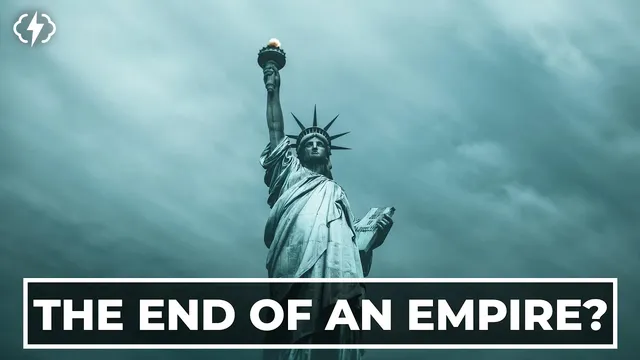
Is the American Century Coming to an End?
Based on Second Thought's video on YouTube. If you like this content, support the original creators by watching, liking and subscribing to their content.
Hegemony is defined as dominance with minimal resistance, so “decline” hinges on whether other powers can resist U.S. military, economic, and cultural influence.
Briefing
The United States’ global dominance is under sharper strain than at any point in decades—not because decline is a simple, linear story, but because the contradictions of American power (economic, political, and social) are colliding with a more multipolar world. For years, U.S. exceptionalism helped justify a hegemonic role: Washington’s military reach, economic architecture, and diplomatic influence were treated as proof that the country was uniquely positioned to lead. That framework was reinforced after World War II through institutions and alliances such as NATO, the Marshall Plan, and the Bretton Woods system, and it later appeared to be sealed by the Soviet Union’s collapse, when U.S. liberal ideology seemed to win globally.
Yet the transcript frames today’s moment as a challenge to that old certainty. Hegemony is defined as dominance with minimal resistance, and the argument is that resistance—economic and political—has grown. China’s rapid rise, Europe’s increasing willingness to regulate and assert sovereignty, and Russia’s persistent ability to complicate U.S. plans all point toward a world where the U.S no longer sets the terms as completely as it once did. At the same time, internal U.S. weaknesses have become harder to ignore. The pandemic is treated as a revealing stress test: high death tolls, uneven government response, and the way wealth concentration and privatized economic structures left many people exposed. Add in Afghanistan’s withdrawal and years of domestic instability, and the transcript portrays “decline” not just as external competition, but as a credibility problem—America’s ability to lead is questioned by what it cannot manage at home.
The discussion also distinguishes between competing interpretations of what’s happening. One camp sees the U.S. as genuinely in decline, pointing to events like Afghanistan as evidence that the hegemonic logic is failing. Another camp argues the decline narrative is overstated or even manufactured: “American hegemony” may be less a real condition than a post-hoc story used to justify interventionism and violence under the banner of liberal progress. A third view treats multipolarity as inevitable but not necessarily permanent—declinism has appeared before whenever a rival surged, whether it was the Soviet Union, Japan, China, or Europe.
The transcript’s most consequential takeaway is that the U.S. response to perceived threats has historically been predictable: increased surveillance, propaganda campaigns, and military or economic escalation framed as necessary to protect “freedom.” That pattern is presented as a reason skepticism about the capitalist status quo is spreading. Developing nations, long pressured by Western economic power, are increasingly receptive to anti-capitalist sentiment, while China’s willingness to support smaller countries is portrayed as offering an alternative model.
So the central question—whether the American century is ending—lands without a definitive answer. The transcript insists no one can know for sure. But it argues the conditions for a shift are real: growing skepticism of neoliberal globalization, rising multipolar competition, and a U.S. public less willing to accept the old story of American exceptionalism as unquestionable truth.
Cornell Notes
The transcript links U.S. global dominance to a broader system of liberal capitalism and institutions built after World War II. It argues that American hegemony is being challenged both externally—by China’s rise, Europe’s assertiveness, and Russia’s persistence—and internally, where crises like COVID-19 expose weaknesses in governance and inequality. It also lays out competing theories: some see genuine decline, others see “decline” as a narrative used to justify intervention, and still others treat multipolarity as a recurring cycle rather than a one-time fall. Even without certainty about the future, the transcript emphasizes that perceptions of threat have repeatedly triggered propaganda, surveillance, and escalation—fueling anti-capitalist sentiment at home and abroad.
What does “hegemony” mean in international politics, and how does that definition shape the decline debate?
How did the U.S. build the postwar foundation for global leadership?
Why is COVID-19 treated as a turning point for assessing U.S. leadership?
What are the main competing explanations for “American decline”?
How does the transcript connect perceived threats to U.S. domestic and foreign escalation?
What does the transcript suggest is driving the shift toward a different global order?
Review Questions
- Which factors in the transcript are presented as evidence of external challenge to U.S. hegemony, and which are presented as evidence of internal weakness?
- How do the three explanations for “decline” differ in what they think is actually happening to U.S. power?
- What recurring U.S. policy pattern is described when threats to hegemony are perceived, and what examples are used to illustrate it?
Key Points
- 1
Hegemony is defined as dominance with minimal resistance, so “decline” hinges on whether other powers can resist U.S. military, economic, and cultural influence.
- 2
Postwar U.S. leadership was built through institutions and alliances such as NATO, the Marshall Plan, and Bretton Woods (IMF and World Bank), tying global finance to the dollar system.
- 3
The transcript treats COVID-19 as a leadership stress test, linking high death tolls and unequal outcomes to failures in governance and the effects of wealth concentration.
- 4
Competing theories of decline include genuine weakening, narrative-driven justification of intervention, and cyclical multipolar shifts that may not equal permanent collapse.
- 5
China’s rise, Europe’s regulatory assertiveness, and Russia’s continued disruption are presented as signs that the U.S. no longer sets the terms as completely as before.
- 6
Historically, perceived threats to U.S. dominance have been met with surveillance, propaganda, and escalation—patterns that can intensify backlash and anti-capitalist sentiment.
- 7
Even if U.S. hegemony weakens, the transcript argues the more important change may be shifting global attitudes toward neoliberal globalization and U.S.-led order.