Is the Mainstream Media a Threat to Freedom and Sanity?
Based on Academy of Ideas's video on YouTube. If you like this content, support the original creators by watching, liking and subscribing to their content.
Information flow is treated as a form of power: controlling what people see and discuss can legitimize or delegitimize political authority.
Briefing
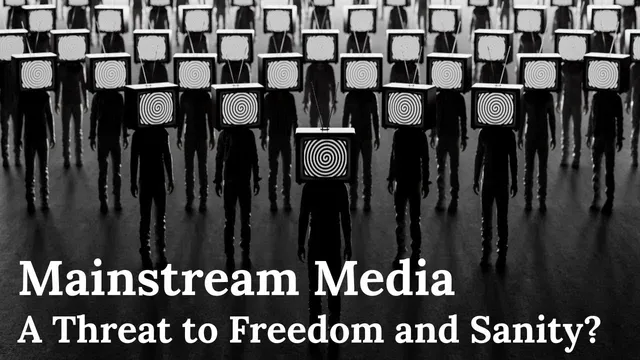
The central claim is that mainstream media’s top-down information control helps enable political submission, but the internet and social media may break that monopoly by empowering mass authorship—making it harder for technocratic totalitarianism to take hold. The argument ties freedom to information flow: whoever shapes what people see, hear, and discuss can frame reality, set agendas, and legitimize or delegitimize ruling power. In that view, modern mass media functions less like a neutral “supplier” of news and more like a “valve” that opens for money or permission, producing conformity while suppressing alternatives.
The case begins with a cultural premise: politics follows culture, and culture follows technology. Communication technologies don’t just transmit ideas; they sculpt how information moves, which in turn directs attention, influences perception, and shapes political outcomes. The transcript points to earlier revolutions as evidence. Gutenberg’s moveable-type printing press lowered the cost of publishing, multiplying books from roughly 12,000 copied in the prior half-century to about 12 million produced in the following half-century, fueling literacy, religious upheaval, and revolutionary pamphleteering. Later, radio, telephone, and television reduced reliance on physical transportation networks for information, enabling simultaneous national broadcasting and establishing a mass-media model defined by centralized, unidirectional messaging.
From there, the argument turns sharply critical. Mass media is described as structurally top-down: a relatively small group owns and operates broadcasting infrastructure, while wealthy and powerful institutions influence content. That arrangement, it says, can “stifle” thought, foster “complacent fictions,” and organize the political world by choosing what to emphasize or ignore. The transcript invokes Michael Parenti’s idea of agenda-setting—media may not dictate every belief, but it strongly determines what people think about. It also draws on historical and ideological parallels: Nazi propaganda is cited as having relied on radio for power, and Plato’s cave is used as a metaphor for a manipulated reality that audiences mistake for truth.
The internet is presented as the escape hatch from that cave. When individuals identify corruption, see through lies, or expose propaganda, they can share discoveries with potentially millions, ending the mass-media monopoly on information. The transcript frames this as an “emancipation of authorship,” enabled by personal computers and mobile devices that let individuals publish and distribute ideas for any purpose. If historical analogies hold, the loss of “sacral control” over information could trigger comparable upheaval—social, political, and economic—because old authorities lose legitimacy when their narrative dominance collapses.
Yet the optimism is conditional. The transcript warns that threatened power structures will push for censorship, often justified as necessary to limit hate speech and correct misinformation. Those measures are portrayed as a strategy to return society to a controlled information environment that protects powerful interests. The closing note is a warning from Aleksandr Solzhenitsyn: without freely expressed, independent public opinion, mass atrocities can recur. The stakes, in this telling, are whether the new communication paradigm expands freedom and pluralism—or becomes the mechanism for technocratic global totalitarianism.
Cornell Notes
The transcript argues that freedom depends on who controls information. Mass media is portrayed as a top-down system where a small ownership class and allied institutions filter and package news, shaping attention and agenda-setting in ways that support centralized power. Earlier communication revolutions—Gutenberg’s printing press and 20th-century broadcast media—are used to show how new information technologies can transform culture and politics. The internet is framed as a break from the “cave” of manipulated shadows because it enables mass authorship: individuals can publish and distribute content widely, undermining the monopoly of traditional media. The main risk is that elites will respond with censorship, justified as combating hate or misinformation, potentially restoring a controlled information environment.
How does the transcript connect technology, culture, and political power?
What role does mass media play in the argument, and why is it considered dangerous?
What historical examples are used to show that communication revolutions change politics?
Why does the transcript treat the internet as an “escape” from manipulated reality?
What does “emancipation of authorship” mean in this argument, and what devices enable it?
What threat does the transcript identify even if the internet expands free expression?
Review Questions
- What causal mechanism does the transcript use to link communication technology to political outcomes?
- How does agenda-setting differ from directly telling people what to think, according to the transcript’s framing?
- What conditions would determine whether the internet leads to emancipation rather than a new form of technocratic control?
Key Points
- 1
Information flow is treated as a form of power: controlling what people see and discuss can legitimize or delegitimize political authority.
- 2
Communication technology is presented as a driver of cultural change, which then shapes the political status quo.
- 3
Gutenberg’s printing press is used as an example of how cheaper publishing can expand literacy and fuel religious and revolutionary movements.
- 4
20th-century broadcast media is characterized as top-down and filtered, enabling conformity through centralized agenda-setting.
- 5
The internet is framed as breaking the mass-media monopoly by enabling mass authorship and wide distribution of revelations.
- 6
Censorship is portrayed as the likely counter-move by threatened elites, even when justified as combating hate or misinformation.
- 7
Independent public opinion is presented as a safeguard against recurring large-scale atrocities.