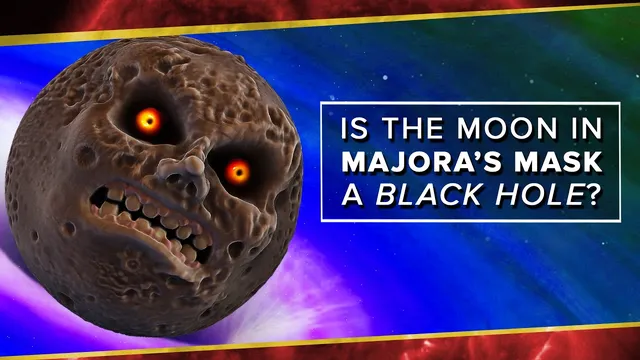
Is the Moon in Majora’s Mask a Black Hole?
Based on PBS Space Time's video on YouTube. If you like this content, support the original creators by watching, liking and subscribing to their content.
Rock levitation in Majora’s Mask is treated as evidence of tidal force, not just the moon’s direct gravitational pull.
Briefing
“Majora’s Mask” moon isn’t a moon at all—it’s a super-dense rocky shell wrapped around a miniature black hole. The claim hinges on a physics mistake common to earlier analyses: treating Termina’s moon as if it had the same density as Earth’s moon. That assumption collapses under tidal-force math, because anything with lunar-like density would be far too weak to levitate rocks at the distances implied by the game’s three-day collision.
The argument starts with a reality check on density. If a body with Earth-moon density came within roughly 12,000 kilometers of Earth’s surface, it would be torn apart by tidal stresses. The same logic applies on Termina regardless of what exact planetary size is chosen: the moon’s gravity can’t be “normal” and still produce the dramatic effects seen before impact.
Instead of guessing density directly, the analysis uses an in-game cue: just before the moon hits, loose rocks lift off Termina’s surface. That doesn’t mean the moon’s raw pull beats the planet’s gravity. The lifting comes from tidal force—differential gravity across the planet. Rocks closer to the moon accelerate toward it slightly faster than the planet’s center does, creating an effective outward “anti-gravity” along the planet–moon line. On Earth, the tidal force from the moon is about 10 million times smaller than Earth’s own gravity on a person, which is why full moons don’t levitate anything. Bringing the moon closer increases tidal effects, but on Termina the game’s levitation requires an enormous jump.
Using MatPat’s measurement that Termina’s moon radius is only about 30-ish meters, plus lower limits on Termina’s planet size derived from the lack of visible horizon curvature, the tidal-force requirement becomes extreme. If Termina’s moon had lunar density, its tidal effect near the surface would be about 200,000 times smaller than what’s needed—equivalent to raising ocean levels by only about 1/100 of a millimeter. The game’s rock-lifting, by contrast, demands a moon density between a billion and 100 trillion times Earth-moon density, depending on whether the rocks are being whipped upward by atmospheric-like forces or lifted directly by gravity.
Such densities push beyond ordinary matter. The only macroscopic objects known to reach them are neutron stars, but neutron-star material requires huge self-gravity to form in the first place—typically needing at least about one-tenth of the Sun’s mass. Termina’s moon, even with the higher mass implied by the measurements, still falls millions of times short of what would be needed for a pure neutron star.
The proposed workaround is a “gravitational seed”: a tiny, ultra-dense core that allows surrounding material to reach neutron-star-like densities without needing the full mass. That seed could be a black hole with a radius under a millimeter, surrounded by a dense crust with teeth. The mechanism for creating such a small black hole is sketched via Hawking radiation: start with a larger black hole and let it evaporate over an astronomically long time until it shrinks to sub-millimeter size.
The conclusion is deliberately speculative but internally consistent: tidal forces inferred from the game’s levitating rocks force Termina’s moon into an ultra-dense configuration, and a miniature black hole provides a plausible physical anchor. Loose ends remain—especially how Link survives traveling through a region where gravity would be billions of times stronger than on Earth—but the tidal-force mismatch is treated as the central reason earlier “normal moon” interpretations fail.
Cornell Notes
Termina’s moon can’t have Earth-moon density because tidal forces would be far too weak to lift rocks off the surface. The key evidence is the game’s pre-impact scenes where loose rocks rise, which points to tidal force (differential gravity) rather than the moon’s simple pull. Calculations using MatPat’s estimate that the moon’s radius is about 30-ish meters—and constraints on Termina’s planet size—imply the moon’s density must be between a billion and 100 trillion times Earth’s moon density. Ordinary matter can’t reach that density at such low mass; neutron-star densities would normally require far more mass. A proposed fix is a tiny, sub-millimeter black hole acting as a gravitational seed, wrapped in a dense crust.
Why does the rock-lifting scene imply tidal force rather than just stronger gravity from the moon?
What goes wrong with earlier interpretations that assume Termina’s moon has the same density as Earth’s moon?
How does the analysis translate the game’s visuals into a density estimate?
Why are neutron stars considered the natural benchmark for such extreme densities?
How does the “mini black hole seed” idea resolve the mass-versus-density problem?
What mechanism is suggested for producing a sub-millimeter black hole?
Review Questions
- What specific in-game phenomenon is used to infer tidal force, and how does tidal force differ from simple gravitational attraction?
- Why does assuming lunar density for Termina’s moon lead to a contradiction with the observed rock levitation?
- What physical role does the proposed miniature black hole play in achieving neutron-star-like densities without requiring neutron-star mass?
Key Points
- 1
Rock levitation in Majora’s Mask is treated as evidence of tidal force, not just the moon’s direct gravitational pull.
- 2
Earth-moon density for Termina’s moon would make tidal effects about 200,000 times too small to lift rocks near the surface.
- 3
The required density for the moon falls between a billion and 100 trillion times Earth-moon density, based on tidal-force calculations using the moon’s ~30-ish meter radius estimate.
- 4
Densities that high are comparable to neutron-star material, but forming a full neutron star would require far more mass than Termina’s moon appears to have.
- 5
A proposed solution is a tiny, sub-millimeter black hole acting as a gravitational seed, surrounded by a dense crust.
- 6
Hawking radiation is suggested as a way such a small black hole could arise after long evaporation times.
- 7
Even if the tidal-force logic is accepted, the scenario leaves open questions about how Link survives extreme gravity near the moon.