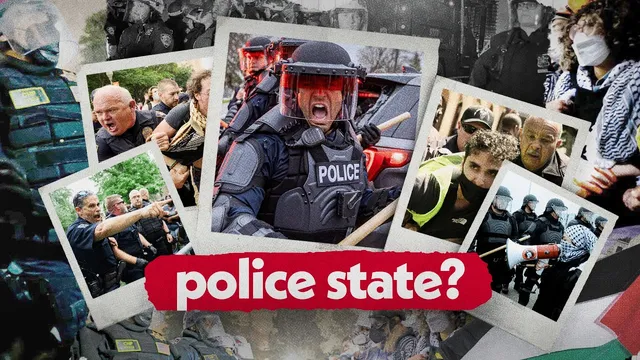
Is The US a Police State?
Based on Second Thought's video on YouTube. If you like this content, support the original creators by watching, liking and subscribing to their content.
The transcript frames the U.S. as operating through a carceral “law and order” logic that criminalizes political dissent, especially during mass upheaval.
Briefing
The United States is being run through a carceral “law and order” system that treats political dissent as criminal behavior—backed by mass surveillance, militarized policing, and near-total lack of accountability for police violence. The central claim is that this isn’t an occasional overreach; it’s a stable governing logic that expands during moments of mass upheaval, turning protests into targets and organizers into criminals.
Recent protest crackdowns are presented as evidence of that pattern. In Chicago, Police Superintendent Larry Snelling warns that “peaceful protest” only receives First Amendment protection when people are not committing crimes—explicitly naming actions like blocking roadways, blocking venues, or refusing to leave private property as grounds for removal and arrest. In New York, NYPD Deputy Commissioner Tariq Shepard is described as standing amid a campus crackdown tied to pro-Palestine organizing, where police were invited to violently disperse an encampment after students occupied a school building.
The transcript links these incidents to a broader, nationwide shift in how protest is policed. It describes surveillance as routine—cameras, drones, and large police presence—while pointing to pressure on protest safety measures such as masking. It cites New York Mayor Eric Adams pushing to restrict mask use at protests, and it argues that courts have made organizing riskier by allowing protest organizers to be financially liable for illegal acts by “bad actors.” The transcript also claims that roughly 3,000 students have been arrested across the country over the past three months for calling for an end to U.S. and university complicity in the Palestinian genocide, with additional arrests at institutions including the Israeli consulate, the Brooklyn Museum, and locations in New Orleans and Washington, D.C.
Violence and injuries are emphasized as part of the enforcement toolkit. The account describes riot-gear “armies” meeting peaceful protesters with less-lethal munitions, assaults, pepper spray and mace, and—at Columbia’s Hamilton Hall—flashbangs, room-to-room raids with guns drawn, and at least one shot fired (without a reported hit). It lists downstream consequences: hospitalized protesters with fractured eye sockets, concussions, broken ribs, and broken hands, alongside felony and misdemeanor charges that can carry years in jail.
To explain why this keeps happening, the transcript argues that neoliberal capitalism since the Reagan era has systematically increased insecurity—through cuts to social services, weakened labor protections, and policies that deepen poverty—while simultaneously expanding policing and incarceration. In that framework, “crime” becomes a flexible label used to manage social conflict: structural problems are reframed as individual wrongdoing, while white-collar and corporate harms are treated differently from street-level offenses. The result is a system where criminal justice normalizes the capitalist hierarchy and makes police the default solution to homelessness, mental health crises, poverty, and even protest itself.
The transcript concludes that the crackdown logic is not unique to any single campus or moment. It portrays the message to dissenters as clear: when protests disrupt the stability of the ruling order, militarized policing and legal punishment follow quickly—and often with unequal outcomes depending on class and media visibility.
Cornell Notes
The transcript argues that the U.S. functions like a police state in practice because political dissent is routinely treated as criminal behavior. It connects campus and street protests—especially pro-Palestine organizing—to a wider system of surveillance, militarized policing, and legal risk for organizers. It claims police violence is widespread and rarely punished, citing Human Rights Watch’s finding that most police killings do not lead to criminal charges. The explanation ties these tactics to neoliberal capitalism: policies that increase insecurity are paired with expanded incarceration, while “crime” is defined in ways that protect existing power. The result is that protests are met not as protected speech, but as threats to social order.
What does “peaceful protest” mean legally in the transcript’s account, and why does that distinction matter?
How does the transcript describe the role of surveillance and policing tactics at protests?
What legal and financial mechanisms does the transcript say increase the risk of organizing protests?
What evidence of police violence and its consequences does the transcript emphasize?
How does the transcript connect policing to neoliberal capitalism and the definition of “crime”?
Review Questions
- Which specific protest actions does the transcript treat as crossing from protected speech into criminalized conduct, and how does that change outcomes?
- What combination of surveillance, legal liability, and policing tactics does the transcript say makes protest organizing increasingly risky?
- How does the transcript explain the relationship between economic insecurity under neoliberalism and the expansion of incarceration and policing?
Key Points
- 1
The transcript frames the U.S. as operating through a carceral “law and order” logic that criminalizes political dissent, especially during mass upheaval.
- 2
Chicago Police Superintendent Larry Snelling’s remarks are used to illustrate how “peaceful protest” can still be treated as unlawful when protesters block access or refuse to leave private property.
- 3
The account describes protest enforcement as surveillance-heavy, with cameras and drones and large police presence designed to enable rapid arrests.
- 4
It argues that courts and local officials have increased organizing risk—citing mask restrictions in New York and a Supreme Court ruling that can make organizers financially liable for illegal acts by others.
- 5
The transcript emphasizes police violence and near-zero accountability, citing Human Rights Watch’s claim that about 98% of police killings do not result in officers being charged with a crime.
- 6
It links expanded policing and incarceration to neoliberal economic policy since the Reagan era, arguing that insecurity is produced while “crime” is defined to manage social conflict.
- 7
The transcript claims outcomes differ by class and media visibility, with more privileged protesters facing faster charge reductions than those at public schools with less institutional protection.