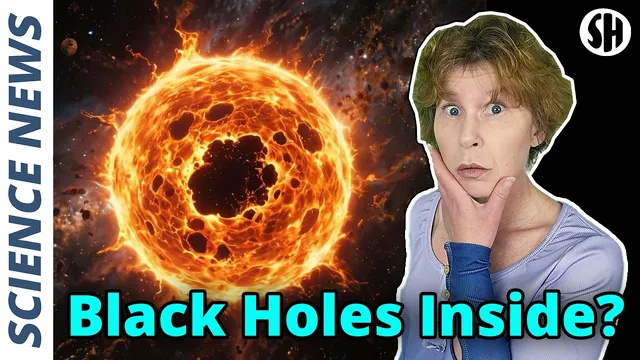
Is there a Black Hole Hiding in the Sun?
Based on Sabine Hossenfelder's video on YouTube. If you like this content, support the original creators by watching, liking and subscribing to their content.
Dark-matter capture by stars could, under general conditions, collapse into tiny black holes that then grow by accreting stellar material from within.
Briefing
A new calculation makes “black holes inside stars” feel less like science fiction: if dark matter particles can accumulate in a star’s core and collapse, they could seed tiny black holes that grow by feeding on the star from within. The mechanism is designed to address a long-standing puzzle—tentative hints of black holes with masses below about 2.5 times the Sun’s mass—without relying on the usual stellar-collapse route, which requires a star to exceed a minimum mass to form a black hole in the first place.
The starting point is the mismatch between observations and standard black-hole formation. For roughly a decade, some data have suggested the existence of black holes lighter than expected from stellar collapse. Primordial black holes were one possibility, but their mass would need to land in a narrow range near ordinary stellar masses, which seems statistically contrived. The new work instead revives an older idea from early dark-matter searches: dark matter can be gravitationally captured by stars. Because dark matter does not generate internal pressure the way normal matter does, it can sink and collapse more readily.
Under broad conditions, the authors argue that certain dark matter candidates—around 100 GeV in mass, assuming they do not self-annihilate efficiently—could accumulate in a star and collapse into a small black hole. These “parasitic black holes” would then grow by pulling in surrounding stellar material until the star ultimately fails. Crucially, the seeded black hole can be below the mass threshold normally required for core collapse, meaning the star’s fate is determined by how quickly the internal black hole can grow.
The paper estimates timescales across different stellar types. Neutron stars, already extremely dense, could be consumed rapidly—on the order of tens of thousands of years—unless they rotate very fast, which could extend the process to millions of years. White dwarfs, being much less dense, would take far longer; the authors suggest that many would not fully collapse. Instead, the black hole might carve out a polar funnel along the rotation axis, with material at larger radii held back by centrifugal effects.
For stars like the Sun, the outlook is more reassuring. Even if a dark-matter-seeded black hole formed, it would need to accrete matter faster than it loses mass through Hawking radiation. Normal stellar densities appear too low for that balance, so the black hole would not survive long enough to grow. The absence of any observed “blink-out” pattern in stars also argues against widespread internal black-hole growth.
Despite the plausibility of the mechanism, the empirical footing remains weak. Evidence for small-mass black holes is described as effectively nonexistent: gravitational-wave candidates have alternative interpretations (such as neutron stars), and microlensing hints come with large uncertainties. Still, the proposed scenario is considered nontrivial because it fits within fairly general dark-matter assumptions and does not require a finely tuned set of parameters—making it a credible, if unconfirmed, pathway connecting dark matter to stellar destruction from the inside.
Cornell Notes
The proposed scenario links dark matter to the possible formation of tiny “parasitic” black holes inside stars. Dark matter particles could be captured by a star, sink to the center, and collapse into a small black hole if they don’t self-annihilate and have masses around ~100 GeV. Once formed, the black hole could grow by accreting stellar material, with outcomes depending strongly on stellar density and rotation: neutron stars could be eaten quickly (or over millions of years if rapidly spinning), while many white dwarfs might only develop a polar funnel. For Sun-like stars, Hawking radiation likely prevents long-term growth because accretion cannot outpace evaporation. The mechanism is considered plausible, but current observational evidence for small-mass black holes remains very weak.
Why do small-mass black holes pose a problem for standard stellar collapse?
How does dark matter accumulation in stars lead to a black hole seed?
What determines whether neutron stars, white dwarfs, or Sun-like stars are affected?
What are “parasitic black holes,” and why does their mass matter?
What observational evidence supports or undermines the idea?
Review Questions
- What physical balance determines whether a dark-matter-seeded black hole can persist inside a Sun-like star?
- How do density and rotation change the predicted timescales for consuming neutron stars?
- Why is the standard stellar-collapse pathway unlikely to produce black holes below ~2.5 solar masses?
Key Points
- 1
Dark-matter capture by stars could, under general conditions, collapse into tiny black holes that then grow by accreting stellar material from within.
- 2
The scenario targets a mismatch between tentative low-mass black-hole hints and the minimum-mass requirement of standard stellar collapse.
- 3
Parasitic black holes can start below the core-collapse threshold yet still destroy stars if they grow fast enough.
- 4
Neutron stars could be consumed on timescales of tens of thousands of years, potentially extending to millions for very rapid rotation.
- 5
White dwarfs are less dense, so many would not fully collapse; the model predicts possible formation of a polar funnel along the spin axis.
- 6
Sun-like stars likely cannot sustain internal black holes because accretion cannot outpace Hawking radiation.
- 7
Current observational evidence for small-mass black holes remains highly uncertain, leaving the mechanism plausible but unconfirmed.