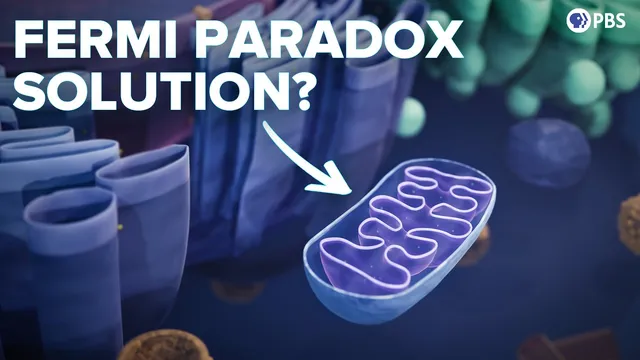
Is There A Simple Solution To The Fermi Paradox?
Based on PBS Space Time's video on YouTube. If you like this content, support the original creators by watching, liking and subscribing to their content.
The Fermi paradox motivates a “great filter” idea: one or more rare steps may prevent most life-bearing worlds from reaching technological civilization.
Briefing
The most newsworthy claim is that the Fermi paradox—why the Milky Way doesn’t seem crowded with technological civilizations—may hinge on a single, rare evolutionary breakthrough: the origin of the first eukaryotic cell (the “eukaryogenesis” event). If that transition is an unusually improbable step, then many worlds could still generate simple life, but most would stall at the prokaryote level or wipe themselves out after oxygenation and climate shocks, leaving behind “slime worlds” rather than galaxy-spanning societies.
The argument starts with a statistical baseline: given the huge number of potentially habitable planets and billions of years for life to develop, it’s surprising that no clear technological signals have been detected. That mismatch is often framed as the “great silence,” and it points to a “great filter”—one or more steps between simple life and advanced civilization that are so unlikely that only a tiny fraction of biospheres complete the journey. The transcript emphasizes that optimism is possible if the filter lies in the past. On Earth, life began early—within roughly the first 10% of the planet’s history—suggesting abiogenesis may not be vanishingly rare. The harder part may come later, when complexity must scale up under harsh environmental and biological constraints.
Several extinction-style catastrophes are considered as candidates for the filter, but the discussion pivots to a different kind of bottleneck: the transition from single-celled prokaryotes to complex eukaryotes. Around two billion years ago, Earth experienced major upheavals. Photosynthesis by cyanobacteria oxygenated the atmosphere, triggering a “great oxidation” event that likely killed most existing life, followed by extreme glaciation—often described as a Snowball Earth. Life at the time was largely prokaryotic and anaerobic, so rising oxygen was lethal.
The proposed escape route was endosymbiosis: an anaerobic host cell engulfed an aerobic bacterium that survived inside it. The partnership became transformative because the host could now generate energy in an oxygen-rich world. Over generations, gene exchange and integration turned the pair into a single organism, with the bacterium’s descendants becoming mitochondria. This shift also solves an energetic scaling problem: larger cells need energy that grows faster than their ability to capture it, but mitochondria provide additional membrane surface area, effectively breaking the size limit that constrains complexity.
A newer study is then used to sharpen the “rarity” claim. Researchers analyzing gene and protein lengths across more than 6,500 species argue that protein length growth decoupled from gene length around the same era—about two billion years ago. Protein folding search becomes computationally infeasible beyond a few hundred amino acids, so evolution hits a practical limit on new protein machinery. The transcript links the continued growth of gene length to a regulatory “algorithmic phase transition”: non-coding DNA, RNA roles, introns, and regulatory elements expand, improving how cells regulate transcription without relying solely on new proteins. In this framing, eukaryogenesis coincides with both an energetic breakthrough and a computational/regulatory upgrade.
If those breakthroughs were indeed singular or near-singular, then many planets could follow a grim path: life modifies the atmosphere, triggers oxygen and climate catastrophes, and then stalls or goes extinct before complex, intelligence-capable ecosystems emerge. The payoff is that if the filter is behind us, humanity’s future may depend less on cosmic odds and more on avoiding self-inflicted collapse.
Cornell Notes
The Fermi paradox asks why the Milky Way doesn’t show signs of many technological civilizations despite abundant opportunities for life. A “great filter” framework suggests one or more rare steps block most worlds from reaching advanced complexity. The transcript argues that eukaryogenesis—the origin of the first eukaryotic cell—may be such a bottleneck. Around two billion years ago, Earth’s great oxidation and Snowball Earth events created extreme stress, and endosymbiosis (leading to mitochondria) provided a major energetic escape route. A separate “algorithmic phase transition” in gene regulation—where gene length keeps growing while protein length caps—may have enabled the regulatory and molecular machinery needed for rapid complexity, making eukaryogenesis a plausible filter and potentially a reason other civilizations never formed.
What does the “great filter” mean in the context of the Fermi paradox, and why does it matter?
Why does the transcript focus on eukaryogenesis rather than just mass extinctions?
How did oxygenation and Snowball Earth set the stage for eukaryogenesis?
What is the endosymbiosis mechanism proposed for the origin of eukaryotes?
What energetic scaling problem does mitochondria help solve?
What does the “algorithmic phase transition” claim, and how does it connect to eukaryogenesis?
Review Questions
- How do oxygenation and Snowball Earth events strengthen the case that eukaryogenesis could be a rare, high-impact transition?
- Explain the energetic scaling argument for why mitochondria matter for cell size and complexity.
- What evidence from gene/protein length patterns supports the idea of an “algorithmic phase transition,” and why would that affect evolutionary search for new protein functions?
Key Points
- 1
The Fermi paradox motivates a “great filter” idea: one or more rare steps may prevent most life-bearing worlds from reaching technological civilization.
- 2
Earth’s early emergence of life (within roughly the first 10% of its history) suggests abiogenesis might be relatively common, shifting attention to later bottlenecks.
- 3
Around two billion years ago, oxygenation and extreme glaciation likely made survival difficult for anaerobic prokaryotes, raising the stakes for any major adaptation.
- 4
Eukaryogenesis is framed as a key adaptation via endosymbiosis, where an anaerobic host incorporated an aerobic bacterium that became mitochondria.
- 5
Mitochondria may break a cell-size limit by increasing effective membrane surface area, letting energy production scale better than energy demand.
- 6
A cited study argues that protein length growth capped while gene length continued to rise, interpreted as a regulatory “algorithmic phase transition” that improved transcription control.
- 7
If eukaryogenesis was near-singular, many planets could stall at prokaryote-level complexity or go extinct after atmospheric and climate upheavals, helping explain the “great silence.”