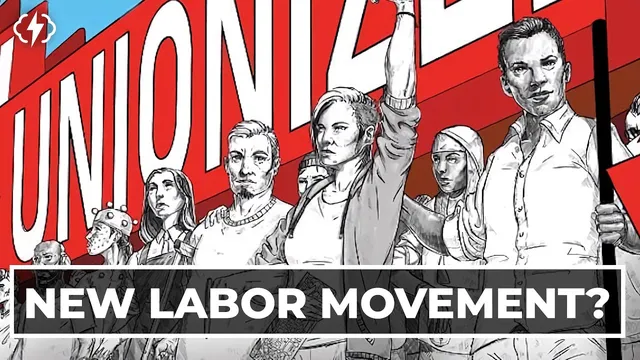
Is This The Beginning Of A New Labor Movement?
Based on Second Thought's video on YouTube. If you like this content, support the original creators by watching, liking and subscribing to their content.
The transcript frames the labor “shortage” debate as a symptom of deeper labor-capital conflict rather than a simple cultural story about work ethic.
Briefing
A renewed wave of labor strikes and a small but meaningful rebound in union membership are pointing to a possible new U.S. labor movement—one driven less by party labels than by shared economic interests between workers and employers. The central claim is that the pandemic-era shift in bargaining power, combined with worsening job conditions and rising awareness of inequality, has created conditions where workers are once again willing to organize, walk out, and demand concrete protections.
The argument begins with the labor market’s contradictions: unemployment has ticked up while businesses report difficulty finding workers, and many states have cut unemployment aid ahead of federal benefits expiring in September. That backdrop has fueled public debate—often framed as “nobody wants to work anymore”—but the underlying tension is portrayed as structural. For decades, workers have lost bargaining power as unionization has been attacked and workplace benefits stripped back: pensions, paid vacation, paid sick days, maternity leave, company cars, and fair wages are described as relics of an earlier era. Meanwhile, executive pay keeps rising, and wealth inequality has returned to levels comparable to the Gilded Age.
The transcript links this erosion to the gig economy and to pandemic pressures that exposed how precarious many jobs are. With 36% of American workers turning to gig work (per the latest available data cited), the combination of low pay, depression, lower life expectancy, and low job satisfaction is framed as a “perfect storm” for renewed class consciousness. Against that, the most visible sign of change is labor militancy: a resurgence of strikes across multiple sectors during the pandemic. Examples include nurses demanding adequate PPE and staffing, teachers pushing for schools to stay closed until safety precautions are in place, flight attendants negotiating paycheck protection tied to industry bailouts, and auto workers forcing plant shutdowns over social-distancing concerns.
Union membership is presented as the measurable indicator of momentum. After decades of decline—reaching an all-time low in 2019, when only 10.3% of workers were union-represented—the figure rises to 10.8% after the pandemic, the sharpest increase in 40 years. Polling is cited to support the idea that more Americans view union decline as harmful, while labor voices spread more easily through social media.
A key case study is an ongoing strike by Alabama miners. Miners from Warrior Met Coal—described as a subsidiary tied to BlackRock’s shareholding—have been on strike for over four months, demanding a fair contract after the company’s 2016 near-bankruptcy rescue. The transcript emphasizes the contrast between record profits (309 million dollars in 2019) and the miners’ sacrifices, including a prior six-dollar-per-hour pay cut, alongside the claim that mainstream coverage has been limited.
Finally, the transcript argues that solidarity can cut across political lines: even if many miners hold right-wing views, their demands are framed as class-based—“following the money” and insisting workers get their share. It credits socialists, particularly the Democratic Socialists of America (DSA), with providing material support and growing membership (from 66,000 to 92,000 dues-paying members since the pandemic). The proposed path forward is rebuilding class consciousness and organizing—using social media for awareness and coordination—so workers can win concessions at scale and improve everyday life.
Cornell Notes
The transcript argues that the U.S. is entering a new phase of labor organizing, driven by renewed strikes and a modest rebound in union membership. It connects pandemic-era bargaining power, worsening job precarity (including gig work), and rising inequality to a growing willingness to fight for better conditions. Strikes by nurses, teachers, flight attendants, and auto workers during COVID-19 are used as examples of workers forcing safety and economic protections. Union representation is said to have risen from 10.3% in 2019 to 10.8% after the pandemic, the biggest jump in four decades. A major case study is the Alabama miners’ strike, which is framed as class solidarity that can transcend party politics, with socialists and the DSA highlighted as key supporters.
Why does the transcript treat the “labor shortage” narrative as incomplete?
What role do pandemic conditions play in the shift toward organizing?
How does the transcript use union membership numbers to support the “new movement” claim?
What makes the Alabama miners’ strike a central example?
How does the transcript argue class solidarity can cross political divides?
Why does the transcript highlight the DSA and socialist organizing?
Review Questions
- What specific workplace demands are cited in the examples of pandemic-era strikes, and how do those demands differ by industry?
- Which union membership figures are used to claim a reversal after decades of decline, and why does the transcript treat a 0.5 percentage-point change as significant?
- How does the transcript connect the Alabama miners’ strike to broader claims about class consciousness and political alignment?
Key Points
- 1
The transcript frames the labor “shortage” debate as a symptom of deeper labor-capital conflict rather than a simple cultural story about work ethic.
- 2
Pandemic-era relief and job insecurity are presented as catalysts that increased workers’ leverage and willingness to organize.
- 3
Strikes during COVID-19 are used as concrete examples of workers winning safety and economic protections through collective action.
- 4
Union representation is cited as rising from 10.3% in 2019 to 10.8% after the pandemic, described as the biggest increase in 40 years.
- 5
The Alabama miners’ strike is highlighted as a case of class-based demands against a company tied to major investors, emphasizing pay cuts, record profits, and executive compensation.
- 6
The transcript argues solidarity can transcend party politics because workers’ interests align through shared economic conditions.
- 7
Socialist organizing—especially via the DSA—is portrayed as providing consistent material support and growing membership during the same period as union momentum.