Is This the End of Traditional Academic Papers? See What Every Researcher Needs to Know!
Based on Andy Stapleton's video on YouTube. If you like this content, support the original creators by watching, liking and subscribing to their content.
Peer-reviewed PDFs often overwhelm readers due to dense formatting, tiny text, and tightly packed tables and figures, especially for newcomers.
Briefing
Traditional peer-reviewed papers remain a gatekeeping format: dense PDFs, tiny fonts, and information packed into short pages make many studies effectively unreadable for anyone outside a narrow specialty. The core shift on display is toward more interactive, digestible ways to access the same scholarly content—without forcing researchers to read every page end to end.
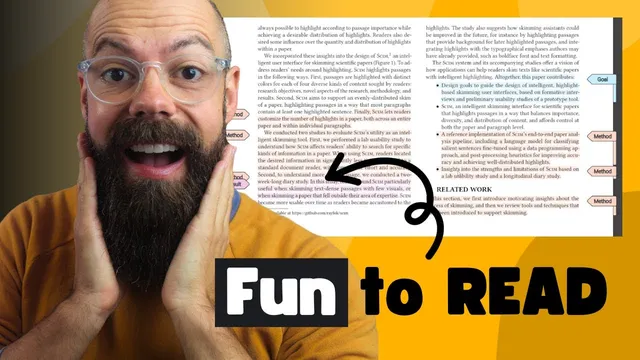
A central example is Semantic Reader, an open research platform built to improve how people discover, comprehend, synthesize, and access academic work. Instead of treating a paper as a static document, it supports intelligent skimming. Once a paper is loaded, the interface adds small markers that map sections to common reading goals—methods, results, and other key parts—so a reader can quickly navigate to what matters. The workflow mirrors what academics already do informally (start with the abstract, then skim for relevance), but it automates the structure and makes it easier for newcomers to follow.
That same accessibility theme extends into discovery tools for finding the right literature fast. Lit Maps is highlighted as a way to start from a single “seed” paper and generate a map of connected research across a field. Its Discover feature takes a set of papers and searches for top connected works, using semantic search to surface articles with similar content. Lit Maps also introduces a “momentum” view that ranks papers by how quickly they’re being cited, helping researchers spot emerging trailblazers rather than only well-established classics.
Other projects aim to reduce the friction between scholarly writing and the way research is communicated in practice. One tool pairs papers with talk videos or conference presentations, effectively bundling the formal manuscript with the more conversational explanation researchers deliver on stage. Another approach lets users ask questions directly about a paper—pulling out key results, supporting evidence, and limitations—turning navigation into a guided Q&A experience rather than manual scanning.
To make papers easier to read at the sentence-and-equation level, additional interfaces add layers of context. Read provides margin-style citations that point readers to related material for deeper understanding, even when those suggestions aren’t tied to the paper’s own reference numbers. Schif (as described) generates a glossary of key terms and symbols in the order they appear, so acronyms and field-specific notation become clickable and transparent. The result is a more dynamic reading experience where equations and terminology don’t function as barriers.
Across these tools, the recurring message is that the future of academic reading is interactive and collaborative: open-source foundations enable new interfaces, and researchers can combine multiple tools to cover the full pipeline—from discovery to comprehension to synthesis. The most notable implication is that “reading papers” may increasingly mean navigating structured, augmented, and question-driven views of scholarship rather than wrestling with static PDFs alone.
Cornell Notes
Peer-reviewed papers often fail readers because PDFs are dense, static, and hard to navigate—especially for newcomers. A wave of open-source and platform-based tools is shifting scholarly reading toward interactive workflows: intelligent skimming, semantic discovery, and guided Q&A. Examples include Semantic Reader’s section markers for methods and results, Lit Maps’ seed-paper mapping plus semantic search and “momentum” citation tracking, and paper-plus-presentation formats that make research more accessible. Other tools add contextual layers like margin citations and in-order glossaries for acronyms and symbols, reducing equation and terminology friction. Together, these approaches aim to improve discovery, comprehension, synthesis, and accessibility without requiring full linear reading of every paper.
Why are traditional academic PDFs so hard for many researchers to use, and what problem the new tools target first?
How does Semantic Reader change the act of reading from linear to goal-based navigation?
What does Lit Maps do differently for research discovery, and what is “momentum” used for?
How do paper-plus-talk tools reduce the gap between formal writing and how research is communicated?
What kinds of questions can interactive paper tools answer, and what does that replace?
How do glossary and margin-citation tools address comprehension barriers like acronyms and equations?
Review Questions
- Which specific features in Semantic Reader are designed to replicate how experienced researchers skim papers, and how do those features change the reading workflow?
- How does Lit Maps’ “momentum” ranking differ from simple citation counts, and what decision does it help researchers make?
- What comprehension barriers do glossary and margin-citation tools target, and how would you combine them with skimming or Q&A tools for a first-pass literature review?
Key Points
- 1
Peer-reviewed PDFs often overwhelm readers due to dense formatting, tiny text, and tightly packed tables and figures, especially for newcomers.
- 2
Semantic Reader improves navigation by adding section markers for methods, results, and goals, enabling intelligent skimming instead of full linear reading.
- 3
Lit Maps accelerates literature discovery by building maps from a seed paper or a set of papers, using semantic search to find connected work.
- 4
Lit Maps’ “momentum” view helps researchers spot emerging papers by tracking how quickly they’re being cited.
- 5
Paper-plus-talk tools make research more accessible by pairing manuscripts with conference presentations or talk videos.
- 6
Interactive paper Q&A tools extract key results, supporting evidence, and limitations, turning reading into question-driven retrieval.
- 7
Glossary and margin-citation layers reduce comprehension barriers by clarifying acronyms/symbols and pointing to related background reading.