Is This What Quantum Mechanics Looks Like?
Based on Veritasium's video on YouTube. If you like this content, support the original creators by watching, liking and subscribing to their content.
Walking droplets remain suspended because a thin air layer prevents recombination with the oil until it shrinks to roughly 100 nanometers.
Briefing
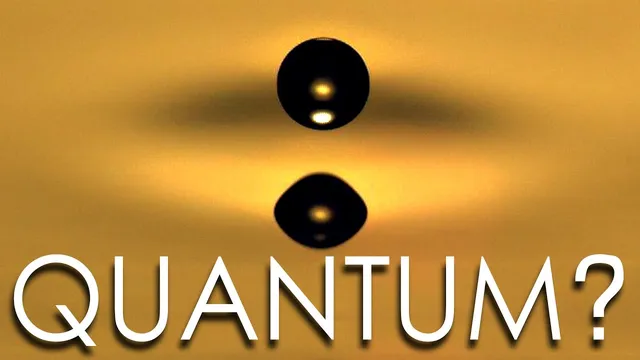
Bouncing “walking” droplets on a vibrating oil bath can reproduce several hallmark behaviors of quantum mechanics—without being microscopic electrons—by turning wave–particle guidance into a tangible, deterministic system. When a droplet hovers and repeatedly bounces, it maintains a thin air cushion that prevents it from merging with the oil, while each impact generates a wave on the surface. Because the bath vibration drives a standing wave pattern, the droplet’s next bounce is influenced by the wave it helped create, allowing it to “surf” the oscillations and move in a coordinated way.
The most striking parallel to quantum physics comes from interference. In the classic double-slit experiment, electrons build an interference pattern even when fired one at a time, implying that each electron contributes to a wave-like probability distribution. With walking droplets, the pilot wave effectively interacts with both slits: the droplet itself passes through only one slit, but its motion is deflected by the wavefield that extends across both openings. The resulting landing distribution behind the slits closely matches the interference patterns expected from quantum mechanics, even though the droplets are about a millimeter across.
Walking droplets also mimic quantum tunneling. By introducing a shallow barrier under the oil surface, the wavefield can reflect the pilot wave and keep the droplet out—yet occasionally the droplet crosses the boundary. In those rare events, the probability of crossing falls off exponentially as the barrier width increases, echoing the quantum tunneling rule where classically forbidden penetration becomes less likely for thicker barriers.
Perhaps the clearest “quantum-like” signature is quantization. When confined to a circular corral, the droplet’s seemingly random motion gradually builds up a stable probability density across the allowed region. That spatial distribution resembles the electron probability density for particles confined in a quantum corral, suggesting that the coupled droplet–wave dynamics can generate the same statistical structure that quantum theory predicts.
These behaviors connect to de Broglie’s pilot-wave idea from the early days of quantum mechanics: particles carry an accompanying wave that guides their motion. The dominant Copenhagen interpretation instead treats the wave function as a tool for predicting measurement outcomes and avoids claims about definite particle trajectories when not observed. Pilot-wave dynamics, by contrast, keeps the particle’s position and momentum as well-defined quantities, with apparent quantum uncertainty arising from incomplete knowledge rather than fundamental randomness.
The takeaway is not that macroscopic oil droplets are literally quantum particles. Still, the walking-droplet experiments demonstrate that wave-guided, coupled dynamics can generate the same kinds of statistics—interference, tunneling-like suppression, and quantized confinement patterns—that normally motivate quantum mechanics. The debate then shifts to interpretation: whether quantum theory’s oddities are fundamental or whether they could emerge from deterministic pilot-wave behavior that reproduces the same experimental outcomes.
Cornell Notes
Walking droplets on a vibrating oil bath bounce for long periods because a thin air layer prevents them from merging with the liquid. Each bounce generates a surface wave, and the droplet’s next motion is guided by the resulting wavefield, letting it behave like a particle steered by a “pilot wave.” In double-slit setups, the droplet passes through one slit while the pilot wave spans both, producing an interference-like landing pattern. Similar wave-guided dynamics yield tunneling-like behavior across shallow barriers and quantization-like probability densities when droplets are confined in a corral. These results echo de Broglie’s pilot-wave theory, offering a deterministic alternative to the Copenhagen interpretation’s emphasis on measurement-driven randomness.
Why do walking droplets keep bouncing instead of merging with the oil?
How can a droplet that goes through only one slit still produce an interference pattern?
What is the tunneling-like signature in the walking-droplet experiments?
What does “quantization” look like for droplets in a corral?
How do these results connect to de Broglie’s pilot-wave theory versus Copenhagen?
How does the wavefield “remember” where the droplet has been?
Review Questions
- In a double-slit setup with walking droplets, what role does the pilot wave play compared with the droplet’s actual path?
- Why does the probability of crossing a barrier decrease with barrier width in the walking-droplet system, and what quantum feature does that resemble?
- What evidence of quantization appears in the corral experiment, and how is it extracted from the droplet’s motion?
Key Points
- 1
Walking droplets remain suspended because a thin air layer prevents recombination with the oil until it shrinks to roughly 100 nanometers.
- 2
Each droplet impact generates a surface wave, and the droplet’s subsequent motion is guided by that wavefield.
- 3
Interference-like patterns emerge in double-slit geometries because the pilot wave spans both slits even when the droplet passes through only one.
- 4
Tunneling-like behavior appears when a shallow barrier is introduced: rare crossings occur and the crossing probability drops exponentially with barrier width.
- 5
Confinement in a circular corral produces quantization-like probability densities, even though individual droplet trajectories look chaotic moment to moment.
- 6
The results align with de Broglie’s pilot-wave concept by offering a deterministic mechanism that reproduces quantum-like statistics.
- 7
The main interpretive question becomes whether quantum oddities are fundamental (Copenhagen) or could arise from pilot-wave dynamics that preserve definite particle properties.