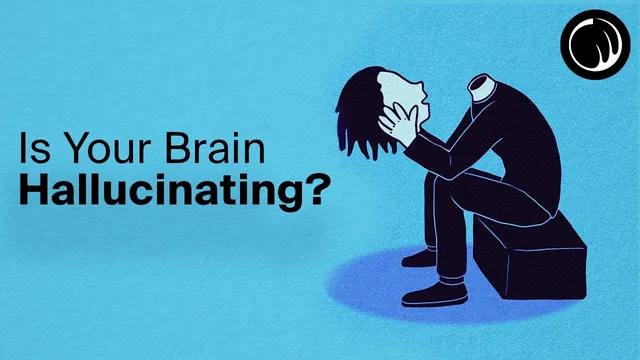
Is Your Brain Hallucinating Reality?
Based on Pursuit of Wonder's video on YouTube. If you like this content, support the original creators by watching, liking and subscribing to their content.
Consciousness is treated as both immediately certain (from first-person experience) and uniquely hard to explain (from third-person evidence).
Briefing
Consciousness remains the one mystery that is both unavoidable and uniquely hard to pin down: everyone has direct access to their own experience, yet no external, physical description seems able to capture what it is like to be that experience. The core tension runs through the entire discussion—awareness feels immediate and self-evident, but the moment scientists try to map it onto brain activity, the subjective “inner screen” refuses to show up in objective measurements.
A central framing compares consciousness to a smartphone interface. Even if engineers fully understand the circuitry inside the phone, the lived experience of using the device depends on the display—something that cannot be located as a single component inside the hardware. Likewise, brain firing patterns may correlate with perception and thought, but the experiential character—the felt quality of seeing blue, tasting, suffering, or loving—doesn’t appear to be identifiable in the same way as a physical function. The result is a mismatch: objective accounts can describe mechanisms, but they still leave out the “what it’s like” aspect that defines consciousness from the inside.
That gap helps explain why many researchers and philosophers treat the problem as unusually resistant to solution. Some argue that consciousness may never be fully understood, at least not in a complete sense, because any theory built from physical facts risks producing an explanation that doesn’t connect to subjective experience. Others look for answers outside mainstream naturalism. Dualism—often associated with René Descartes—claims mind and brain are separate, with the brain acting as a kind of interface to a non-physical substance. But the discussion highlights a common objection: if consciousness has no physical attributes, it’s unclear how it could produce physical effects like moving the body.
The alternative most aligned with contemporary science is physicalism: consciousness is treated as a natural phenomenon arising from matter governed by physics. Yet physicalism runs into what’s called the “hard problem” or “heart problem” of consciousness, a term associated with David Chalmers (1995). Even if every neural event were matched to a reported experience, the explanation would still not show why those physical processes should generate experience at all—why non-sentient matter becomes felt happiness, wonder, colors, and inner imagery.
Panpsychism offers a different route by treating consciousness-like qualities as fundamental to reality, suggesting that physical systems have mind-like aspects. Even if that idea fits within a rational framework, it still doesn’t automatically solve the question of how subjective experience is structured and unified into the specific, personal stream of awareness people recognize.
Ultimately, the discussion circles back to the most stubborn feature of consciousness: it is private by definition. No one else can access another person’s experience directly, and no external observer can fully verify what blue, pain, or love feels like from the inside. That privacy makes consciousness both the most certain thing—because it is directly known—and the least accessible to complete scientific explanation, leaving it as humanity’s tightest sealed mystery.
Cornell Notes
Consciousness is treated as the one mystery that is simultaneously undeniable and hard to explain: people have direct access to their own experience, but objective brain descriptions don’t seem to capture what it feels like. A smartphone “interface” analogy is used to argue that even complete knowledge of internal mechanisms may miss the subjective “display” of experience. Dualism is criticized for failing to explain how an immaterial mind could cause physical actions. Physicalism is challenged by the “hard problem” (linked to David Chalmers), which asks why physical processes should generate subjective experience at all. Panpsychism is presented as a possible alternative, but it still doesn’t fully explain how experience becomes the specific, unified inner life each person knows.
Why does the smartphone analogy matter for understanding consciousness?
What is the main objection to dualism?
How does physicalism define the problem, and why doesn’t it end the mystery?
What is the “hard problem” (or “heart problem”) of consciousness?
What does panpsychism claim, and what does it still leave unresolved?
Why is consciousness described as uniquely private and difficult to verify?
Review Questions
- Which part of the smartphone analogy is meant to correspond to the subjective character of consciousness, and why does that create a challenge for purely physical explanations?
- How do the objections to dualism and the hard problem challenge different approaches to explaining consciousness?
- What would a successful explanation need to accomplish to address the hard problem as described here?
Key Points
- 1
Consciousness is treated as both immediately certain (from first-person experience) and uniquely hard to explain (from third-person evidence).
- 2
Objective brain activity may correlate with experience, but correlations don’t automatically explain why experience has felt qualities.
- 3
The smartphone interface analogy argues that understanding internal mechanisms may still miss the “display” of subjective experience.
- 4
Dualism faces a causal problem: if mind is immaterial, it’s unclear how it produces physical effects like bodily movement.
- 5
Physicalism avoids supernatural explanations but still struggles with the hard problem: why physical processes generate experience at all.
- 6
Panpsychism proposes consciousness-like qualities as fundamental, yet it doesn’t fully resolve how subjective experience becomes structured and unified.
- 7
Because inner experience is private, no external observer can directly verify what another person’s consciousness is like.