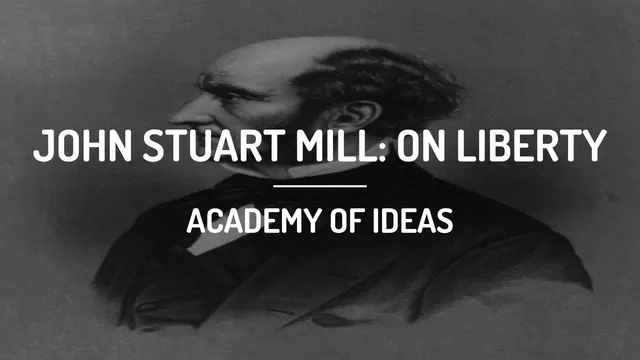
John Stuart Mill - On Liberty
Based on Academy of Ideas's video on YouTube. If you like this content, support the original creators by watching, liking and subscribing to their content.
Mill limits society’s legitimate interference to preventing harm to others, not enforcing moral or cultural conformity.
Briefing
John Stuart Mill’s central claim is that society may restrict individual liberty only to prevent harm to others—and that protecting wide freedom of thought and action is the engine of both personal development and social progress. Mill treats liberty as a core condition of well-being, but he draws a sharp boundary: society’s legitimate power is limited, and it becomes illegitimate the moment it tries to control beliefs or lifestyles that primarily affect only the person holding them.
Mill’s case begins with a warning about where liberty actually gets crushed. Government is an obvious threat because it can use coercion backed by law—imprisonment or even death for defying its commands. But Mill also highlights a subtler force: the “tyranny of the majority.” In every society, customs and prevailing opinions harden into what most people treat as “the right way” to think and live. Those who deviate are shunned and pressured into conformity, and the resulting control penetrates daily life and even “enslaves the Soul,” often without the extreme penalties that come with state violence. The result is a kind of social enforcement that can be harder to escape than government rule because it operates through criticism, ostracism, and social exclusion.
Mill then specifies the limits of legitimate interference. He distinguishes between self-regarding actions—acts that affect only the individual—and other-regarding actions—acts that directly affect other people. For self-regarding conduct, society has no right to intervene, since the person is not accountable to society for choices that concern only themselves (the transcript gives illicit drug use as an example of “victimless” behavior). For other-regarding conduct, society may punish—and if necessary incarcerate—when someone harms others or infringes their basic rights. Mill summarizes the principle with a single purpose: society may interfere only for self-protection, meaning the prevention of harm to others.
Mill’s defense of free speech and belief is equally strict. Freedom to hold and express ideas should be “completely unconstrained” because silencing a dissenting person is no more justified than silencing an entire majority. The transcript emphasizes two reasons this matters. First, suppressing ideas risks suppressing truth: human beings are fallible, and past “cherished ideas” have repeatedly turned out wrong. Second, even if an idea is true, it needs opposition to stay alive; once a truth is treated as untouchable dogma, it loses the vigor that comes from being tested and discussed fearlessly.
Finally, Mill argues that individuality—especially nonconformity—is not a threat to society but a requirement for progress. He calls for “experiments of living,” where people try different ways of life in domains that don’t primarily concern others. When conformity becomes pervasive, social stagnation follows, and people lose the qualities that make them “superior creatures.” The transcript closes by stressing that liberty supports the greater good precisely because it increases the number of things tried and accelerates progress, echoing the idea that restrictions reduce experimentation and slow advancement.
Cornell Notes
Mill’s core principle is that society may limit individual liberty only to prevent harm to others. He distinguishes self-regarding actions (affecting only the individual) from other-regarding actions (affecting other people), arguing that only the latter justify punishment or incarceration. Mill also treats free expression as essential: suppressing ideas risks suppressing truth, and even true ideas weaken when they become untouchable dogma. Because individuality and nonconformity drive “experiments of living,” liberty becomes a practical engine for social progress, not just a personal preference.
What is Mill’s “only legitimate power” for society over individuals?
How does Mill explain threats to liberty that go beyond government?
Why does Mill insist that freedom of thought and expression should be unconstrained?
What is the difference between self-regarding and other-regarding actions?
How does Mill connect liberty to social progress?
What does “dead dogma” mean in Mill’s argument?
Review Questions
- How does Mill’s harm principle determine when society may punish someone?
- What mechanisms make the “tyranny of the majority” potentially more pervasive than government coercion?
- Why does Mill think suppressing even false ideas can still be harmful to society?
Key Points
- 1
Mill limits society’s legitimate interference to preventing harm to others, not enforcing moral or cultural conformity.
- 2
“Tyranny of the majority” can restrict liberty through social pressure—customs, shunning, and ostracism—without relying on formal state penalties.
- 3
Mill’s self-regarding vs other-regarding distinction determines when punishment is justified: only actions affecting others warrant coercion.
- 4
Unconstrained freedom of belief and expression is defended as a safeguard against human fallibility and as a way to keep truths intellectually vigorous.
- 5
Mill argues that true ideas weaken when treated as untouchable dogma; they need ongoing challenge and discussion.
- 6
Individuality and nonconformity are treated as prerequisites for progress through “experiments of living.”
- 7
Restrictions reduce the number of things tried, slowing advancement in an advancing society.