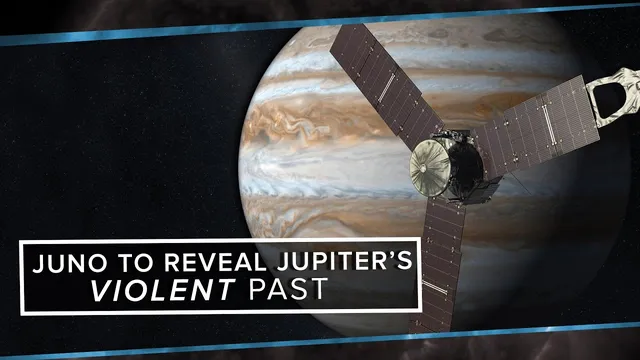
Juno to Reveal Jupiter's Violent Past
Based on PBS Space Time's video on YouTube. If you like this content, support the original creators by watching, liking and subscribing to their content.
Jupiter’s early gravitational influence helped set the positions of planetary orbits during the solar system’s first billion years.
Briefing
Jupiter’s gravity didn’t just shape the solar system—it likely helped write the rules for how it ended up looking the way we do now, from Earth’s habitability to the odd mix of bodies in the asteroid belt. Jupiter is the solar system’s heavyweight: it holds about 1/1,000 of the Sun’s mass yet outweighs all other planets combined, and its gravitational influence during the solar system’s first billion years helped determine where planetary orbits settled. That same pull still matters today, driving long-term orbital cycles on Earth that correlate with glaciation patterns, and acting as a cosmic filter that can deflect some long-period comets while also stirring up asteroids that may later cross Earth’s path.
The story begins with Jupiter’s physical makeup and early behavior. Jupiter likely formed very early, growing from rock and ice clumps in the protoplanetary disk until it became massive enough to retain roughly 300 Earth masses of hydrogen and helium. Its solid core is thought to be at most about 15% of Jupiter’s mass, while the bulk is believed to be metallic hydrogen—hydrogen in an extreme-density state that conducts electricity. Those electric currents are tied to Jupiter’s magnetic field, which is about 20,000 times stronger than Earth’s and powers the brightest auroras in the solar system. Jupiter also orbits at an average distance of 5.2 astronomical units, taking about 12 years, and carries at least 67 moons plus a faint ring system.
Where the narrative turns is the claim that Jupiter probably didn’t stay put. In the chaotic early disk, stable orbits were hard to maintain, and planets could migrate inward or outward by exchanging angular momentum with surrounding gas and debris. Most formation scenarios place Jupiter “rampaging” through the disk before it eventually settled into its current orbit. One leading explanation, the Grand Tack Hypothesis, suggests Jupiter formed closer to the Sun at about 3.5 AU, then migrated inward through gas drag until it stalled near 1.5 AU. Saturn would have followed and locked into an orbital resonance with Jupiter (three Saturn orbits for every two Jupiter orbits), after which the pair would have migrated back outward—“tacking” like a sail—until Jupiter reached its present location.
This migration is proposed as a solution to several solar-system puzzles. Simulations often predict a Mars-sized gap should have produced another large planet near Mars’s orbit, but Mars is only about 10% of Earth’s mass. Jupiter’s early passage through that region could have cleared out the material needed to build a bigger neighbor. The model also helps explain why our solar system lacks “super-Earths” common in exoplanet surveys: Jupiter’s early inward sweep could have sent such planets spiraling into the Sun, leaving less material to form the terrestrial planets we see today. The asteroid belt’s mixed composition—inner- and outer-solar-system material—fits the idea that Jupiter crossed that zone.
A second framework, the Nice Model, shifts the timeline to after the gas disk evaporated. It imagines the gas giants starting more tightly packed, with Jupiter near its current distance but Saturn, Uranus, and Neptune closer in. As Saturn fell into resonance with Jupiter again (two Saturn orbits per one Jovian), Saturn’s eccentricity would increase, pushing Uranus and Neptune outward. The outer planets then plowed through a vast sea of planetesimals, scattering icy bodies across the solar system—potentially fueling the late heavy bombardment that reworked Earth’s crust—and possibly even nearly ejecting a distant “Planet Nine.”
Both scenarios remain unconfirmed, but they converge on one point: Jupiter’s early formation location and migration path are central to understanding Earth’s origin. The Juno spacecraft was sent to probe Jupiter’s internal composition, because that chemical and structural record could constrain where Jupiter formed and refine these simulations.
Cornell Notes
Jupiter’s early gravity and migration likely determined the solar system’s architecture—helping set planetary orbits, shaping Earth’s climate cycles, and influencing which small bodies survived. Its mass and magnetic environment come from a hydrogen-helium envelope over a relatively small core, with metallic hydrogen driving strong electrical currents and a magnetic field about 20,000 times Earth’s. The Grand Tack Hypothesis proposes Jupiter formed around 3.5 AU, migrated inward to about 1.5 AU with Saturn in resonance, then migrated outward to its current orbit, clearing material that would otherwise have built a large planet near Mars. The Nice Model adds a later phase after the gas disk vanished, with the outer planets starting more tightly packed and scattering planetesimals to help trigger the late heavy bombardment. Juno’s mission aims to use Jupiter’s internal composition to pin down its birth orbit, tightening these models.
Why does Jupiter’s gravity matter so much for the rest of the solar system?
What does Jupiter’s internal structure imply about its magnetic field and auroras?
How does the Grand Tack Hypothesis explain why Mars is small?
What solar-system clues support the idea that Jupiter crossed the asteroid belt?
How does the Nice Model connect outer-planet resonances to the late heavy bombardment?
Why is Juno’s target—Jupiter’s internal composition—so important for these models?
Review Questions
- What specific observational or structural features of the solar system does Jupiter’s early migration help explain (and why)?
- Compare the timing and mechanisms of the Grand Tack Hypothesis versus the Nice Model.
- How could Jupiter’s internal composition measurements reduce uncertainty about Jupiter’s birth orbit?
Key Points
- 1
Jupiter’s early gravitational influence helped set the positions of planetary orbits during the solar system’s first billion years.
- 2
Jupiter’s magnetic field is tied to metallic hydrogen conducting electricity, with an estimated field strength about 20,000 times Earth’s.
- 3
Planet migration in the early disk can move a planet inward or outward by exchanging angular momentum with gas and debris.
- 4
The Grand Tack Hypothesis proposes Jupiter formed near 3.5 AU, migrated inward to about 1.5 AU with Saturn in resonance, then migrated outward to its current orbit.
- 5
Grand Tack offers explanations for Mars’s small mass, the lack of super-Earths in our solar system, and the asteroid belt’s mixed composition.
- 6
The Nice Model describes a later, post-gas phase where resonances among the gas giants push Uranus and Neptune outward and scatter planetesimals, potentially fueling the late heavy bombardment.
- 7
Juno’s measurements of Jupiter’s internal composition aim to constrain Jupiter’s birth orbit, tightening formation and migration scenarios.