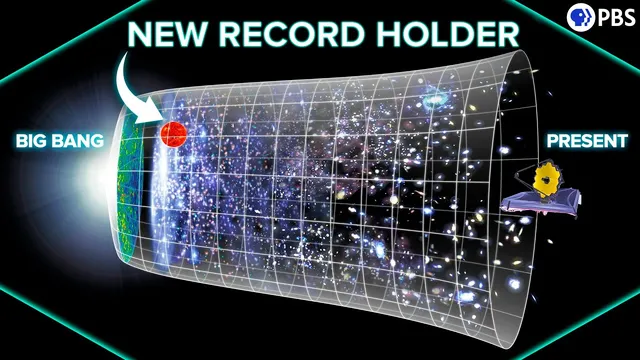
JWST Discovered The Farthest Star Ever Seen!
Based on PBS Space Time's video on YouTube. If you like this content, support the original creators by watching, liking and subscribing to their content.
Earendel is an individual star candidate at about 28 billion light-years away, detected thanks to strong gravitational lensing by a foreground galaxy cluster.
Briefing
A single star—named Earendel—has been spotted at an extraordinary distance of about 28 billion light-years away, made visible only because its light was dramatically amplified by gravitational lensing from a foreground cluster of galaxies. The find matters because it provides rare, direct information about the kinds of stars that formed when the universe was young, a period otherwise dominated by faint, unresolved “blobs” of light from early galaxies.
Earendel was first detected by the Hubble Space Telescope in March 2022 during the Reionization Lensing Cluster Survey (RELICS), which targets extremely distant galaxies whose light has been warped and magnified by intervening galaxy clusters. RELICS identified hundreds of galaxies from the first billion years after the Big Bang, and within one of those galaxies a solitary star stood out as an inexplicably bright point. The star’s apparent brightness is not intrinsic; it sits near a lensing “caustic,” where magnification can surge by at least a factor of 1,000 and possibly as high as 40,000. That lucky geometry lets astronomers pick out an individual star that would otherwise be far too faint to resolve.
The distance estimate is tied to cosmological redshift. Because the universe is expanding, photons stretch to longer wavelengths over time; measuring Earendel’s redshift of 6.2 indicates its light has been traveling for nearly 13 billion years, with the star now farther away because space itself has continued expanding during the journey. At such redshift, much of Earendel’s visible and ultraviolet light arrives to Earth as infrared, which is why Hubble—optimized for visible wavelengths—captured only a small fraction of the star’s emission. The James Webb Space Telescope (JWST), with a collecting area more than five times larger than Hubble and designed for deep infrared work, can observe much more of the star’s shifted light.
Early spectral analysis after “de-redshifting” suggests Earendel is a blue-white B-type main-sequence star, likely at least 50 times the Sun’s mass and hotter than 20,000 Kelvin. There also appears to be an excess of red light, interpreted as possible evidence for a companion star—potentially a binary system where a very luminous blue star and a red giant contribute to the combined spectrum. Uncertainties remain because gravitational magnification affects the observed brightness, and the lensing model must be refined to determine the star’s true luminosity.
Earendel is scientifically valuable because it offers direct data points for the earliest generations of stars—something that’s hard to obtain when early star formation is mostly inferred from galaxy-scale observations. Star-formation simulations predict that the early universe’s “pristine” gas (mostly hydrogen and helium, with far fewer heavy elements) should favor more massive stars than later, metal-enriched gas. In today’s Milky Way, only about 3% of new stars exceed 10 solar masses, while simulations for early galaxies suggest up to 20% might. Earendel’s existence therefore supports the idea that massive stars could have been more common in the cosmic dawn.
Still, the story is not finished. The magnification factor and the nature of the red companion are not fully pinned down, and better spectra could test whether Earendel truly has the low heavy-element abundance expected for an early star. Future surveys are expected to find many more lensed stars near caustics, enabling population statistics—crucial for determining whether the early universe produced massive stars in larger numbers and how that shaped the growth of the first galaxies.
Cornell Notes
Earendel is the most distant individual star detected so far, at roughly 28 billion light-years away, and it became observable only because a foreground galaxy cluster gravitationally lensed and magnified its light. The star was first found with Hubble in March 2022 through RELICS, a survey that searches behind massive clusters for extremely distant galaxies and, occasionally, individual stars. JWST’s infrared sensitivity allowed astronomers to capture much more of Earendel’s redshifted light and infer it is likely a hot, blue-white B-type main-sequence star (≥50 solar masses, >20,000 K), with possible red light from a companion. Because early stars formed from mostly hydrogen and helium, Earendel offers a rare direct probe of star formation in the universe’s first billion years—though uncertainties in lens magnification and the companion remain.
Why could Earendel be seen at all when most early stars are too faint to resolve?
How does redshift translate into distance and lookback time for Earendel?
Why did Hubble capture only a small fraction of Earendel’s light, and what changed with JWST?
What do current spectra suggest about Earendel’s physical properties?
How could Earendel inform theories of early star formation?
What uncertainties still limit what astronomers can conclude?
Review Questions
- What observational “trick” makes it possible to detect an individual star at the edge of the observable universe?
- How do redshift measurements connect to both lookback time and present-day distance for a distant object like Earendel?
- What specific spectral clues would help confirm whether Earendel formed from low-metallicity (mostly hydrogen and helium) gas?
Key Points
- 1
Earendel is an individual star candidate at about 28 billion light-years away, detected thanks to strong gravitational lensing by a foreground galaxy cluster.
- 2
RELICS used Hubble to find extremely distant galaxies behind lensing clusters; Earendel emerged as an unusually bright point within one of those galaxies.
- 3
Earendel’s redshift is 6.2, implying its light has traveled for nearly 13 billion years, with the star now farther away due to ongoing cosmic expansion.
- 4
JWST’s infrared capability and larger collecting area let astronomers measure much more of Earendel’s redshifted light than Hubble could.
- 5
Preliminary spectra suggest a hot blue-white B-type main-sequence star (≥50 solar masses, >20,000 K) and possible red light from a companion.
- 6
Gravitational magnification near a caustic likely boosts Earendel’s brightness by at least 1,000 and possibly up to 40,000, leaving intrinsic luminosity uncertain until lens models improve.
- 7
Future surveys should find more lensed stars near caustics, enabling population statistics about how common massive stars were in the early universe.