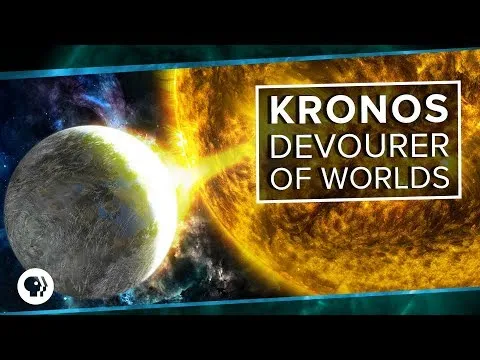
Kronos: Devourer Of Worlds
Based on PBS Space Time's video on YouTube. If you like this content, support the original creators by watching, liking and subscribing to their content.
Gaia astrometry and spectroscopy identify HD240430 (“Kronos”) and HD240429 (“Krios”) as a likely wide binary with shared galactic motion and an orbital period around 10,000 years.
Briefing
A pair of widely separated stars, HD240430 (“Kronos”) and HD240429 (“Krios”), appear to move together through the Milky Way as a gravitationally bound wide binary—yet their chemical fingerprints are strikingly different. The mismatch matters because wide binaries are usually treated as “chemical twins” formed from the same gas cloud; when they aren’t, it signals that planet formation and later accretion can measurably rewrite a star’s surface composition.
Gaia data and follow-up spectroscopy identified the stars as a likely wide binary: they sit about 326 light-years away, are nearly two light-years apart, and share matching space velocities consistent with an orbital period of roughly 10,000 years. Because they likely originated in the same birth cluster, researchers expected similar metallicity and elemental abundances. Instead, Kronos shows higher metallicity than Krios, with extreme over-abundances of elements that condense at high temperatures—especially silicon and other “refractory” metals. By contrast, volatile elements such as carbon, nitrogen, and oxygen are only slightly enhanced.
The pattern points toward a specific kind of pollution: rocky, inner-system material. High condensation-temperature elements are the first to solidify as a planetary system cools, so they become concentrated in terrestrial planets. Volatiles remain gaseous closer in and only condense farther out, later feeding gas giants and icy bodies. Kronos’s abundance pattern matches what would be expected if it swallowed a substantial amount of terrestrial-planet material.
Lithium strengthens the case. Lithium is normally depleted in young-to-middle-aged stars like the Sun because it is mixed into stellar interiors and destroyed by fusion. Kronos has an unusually high lithium abundance for its age, while Krios has the expected level. That combination—refractory enrichment plus excess lithium—suggests Kronos accreted fresh material well after its initial formation, likely after any planets formed.
Quantitatively, the team’s calculations indicate that accreting about 15 Earth masses of rocky material would reproduce the observed abundance differences. The scenario is dramatic but plausible: planet-formation simulations allow planets to spiral into their host star, particularly if a gas giant migrates inward or if gravitational perturbations (including from other stars) push outer planets onto eccentric orbits that later lead to infall.
Future Gaia releases will help test the broader mechanism by searching for additional “planet-eating” stars and for signs of rampaging outer planets around Kronos. The discovery also serves as a caution for chemical-tagging studies: even stars that share a common origin can diverge chemically if one member later accretes planetary debris.
The discussion ends with a separate, audience-driven detour into speculative climate survival ideas—ranging from “star lifting” to solar-blocking solar farms and orbital changes—before returning to the central takeaway: Kronos’s chemical signature looks like the aftermath of a planetary system being consumed.
Cornell Notes
Gaia and spectroscopy identified HD240430 (“Kronos”) and HD240429 (“Krios”) as a likely wide binary: they share matching motions and should have formed together. Yet Kronos has higher metallicity than Krios, with strong over-abundances of high-condensation-temperature elements (like silicon) and only mild enhancements of volatiles (like carbon, nitrogen, oxygen). Kronos also shows an unusually high lithium abundance for its age, unlike Krios. Together, the chemical pattern and lithium excess suggest Kronos accreted fresh, rocky material after planet formation—on the order of ~15 Earth masses—consistent with planet infall scenarios. This matters because wide binaries are often used to trace star formation and chemical “tagging,” but planet ingestion can scramble those signatures.
Why does a wide binary usually imply similar chemistry, and why is Kronos an exception?
What does the difference between high-condensation-temperature elements and volatiles reveal about what Kronos consumed?
How does lithium abundance strengthen the planet-ingestion explanation?
What mass of rocky material would reproduce Kronos’s observed chemical pattern?
What mechanisms could drive planets into their host star in the Kronos scenario?
How will future Gaia data help test the broader idea?
Review Questions
- What observational evidence supports treating HD240430 and HD240429 as a wide binary rather than unrelated stars?
- How do the abundance trends of refractories versus volatiles point to rocky-planet accretion?
- Why does an unusually high lithium abundance imply late-time material accretion rather than a purely primordial chemical difference?
Key Points
- 1
Gaia astrometry and spectroscopy identify HD240430 (“Kronos”) and HD240429 (“Krios”) as a likely wide binary with shared galactic motion and an orbital period around 10,000 years.
- 2
Kronos’s spectrum shows higher metallicity than Krios, with extreme over-abundances of high-condensation-temperature elements such as silicon.
- 3
Volatile elements (carbon, nitrogen, oxygen) are only slightly enhanced in Kronos, matching the chemistry expected from rocky inner-system material.
- 4
Kronos’s unusually high lithium abundance for its age—contrasted with Krios’s normal lithium—signals late-time accretion after early stellar lithium depletion.
- 5
Modeling indicates that accreting about 15 Earth masses of rocky material can reproduce the observed abundance differences.
- 6
Planet infall is dynamically plausible: migrating or perturbed gas giants can destabilize systems and drive planets into their host star.
- 7
Future Gaia data will search for additional planet-eating stars and for signs of outer planets being dynamically “ramped up” around systems like Kronos.