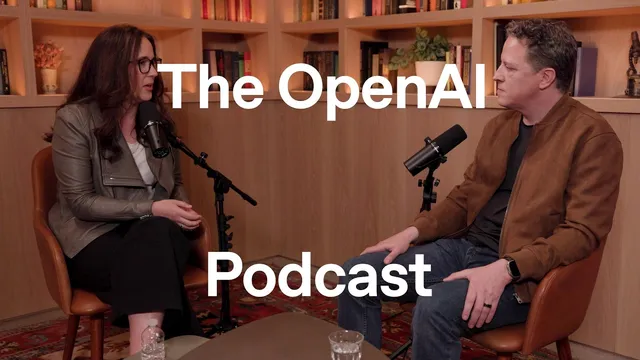
Leah Belsky on how AI is transforming education — the OpenAI Podcast Ep. 4
Based on OpenAI's video on YouTube. If you like this content, support the original creators by watching, liking and subscribing to their content.
ChatGPT is positioned as a large-scale learning destination, with learning among the top use cases and roughly 600 million users.
Briefing
AI is reshaping education less by replacing learning and more by changing how students get help—turning ChatGPT into a tutor-like experience that can personalize practice, reduce access gaps, and push assessment toward deeper thinking. OpenAI’s Leah Belsky frames ChatGPT as “the world’s largest learning platform,” citing roughly 600 million users and emphasizing that learning happens both inside and outside formal schooling. Teachers are adopting it to cut administrative load and to support classroom instruction, while countries are increasingly treating AI as core education infrastructure—partly to improve learning systems and partly to prepare students for an AI-powered economy.
Belsky traces her own path from years in education-focused roles at the World Bank and Coursera to OpenAI, where she was urged to pursue a “moonshot” that makes AI tutoring and companionship widely available. That mission shows up in how governments and institutions are approaching deployment. OpenAI’s “OpenAI for countries” program has drawn interest from multiple ministries, including Estonia early on, where strong education outcomes and teacher empowerment are central goals. The recurring theme from partners is twofold: equalize access to AI across campuses and ensure students graduate with practical AI literacy for workforce readiness.
The conversation also tackles the backlash—cheating fears, “brain rot” headlines, and the failure of AI detectors. Belsky argues that the real risk comes from misuse: if students treat AI as an answer machine, learning stalls. She criticizes early institutional reactions that focused on policing rather than redesigning assignments and assessments. A key shift is building trust with students, especially in university settings where the “COVID generation” already experienced heavy monitoring through tools like Zoom and Google Classroom. Students, she says, are more hesitant when schools provide AI without clear assurances about privacy and oversight.
A major product thread is “Study mode,” launched to move ChatGPT from delivering answers to guiding students through them. It uses Socratic-style questioning, adapts to a learner’s level and context, and can generate quizzes and follow-up prompts to encourage deeper engagement. The feature was shaped by learning-science input and “golden examples” collected with experts, and it emerged from an India trip where the team saw how families spend heavily on tutors and how young people strongly want to advance.
Beyond classrooms, Belsky highlights confidence and accessibility as the first-order benefits. Students in ChatGPT Lab describe AI as a companion that helps them ask questions without embarrassment, persist when they feel stuck, and get feedback on writing and homework. One student story centers on a computer science learner who struggled with textbooks but gained momentum after using ChatGPT outside class as a tutor.
The student participants describe how professors are adapting: communication courses shift from definition-heavy prompts to application and meaning; computer science projects sometimes offer AI and non-AI tracks with reflection requirements. They also share practical prompting habits—narrowing sources, asking for counterpoints, using personas, and relying on Study mode’s interactive checks. Overall, the message is that AI’s educational value depends on scaffolding struggle, encouraging critical thinking, and keeping humans central for mentorship and ethics—even as AI becomes more capable and more integrated into everyday learning.
Cornell Notes
ChatGPT’s role in education is shifting from “answer delivery” to “tutoring and guided practice.” OpenAI’s Leah Belsky calls ChatGPT a large-scale learning destination (about 600 million users) and says teachers and countries are adopting it as core infrastructure to equalize access and build an AI-ready workforce. The key product move is Study mode, designed to ask Socratic follow-ups, personalize to a learner’s level, and prompt quizzes and deeper exploration rather than letting students copy-paste solutions. Students and educators also report that assessment is changing—more application, reflection, and open-format work—because detectors and policing alone don’t solve learning integrity. The central claim: AI helps most when it increases feedback and critical thinking, not when it replaces effort.
Why does Leah Belsky frame ChatGPT as more than a classroom tool?
What’s the core problem with “AI detectors,” and what does that imply for assessment?
How does Study mode differ from regular ChatGPT use?
What does “trust” mean in the context of student adoption?
How are educators adapting assignments to reduce cheating incentives?
What prompting strategies do students say improve learning outcomes?
Review Questions
- How does Study mode’s Socratic, quiz, and recall-check approach change the learning process compared with using ChatGPT as an answer generator?
- What assessment redesigns (e.g., reflection, application-based prompts, project tracks) are described as alternatives to policing or detector-based enforcement?
- Why does Belsky connect student adoption to privacy and trust, and how does that relate to earlier experiences with monitoring during remote learning?
Key Points
- 1
ChatGPT is positioned as a large-scale learning destination, with learning among the top use cases and roughly 600 million users.
- 2
Teachers adopt ChatGPT both to reduce administrative workload and to support classroom instruction.
- 3
Countries are treating AI as education infrastructure to improve systems and to build an AI-ready workforce, not just to add AI-themed courses.
- 4
Early education responses often relied on policing and AI detectors, but detector unreliability and surveillance concerns undermine trust and fairness.
- 5
Study mode is designed to guide learning through Socratic prompts, personalization, follow-up questions, quizzes, and deeper exploration rather than answer dumping.
- 6
The strongest educational benefits described come from feedback, confidence-building, and accessibility—especially for students who struggle with traditional materials.
- 7
Assessment is shifting toward application, reflection, and larger projects, so students demonstrate understanding and growth even when AI is used.