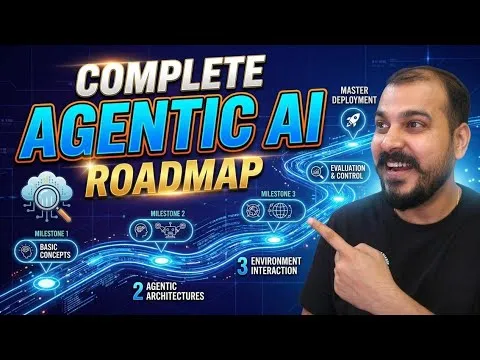
Learn Agentic AI in 2026 With These 7 Steps
Based on Krish Naik's video on YouTube. If you like this content, support the original creators by watching, liking and subscribing to their content.
Master LLM fundamentals first: prompting, context handling, sampling behavior, and how tool-calling/reasoning models differ in practice.
Briefing
Agentic AI becomes “production-ready” only when learning goes beyond building a basic LLM app and instead follows a structured path from fundamentals to deployment. A seven-step roadmap lays out what to master—LLM behavior, agent architecture, retrieval, orchestration, and then the production layer of safety, evaluation, and operations—so new techniques (like newer RAG variants) can be slotted in without breaking the system.
The plan starts with prerequisites, especially Python, then moves into LLM fundamentals: how to send inputs and get outputs, how different model types behave (including reasoning and tool-calling variants), and how prompting shapes the model’s behavior. It also emphasizes context-related concepts such as context engineering, plus sampling and how to manage the information the model receives. From there, the roadmap pushes learners into practical agent patterns—starting with the ReAct-style loop where the model decides when to use external tools (search APIs, RAG/vector stores, or other company services) to fetch up-to-date context, then combines that context with the prompt to produce an answer.
Next comes the agent life cycle: planning, executing, and reflecting on agent behavior over time. With that foundation, the roadmap upgrades agents into more capable systems by adding tool use and function calling, then introduces memory systems. Memory is broken into in-memory (short context), external (stored in third-party databases), and long-term memory. The goal is for an assistant to remember prior conversations and relevant state efficiently, with integrations available in common agent frameworks.
Context engineering follows as a core skill: instead of dumping raw information, teams should feed high-quality context—whether retrieved from tools, derived from conversation history, or assembled through structured prompting—because output quality tracks directly with context quality. After that, orchestration becomes the engineering focus: using frameworks to run agents quickly and reliably. The roadmap highlights stateful graphs, routing, and multi-agent architectures, including supervisor/worker patterns and “human-in-the-loop” approval gates so critical decisions pause for confirmation.
Retrieval-augmented generation (RAG) and retrieval techniques form the next major pillar, framed as the practical alternative to fine-tuning on company data. The approach includes chunking documents (like PDFs), converting them into vectors, storing them in a vector database, and retrieving relevant passages at query time. It also points to advanced RAG methods—reranking, HyDE-style ideas, self-RAG, and agentic RAG variants such as self-reflective RAG. Importantly, it calls out newer shifts like vectorless RAG, where retrieval can be performed without a vector database by building an “LLM tree” (nodes with traversed summaries) represented in structured form.
Design patterns round out the build phase, including router agents, reflection/self-reflection agents, and planning/self-fill style patterns. The final steps move into production discipline: guardrails to address security and reliability issues (validation, injection risks, PII handling), evaluation using metrics to measure performance, and deployment through production protocols such as MCP. Operational concerns—latency, cost, observability, and cloud/API integration across platforms like AWS, Azure, and managed model services—complete the loop. The payoff is a learning system that can absorb future changes (new RAG methods, new multi-agent communication protocols) because the underlying foundation and production workflow remain stable.
Cornell Notes
The roadmap for learning agentic AI in 2026 is built to take learners from LLM basics to production deployment. It starts with LLM fundamentals (prompting, context, sampling, tool-calling vs reasoning models) and then moves into agent patterns like ReAct, where the model fetches up-to-date context via external tools. Learners then add agent life cycle management, tool/function calling, memory systems (in-memory, external, long-term), and context engineering to improve output quality. Orchestration comes next through frameworks and multi-agent architectures, including supervisor/worker setups and human-in-the-loop approval gates. Finally, production readiness requires RAG (including advanced and vectorless approaches), design patterns, guardrails, evaluation metrics, and deployment/ops via protocols like MCP and cloud/API integration.
What does “foundation” mean for building agentic AI systems, beyond just using an LLM?
Why does the roadmap start with ReAct-style patterns?
How do memory systems fit into agentic AI, and what are the three types?
What is the production role of orchestration and human-in-the-loop?
Why is RAG treated as essential, and what changes with “vectorless RAG”?
What separates “advanced agent building” from “production readiness” in the roadmap?
Review Questions
- Which specific LLM skills (prompting, context engineering, sampling, tool-calling vs reasoning) must be mastered before building agent patterns?
- How does ReAct-style tool use help overcome an LLM’s knowledge cutoff, and what kinds of tools are typically integrated?
- What production safeguards (guardrails, evaluation metrics, and deployment/ops practices) are necessary before deploying an agent to real users?
Key Points
- 1
Master LLM fundamentals first: prompting, context handling, sampling behavior, and how tool-calling/reasoning models differ in practice.
- 2
Use agent patterns like ReAct to connect LLMs to external tools for up-to-date context instead of relying on static training knowledge.
- 3
Build agent capability through tool/function calling, agent life cycle planning/execution/reflection, and memory systems (in-memory, external, long-term).
- 4
Treat context engineering as a quality lever: feed high-quality, relevant context rather than dumping raw information.
- 5
Orchestrate agents with frameworks using stateful graphs, routing, multi-agent architectures, and human-in-the-loop approval gates for critical actions.
- 6
Adopt RAG for company data use cases, including advanced RAG techniques and newer vectorless RAG approaches when vector databases aren’t desired.
- 7
Before deployment, implement guardrails, run evaluation with appropriate metrics, and plan for ops (latency, cost, observability) using deployment protocols like MCP and cloud/API integration.