Learn How AI Technology is Generating Stunning 3D Art!
Based on MattVidPro's video on YouTube. If you like this content, support the original creators by watching, liking and subscribing to their content.
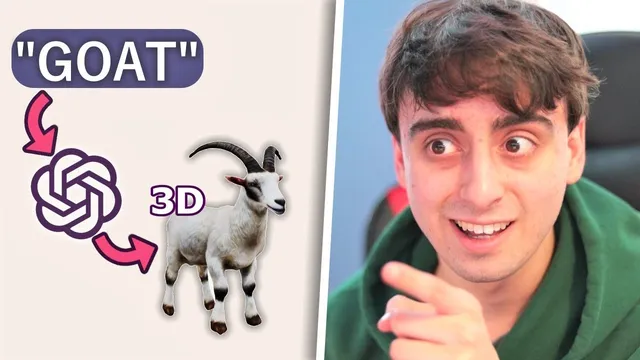
Luma Labs demonstrates text-to-3D generation from prompts like “goat,” producing recognizable geometry but often missing fine details such as hands and sharp edge fidelity.
Briefing
AI-driven tools are rapidly turning simple inputs—often just a word or a rough sketch—into usable 3D assets, hinting at a future where people can “conjure” 3D worlds through voice, drawing, or text. The most immediate impact is practical: creators may soon generate 3D characters for games without starting from scratch, while everyday users could shape immersive environments by describing what they want and watching it appear in front of them.
A key early example comes from Luma Labs, which offers a waitlist-based prototype for generating 3D objects from text. In one demonstration, typing “goat” produces a detailed 3D animal with recognizable proportions—hind legs, underside detail, and horns included. It’s not perfect (edges can look rounded, and some fine details are missing), but the output is striking given the minimal prompt. Other examples push the same idea: a donut prompt yields a “weird looking gross donut” with blue frosting and yellow sprinkles, and the system separates frosting from the donut body as distinct parts. A Daft Punk-inspired character lands the overall silhouette and gold suit look, though hands are badly mangled—an ongoing limitation where complex anatomy and sharp, high-detail regions still fail.
Across the gallery, the strengths are consistency of form and convincing material cues—especially when the prompt implies a specific look, like gold, glass, or water. A koi fish generation shows how well thin, complex shapes can sometimes come through, even if fins are thicker than expected. A race car example highlights the current ceiling: sharp edges and corners don’t render cleanly, and many objects can look like clay molds. Some outputs are intentionally unsettling or surreal—mutant sushi, a horror-like “Harry Styles” stage figure, and a mouse skeleton that is anatomically wrong but effectively creepy—suggesting that imperfections may sometimes enhance artistic effect.
A second track targets textures rather than geometry. Leonardo.ai uses “text to texture,” taking an untextured 3D model and applying a prompt to fill in surface detail. The results look more polished than earlier texture attempts, with lighting and material properties reading more convincingly—shiny areas, rougher skin, and nuanced reflections. This approach matters because it enables rapid variant creation: once a base model exists, prompts can generate many differently styled versions without rebuilding the 3D asset.
The most interactive direction comes from “3D aware conditional image synthesis,” where a system interprets drawings and converts them into rotatable 3D objects. In a demo, a simple mouse-drawn car becomes a 3D model after pressing generate, and the model can be rotated. The tool also supports in-painting/editing: changing the drawing’s style updates the resulting 3D object, and even a cat can be generated and altered (for example, making it skinnier). While access is limited, the concept points toward VR-style creation—drawing in a headset and having it materialize as a manipulable 3D scene—making 3D world-building feel less like modeling and more like sketching reality.
Cornell Notes
Text-to-3D and related AI tools are turning minimal inputs—words, prompts, and even rough sketches—into 3D objects that can be rotated and used as game assets. Luma Labs demonstrates text-to-3D with examples like a “goat” model and a prompt-driven donut, showing strong overall shape and material cues but frequent failures in fine details (notably hands, sharp edges, and complex anatomy). Leonardo.ai shifts focus to text-to-texture, applying prompts to untextured 3D models so surfaces gain convincing detail and lighting response. A separate system uses 3D-aware synthesis to convert drawings into 3D and supports edits via in-painting, suggesting a future where VR users draw and see objects appear in real time.
What does Luma Labs’ text-to-3D prototype produce, and what kinds of outputs look most convincing right now?
Where do the current text-to-3D models break down most often?
How does Leonardo.ai’s text-to-texture workflow differ from text-to-3D?
What does “3D aware conditional image synthesis” add beyond text prompts?
Why do the demos suggest a future use case in VR or interactive creation?
Review Questions
- Which specific failure modes (e.g., hands, sharp edges, anatomy) show up repeatedly in the text-to-3D examples, and how do they affect usability for game assets?
- Compare Luma Labs’ text-to-3D approach with Leonardo.ai’s text-to-texture approach: what changes in the input, the output, and the likely production workflow?
- How does in-painting/editing in the drawing-to-3D demo change the resulting 3D object, and what does that imply for iterative creative control?
Key Points
- 1
Luma Labs demonstrates text-to-3D generation from prompts like “goat,” producing recognizable geometry but often missing fine details such as hands and sharp edge fidelity.
- 2
Material cues can be strong in early outputs—gold can read as gold, and water/glass concepts can produce detailed splash-like forms.
- 3
Current text-to-3D models struggle with complex anatomy and crisp corners, sometimes resulting in clay-mold-like surfaces or humorous failures.
- 4
Leonardo.ai’s text-to-texture applies prompts to untextured 3D models, improving surface realism through better lighting and material response.
- 5
Text-to-texture is especially useful for generating many stylistic variants from the same base model without rebuilding geometry.
- 6
3D-aware drawing systems convert mouse sketches into rotatable 3D objects and support in-painting edits that change the style of the generated model.
- 7
The interactive sketch-to-3D workflow points toward VR-style creation where users draw and see objects appear as manipulable 3D assets.