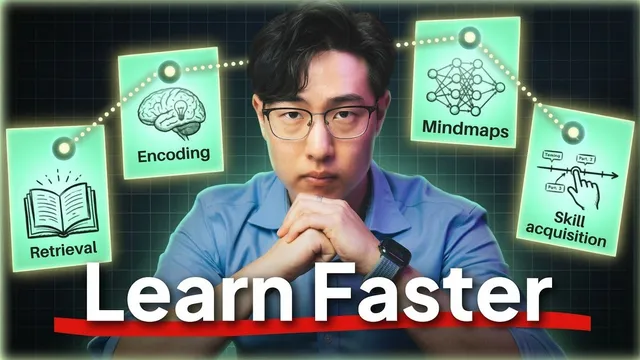
Learn to Learn in 4hrs 54mins - Full Course
Based on Justin Sung's video on YouTube. If you like this content, support the original creators by watching, liking and subscribing to their content.
Learning to learn is built on three pillars—encoding, retrieval, and enablers—and each pillar has to be strong enough for the others to work.
Briefing
The core message is that “learning to learn” isn’t about covering more material or relying on trendy recall tools—it’s about building a reliable system for how information becomes durable memory. Justin Sung frames learning as a three-part pipeline: encoding (turning information into long-term memory), retrieval (pulling it back out to expose gaps and strengthen memory), and enablers (the self-management and growth skills that make consistent practice possible). The payoff is confidence and mastery that compounds over time—especially for complex exams and professional skill-building.
Sung argues that most people chase speed or tactics while neglecting the mental work that actually creates learning. Fast studying can still fail if it doesn’t produce retention and usable knowledge. Even perfect recall of isolated facts is useless if it can’t be applied to solve problems. High-quality learning, he says, is effortful and often uncomfortable; the goal is not to eliminate difficulty but to become accustomed to it, like distance running.
The three pillars are treated as interdependent. Retrieval strengthens long-term memory and reveals what’s missing, but it can’t fix weak encoding—if the initial encoding is superficial, retrieval becomes an endless “relearn everything” loop. Sung criticizes the common “Anki grind” pattern where most effort goes into flashcards and testing while encoding quality lags, creating overwhelming forgetting. In his model, retrieval works best once enablers ensure consistent study sessions (no procrastination, sustained focus), and once encoding is strong enough that memory isn’t full of holes.
A major ordering principle drives the system: work on enablers first, then retrieval, and only later focus heavily on encoding. Enablers include self-management (time management, prioritization, focus) and growth skills—especially experimentation and critical reflection. Sung claims slow progress usually comes from rate-limiting enablers, not from lacking a better technique.
Retrieval strategies are described as flexible: quizzes, problem-solving, teaching, generating practice questions, and even AI-assisted test creation can all serve different retrieval needs. The key is alignment—matching retrieval practice to how knowledge must be used.
Encoding is presented as the “most important” long-term lever but also the hardest to build. Encoding is defined less as note-taking style and more as long-term habits of how the brain interprets and organizes information. Sung emphasizes cognitive load: effective encoding requires a level of mental effort that feels confusing or challenging (a form of “desirable difficulty”), but not so much that learners become overwhelmed.
He then challenges the common belief that active recall and space repetition are universally optimal. They can help by flattening the forgetting curve, but they have diminishing returns and can become repetitive, demoralizing, and inefficient—especially for learners who haven’t developed strong encoding. In his view, relying on retrieval alone can be like refilling a bucket with a hole.
Flashcards (including Anki) are defended with limits: they’re best for discrete fact recall and microlearning, not for building higher-order networks of understanding. He proposes a more structured flashcard workflow: filter cards based on repeated correctness/incorrectness, deepen “wrong” cards by connecting them to prior knowledge, and “merge and upgrade” “right” cards into higher-order questions that test relationships rather than isolated definitions.
For encoding and reading, Sung introduces Pacer, a five-part framework for categorizing information (Procedural, Analogous, Conceptual, Evidence, Reference) and using targeted digestion processes (practice, critique, mapping, store-and-rehearse). Finally, he adds practical tactics for sustaining effort: the ladder method to study when tired, delayed and low-word-count note-taking to force organizing rather than transcription, and mind mapping via a stepwise “GRIND” checklist (grouping, relational links, interconnection, nonverbal expression, directionality, and emphasis). The overarching claim is that learning becomes faster only after the thinking processes that create durable memory are built—and maintained through iterative practice and feedback.
Cornell Notes
Sung’s learning system treats durable mastery as the result of three pillars: encoding (building long-term memory), retrieval (pulling it out to strengthen memory and reveal gaps), and enablers (self-management plus growth skills that keep practice consistent). Retrieval and flashcards help, but they can underperform when encoding is weak—leading to endless relearning and “grind” without understanding. Encoding is slow to build because it depends on cognitive load and on habits of organizing information into networks; effective encoding often feels confusing at first. Sung also argues that active recall and space repetition have diminishing returns and may be inefficient for learners who haven’t developed strong encoding. To improve encoding and retention, he recommends targeted digestion (Pacer), structured flashcard workflows (filter, deepen, merge), and mind mapping (GRIND) that forces higher-order thinking rather than transcription.
Why does Sung insist that retrieval can’t compensate for weak encoding?
What are “enablers,” and why do they come before retrieval and encoding?
How does Sung justify limiting active recall/space repetition as a universal solution?
What’s the practical role of flashcards like Anki in his framework?
How does Pacer change how someone reads and digests information?
What does GRIND require from a “perfect” mind map, and why does it matter?
Review Questions
- Which pillar(s) does Sung treat as rate-limiting, and what specific behaviors fall under enablers?
- Describe one scenario where active recall/space repetition would likely underperform in his framework, and explain what would fix it.
- How do Pacer’s categories determine the digestion step (practice, critique, mapping, store-and-rehearse), and what does “balance consumption and digestion” mean in practice?
Key Points
- 1
Learning to learn is built on three pillars—encoding, retrieval, and enablers—and each pillar has to be strong enough for the others to work.
- 2
Covering content quickly doesn’t matter unless it produces retention and usable knowledge for problem-solving and application.
- 3
Retrieval strengthens memory and reveals gaps, but it can’t compensate for weak encoding; otherwise learners fall into endless relearning.
- 4
Enablers (self-management plus growth skills like experimentation and critical reflection) must be addressed first because they determine whether practice is consistent.
- 5
Active recall and space repetition can help by flattening the forgetting curve, but they have diminishing returns and can become inefficient without strong encoding.
- 6
Flashcards are best for discrete fact recall and microlearning; to improve higher-order understanding, filter cards and “merge and upgrade” them into relationship-based questions.
- 7
Encoding is slow because it depends on cognitive load and on building organized networks of meaning; techniques like Pacer and GRIND aim to force that organizing work.