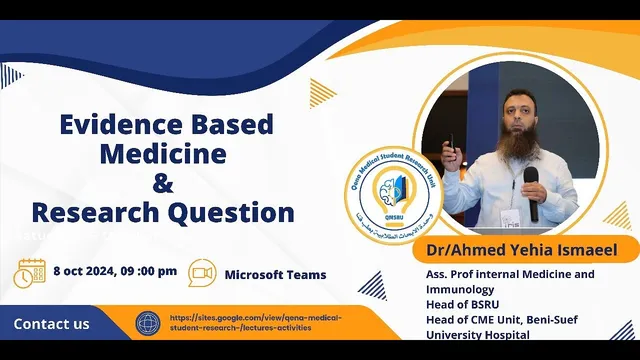
Lecture1 : EBM & Research question By Dr.Ahmed Yahya
Based on Qena medical student research unit's video on YouTube. If you like this content, support the original creators by watching, liking and subscribing to their content.
EBM decisions should begin by converting a patient problem into a clear, searchable question rather than relying on tradition or personal habit.
Briefing
Evidence-based medicine (EBM) is presented as the antidote to “following هوا” in clinical decisions—whether that هوا comes from tradition, personal habit, or persuasive authority. The core message is blunt: treatment choices should start with the right clinical question, then be answered using the strongest available evidence, not vibes, seniority, or marketing. This matters because wrong or ungrounded decisions can waste resources, harm patients, and even expose clinicians to legal and professional consequences.
The lecture frames EBM as a discipline of disciplined thinking. It begins by criticizing common everyday practices—cultural “rules” and inherited beliefs that substitute for evidence—and links that habit to a broader moral and intellectual duty to seek proof. From there, it lays out a practical workflow: convert a problem into a searchable question, acquire evidence through systematic searching (e.g., databases and reviews), and then judge the evidence’s quality rather than accepting it at face value. A recurring warning targets low-quality sources: Wikipedia-style summaries, “expert opinions” at the bottom of evidence hierarchies, and studies that are outdated or not methodologically sound.
A major portion explains how to rank evidence using an evidence hierarchy. The lecture contrasts weak forms of knowledge—case reports, case series, and expert opinion—with stronger designs such as randomized controlled trials, systematic reviews, and meta-analyses. The point isn’t just to “collect papers,” but to understand what each study design can reliably support. It also emphasizes currency: evidence must be updated, because new studies can change conclusions and guidelines. Even when evidence exists, the lecture stresses that clinicians must interpret it in context—availability of tests and treatments, local resources, and patient-specific realities.
The lecture also tackles the human side of EBM: patient preferences and shared decision-making. Guidelines and evidence guide the conversation, but the final choice involves the patient’s values, risks, and constraints. The clinician’s role becomes “shared” rather than authoritarian—explaining benefits and harms, documenting discussions, and respecting refusal when appropriate while still minimizing risk through safer alternatives or monitoring plans. This is paired with a practical ethics warning: clinicians should not hide behind evidence to avoid responsibility, nor should they ignore evidence because a patient dislikes it.
Finally, the lecture connects EBM to research training. It argues that research begins with a well-formed question—because “corruption of the ending comes from corruption of the beginning.” A good research question is feasible (possible with available resources and sample sizes), interesting to the target community, novel enough to add value, and grounded in a systematic review that identifies the knowledge gap. The lecture encourages students to “hunt” ideas, record them, and then refine them into structured objectives and study designs. It closes by reinforcing that evidence-based practice improves patient care, protects clinicians, strengthens academic output, and ultimately advances healthcare systems—especially when research is aligned with real local problems rather than copied topics.
Cornell Notes
EBM is framed as a disciplined way to make clinical decisions: start by turning a real patient problem into a searchable question, then find and appraise the best available evidence. Evidence quality follows a hierarchy—expert opinion and case reports sit low, while randomized trials, systematic reviews, and meta-analyses sit higher—yet evidence must also be current and methodologically credible. The lecture stresses that guidelines are not a substitute for clinical judgment: patient preferences, local resources, and clinician expertise shape how evidence is applied. It also links EBM to research training, arguing that research succeeds only when the question is clear, feasible, novel, and supported by a proper systematic review to identify the knowledge gap.
How does EBM turn a messy clinical problem into something actionable?
Why does the lecture insist on an evidence hierarchy instead of trusting “results” or “experience” alone?
What does “currency” mean in EBM, and why can older evidence mislead?
How should clinicians handle situations where patient preferences conflict with guideline-based evidence?
What makes a research question “good” according to the lecture’s framework?
Why is systematic review treated as a gatekeeper before starting a new study?
Review Questions
- Describe the steps from a clinical problem to an evidence-based decision, including how the question is formed and how evidence quality is judged.
- Explain the evidence hierarchy used in the lecture and give examples of study types at different levels.
- What criteria does the lecture use to evaluate whether a research question is feasible, interesting, novel, and supported by evidence?
Key Points
- 1
EBM decisions should begin by converting a patient problem into a clear, searchable question rather than relying on tradition or personal habit.
- 2
Evidence quality must be judged using an evidence hierarchy, with systematic reviews/meta-analyses generally carrying more weight than expert opinion or case reports.
- 3
Evidence must be current and methodologically credible; outdated or low-quality sources can mislead clinical practice.
- 4
Guidelines and evidence guide care, but clinician expertise and patient preferences shape the final plan through shared decision-making and documentation.
- 5
Research success depends on a well-formed question: it must be feasible, interesting to the target community, novel enough to add value, and grounded in a systematic review that identifies the knowledge gap.
- 6
Systematic searching and appraisal prevent redundant or weak studies and improve both clinical outcomes and publication quality.