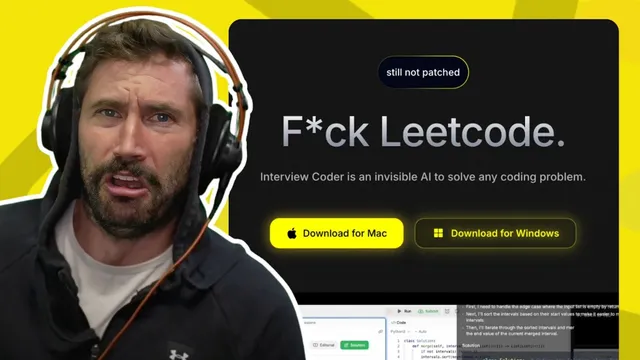
LeetCode is dead? Privacy is done? | The Standup Ep. 1
Based on The PrimeTime's video on YouTube. If you like this content, support the original creators by watching, liking and subscribing to their content.
Cheating in live technical interviews is treated as wrong not only because it’s unfair, but because it can reinforce dishonest behavior as a long-term habit.
Briefing
A live-streamed “LeetCode cheating” stunt—using an LLM to copy exact interview answers—sparks a broader fight over whether shortcuts in technical hiring are justifiable, and what they do to both candidates and employers. The controversy centers on a tool that claims “invisible cheating” during Amazon-style coding interviews, paired with a recorded walkthrough where the candidate appears to solve problems (including a classic “two heaps” median question) without doing the underlying work. The debate quickly shifts from “is this fair?” to “what kind of behavior does it train into people?”
TJ lands on the most uncompromising position: cheating is bad in principle because it rewires a person’s internal decision-making—turning “cheating equals good” into a lasting habit. Even if the target company is disliked, the moral logic still matters, because the same justification can metastasize into broader dishonesty later. Casey and others push back on the framing that the only problem is the cheater. They argue the interview system itself is often mismatched: companies ask synthetic, performance-irrelevant questions that don’t reflect real day-to-day engineering, and the “barrier” becomes a test of memorization, test-bank familiarity, or willingness to game the process.
Still, the group converges on a practical takeaway: cheating doesn’t help long-term. Even if the hurdle is “stupid,” it doesn’t change the ethical baseline. At the same time, there’s agreement that interview design is overdue for reform. Several participants note that companies could screen for coding ability and communication without relying on contrived algorithm puzzles—especially ones that are easy to automate with LLMs. The discussion points toward more revealing formats, like drill-down interviews based on a candidate’s own past projects, where interviewers can probe design choices, tradeoffs, and reasoning in context.
The second half turns to Firefox, where new acceptable-use and terms language raises privacy and data-use concerns. One clause restricts downloading or uploading “obscene” or “explicit sexual content,” which triggers jokes about whether adult creators can use the browser normally. The bigger worry is the broader permissions language: Mozilla is granted rights to process user data and a license to use content provided in Firefox for “the purpose of doing as you request,” which fuels speculation about training AI systems or monetizing user inputs. Participants also connect the change to Mozilla’s business pressures—especially as it buys privacy-related companies and shifts toward advertising-adjacent revenue models.
Across both topics, the episode lands on a shared theme: when systems are easy to game—whether interviews or browser terms—people will look for loopholes, and companies should expect backlash. The proposed remedy isn’t moralizing cheaters alone; it’s redesigning incentives and evaluation methods so the “right” path is also the easiest path.
Cornell Notes
The episode debates whether using LLMs to cheat in technical interviews is ever acceptable, using a LeetCode “invisible cheating” stunt as the spark. TJ argues cheating is wrong in principle because it conditions a person’s internal decision-making toward dishonesty. Others agree cheating is still bad, but they also criticize interview design for being overly synthetic and mismatched to real engineering work—making gaming more tempting. The discussion then pivots to Firefox policy updates, where acceptable-use restrictions and broad permissions language raise concerns about data processing and potential AI-related use. The shared conclusion: loopholes will be exploited unless hiring and product policies are redesigned to reduce incentives to cheat or fear misuse.
Why does TJ treat cheating as morally wrong even when the target company is disliked?
What criticism emerges about LeetCode-style interview questions like the “two heaps” median problem?
How do participants distinguish “prepared” from “cheating” in interview prep?
What specific Firefox policy language triggers concern, beyond the adult-content restriction?
What interview format is proposed as more informative than puzzle-based coding tests?
Review Questions
- What moral principle does TJ use to argue cheating is wrong even if the company is unethical, and how does that principle relate to “decision-making conditioning”?
- Which parts of the interview design are criticized as mismatched to real engineering work, and what alternative formats are suggested to address those weaknesses?
- What Firefox terms language raises concerns about data processing or content licensing, and why do participants connect it to Mozilla’s business incentives?
Key Points
- 1
Cheating in live technical interviews is treated as wrong not only because it’s unfair, but because it can reinforce dishonest behavior as a long-term habit.
- 2
Even when interview questions are viewed as synthetic or poorly aligned with real work, participants still argue that cheating doesn’t become acceptable.
- 3
Interview design is criticized for using contrived algorithm puzzles that may not reflect actual performance constraints or day-to-day engineering tasks.
- 4
More effective hiring formats are suggested, including drill-down interviews that start from candidates’ real projects and probe reasoning and implementation details.
- 5
Firefox’s policy updates raise concerns through both acceptable-use restrictions and broader permissions language that grants Mozilla rights to process and use user-provided content.
- 6
Participants connect privacy policy changes to business incentives, including revenue pressure and shifts toward advertising-adjacent models.
- 7
When systems are easy to game—whether hiring or browser terms—backlash and loophole-seeking become predictable outcomes.