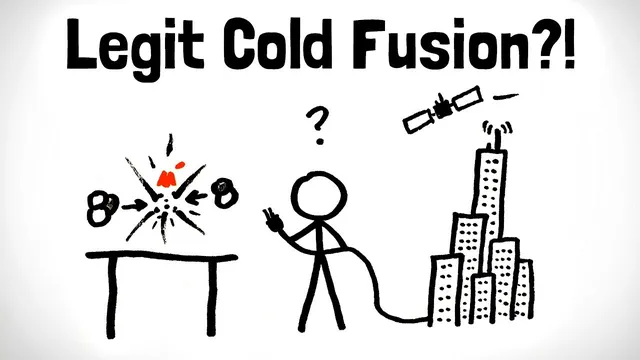
Legitimate Cold Fusion Exists | Muon-Catalyzed Fusion
Based on minutephysics's video on YouTube. If you like this content, support the original creators by watching, liking and subscribing to their content.
Muon-catalyzed fusion can occur at far lower temperatures than conventional fusion because muons orbit much closer to nuclei than electrons do.
Briefing
Muon-catalyzed fusion really does achieve fusion at dramatically lower temperatures than conventional fusion—down to room temperature in experiments—by swapping ordinary electrons for much heavier muons that pull nuclei much closer together. That proximity makes it far more likely for hydrogen nuclei to overcome their electric repulsion and fuse, even in non-plasma molecular settings where ordinary “cold fusion” would be vanishingly rare.
The mechanism hinges on muons acting like heavy electrons. Because muons are about 200 times heavier than electrons, they orbit much closer to the nucleus, shrinking the effective size of the atom or molecule by roughly the same factor. With nuclei packed about 200 times closer together, fusion events become vastly more probable. This muon-aided pathway was predicted in 1947 and demonstrated experimentally in 1956, and researchers have even pushed muon-facilitated fusion toward temperatures near absolute zero.
Despite that success, muon-catalyzed fusion has a hard physics bottleneck that blocks it from becoming a practical power source. Muons are short-lived: after about 2 microseconds they decay into an electron and neutrinos. That short lifetime doesn’t prevent them from catalyzing fusion quickly, but it does mean there aren’t many muons available at any moment. Producing a reliable muon supply requires a high-energy particle accelerator, costing on the order of 5 gigaelectronvolts (GeV) per muon.
Even worse, each muon can only catalyze a limited number of fusion reactions before it gets “stuck.” After a fusion event produces helium, the muon sometimes remains bound to the newly formed helium nucleus instead of freeing to catalyze more reactions. In the best-case accounting described, a muon helps on average about 150 fusion events before sticking. Since each fusion releases about 18 megaelectronvolts (MeV), that translates to roughly 150 × 18 MeV ≈ 2700 MeV, or about 2.7 GeV of energy generated per muon.
Put side by side, the energy ledger doesn’t balance: generating a muon costs about 5 GeV, while the muon enables only about 2.5–2.7 GeV of fusion energy before it becomes unavailable. The result is a net energy consumer, not an energy source. The path to viability would require major breakthroughs—making muons with far less energy, reducing the probability that muons stick to helium, or finding a way to unstick them—but those constraints are tied to fundamental properties of muons and nuclei. After decades of research, progress has been slow, and the conclusion is blunt: muon-induced fusion is real and scientifically important, yet it’s not poised to power civilization anytime soon.
Cornell Notes
Muon-catalyzed fusion achieves fusion at much lower temperatures than standard fusion by replacing electrons with muons. Because muons are about 200× heavier than electrons, they orbit much closer to nuclei, shrinking atoms/molecules and bringing nuclei roughly 200× closer together, which greatly increases fusion probability. Experiments have demonstrated this effect since the mid-20th century, including room-temperature fusion and results near absolute zero. The limiting factor is energy economics: muons decay after about 2 microseconds and must be produced using accelerators at ~5 GeV per muon. Each muon catalyzes only ~150 fusions before getting stuck to helium, yielding ~2.7 GeV per muon—insufficient to break even. Net energy gain remains out of reach.
How do muons make fusion possible at room temperature when ordinary molecular fusion is extremely rare?
What is the main practical obstacle to using muon-catalyzed fusion as a power plant?
Why does muon “sticking” matter quantitatively?
What does “net energy consumer” mean in this context?
What kinds of breakthroughs would be required to make muon-catalyzed fusion viable?
Review Questions
- What physical change does replacing electrons with muons make to the size and nuclear spacing of atoms/molecules?
- Using the provided figures, estimate the energy generated per muon from ~150 fusions and compare it to the ~5 GeV cost to produce a muon.
- Which factor—muon decay or muon sticking—primarily limits the energy yield per muon, and why?
Key Points
- 1
Muon-catalyzed fusion can occur at far lower temperatures than conventional fusion because muons orbit much closer to nuclei than electrons do.
- 2
Muons are about 200× heavier than electrons, shrinking muonic atoms/molecules and bringing nuclei roughly 200× closer together, which boosts fusion probability.
- 3
Muon lifetimes are short (about 2 microseconds), so any catalytic process must occur quickly and muons must be continuously produced.
- 4
Producing muons requires high-energy accelerators, costing roughly 5 GeV per muon in the stated accounting.
- 5
Each muon catalyzes only a finite number of fusions because it can get stuck to the helium nucleus after fusion, with an average of about 150 fusions per muon.
- 6
With ~18 MeV released per fusion, ~150 fusions yield about 2.7 GeV per muon, which falls short of the ~5 GeV production cost.
- 7
Current muon-catalyzed fusion is therefore a net energy consumer; viability would require cheaper muon production and/or reduced sticking/unbinding solutions.