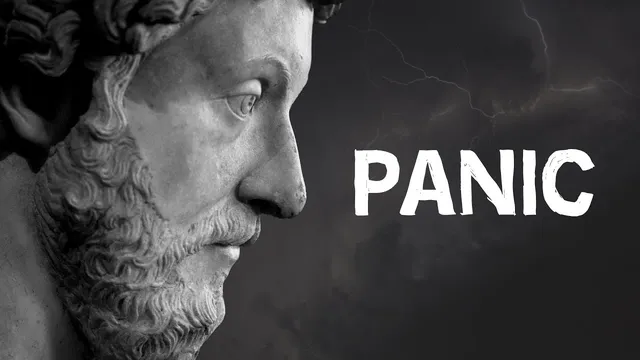
“Let Them Scream Whatever They Want” | Marcus Aurelius on Panic
Based on Einzelgänger's video on YouTube. If you like this content, support the original creators by watching, liking and subscribing to their content.
Panic undermines rational judgment; Stoic practice aims to restore decision-making based on facts and logic.
Briefing
Panic doesn’t just feel bad—it actively derails judgment, pushing rationality aside when people most need it. From a Stoic lens, the antidote is not denial of danger but disciplined attention to facts, logic, and the common good, even while others around you spiral. Marcus Aurelius’ core message is that crises repeat familiar patterns; what feels unprecedented is often just fear of the unknown wearing a new mask. That perspective matters because it turns “this has never happened before” into “this has happened, and people have adapted,” making calm action more attainable.
The first step is internal: notice what’s driving the panic and why it feels novel. Aurelius’ Meditations emphasize that events may feel alien in the moment, yet history is packed with the same archetypal storylines—different characters, different formats. Losing money or a job is not unique; plague and disease have recurred across eras, from the Spanish Flu to the Black Death, SARS, and MERS. Peace and war also cycle through human experience. The transcript frames this as a kind of universal transience—life shifting like yin and yang—so the mind panics because the threat appears disguised as something unprecedented. Once the “newness” is stripped away, fear loses some of its grip: what is scary today becomes familiar tomorrow, and humans are adaptable enough to meet that reality.
That mental reframing leads to practical guidance. In hardship, preparation should happen—but over-preparation that harms the community should be avoided. Aurelius repeatedly ties right action to the needs of the whole: “to do what the community needs done.” Panic often produces unintelligent behavior—either doing the wrong thing in the wrong way or ignoring what actually matters. In a virus outbreak, for example, the “hero” impulse is treated as a trap; staying home is presented as a more rational contribution than performative action.
The transcript also warns that mass hysteria is amplified by incentives. Media organizations are described as profit-driven, repeatedly inflating and focusing on attention-grabbing disasters. Constant exposure can narrow perception until it feels like nothing else exists besides catastrophe. The suggested counter is to prioritize the direct environment—what can be influenced—and to take beneficial steps there.
When dealing with panicking people, the emphasis shifts outward: you can’t control others’ reactions, and trying to argue with the closed-minded often wastes time. The better move is to protect inner tranquility and refuse engagement with irrationality. Aurelius’ advice is quoted in spirit—let others scream, let the chaos happen to the body, and keep the mind steady enough to assess what’s around you and respond effectively. If others won’t consider alternatives, maintaining calm becomes the most reliable form of self-governance—and a way to keep moving “straight for the finish line.”
Cornell Notes
Stoic guidance for panic centers on a simple but powerful reframing: crises feel unprecedented only because the moment is new, even though history repeats the same patterns. Marcus Aurelius’ Meditations are used to argue that fear of the unknown drives panic, while rationality and facts make calm action possible. The transcript links calm to community-minded behavior—prepare, but avoid actions that undermine others, and focus on what the community needs. It also warns that profit-driven media can distort reality by constantly spotlighting disasters, narrowing perception. When others panic, the most effective response is often to protect one’s own inner tranquility rather than get pulled into the crowd’s irrationality.
Why does panic feel so intense even when similar events have happened before?
How does the Stoic framing of history repeating itself help someone stay calm?
What does “prepare but don’t overdo it” mean in practical terms during a crisis?
How can media consumption worsen panic, and what’s the counter-strategy?
What should someone do when people around them are irrational or violent?
How does Stoic calm relate to community and personal responsibility?
Review Questions
- What recurring “archetypal storylines” does the transcript use to argue that crises are not truly unprecedented?
- How does the transcript connect media incentives to changes in perception during mass panic?
- In what ways does the transcript distinguish rational preparation from panic-driven overreaction?
Key Points
- 1
Panic undermines rational judgment; Stoic practice aims to restore decision-making based on facts and logic.
- 2
Crises feel new because the moment is new, but history shows repeating patterns that reduce the fear of the unknown.
- 3
Right action in hardship is measured by what serves the community, not by ego or performative heroism.
- 4
Preparation is appropriate, but overdoing it—especially when it harms others—can make situations worse.
- 5
Profit-driven media can distort reality by amplifying disasters, so attention should shift to what can be influenced directly.
- 6
When others panic, the most effective response is often to protect inner tranquility rather than argue with the closed-minded.
- 7
You can’t control other people’s reactions, but you can keep your mind steady enough to respond well to what’s in front of you.