Life-Changing Bible Study Method: Precept Upon Precept
Based on Bible Notetaking with Katie 's video on YouTube. If you like this content, support the original creators by watching, liking and subscribing to their content.
Use Isaiah 28’s “precept upon precept” framework to justify searching across Scripture instead of relying on single verses.
Briefing
A Bible study approach built on “precept upon precept” and “line upon line” is presented as a practical way to avoid spiritual confusion—by forcing readers to accumulate supporting Scripture across the whole Bible instead of relying on isolated verses, tradition, or a teacher’s authority. The core claim is that God’s truth is distributed “here a little and there a little,” so anyone who doesn’t actively search for it risks being “broken and snared and taken,” especially when messages sound convincing but aren’t grounded in Scripture.
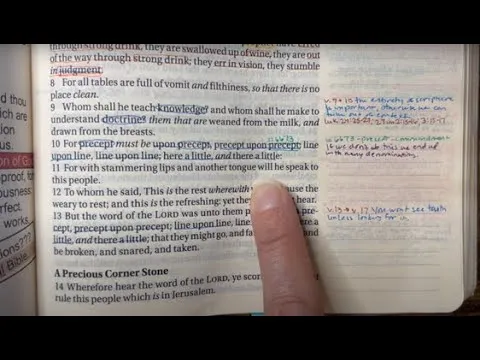
The method begins with Isaiah 28:9–13, where the text warns that God teaches knowledge and understanding of doctrine through layered instruction rather than one concentrated lesson. The transcript connects this to a fear of being deceived: people can build a “refuge of lies,” believing they’re following God while actually being swept away by what they didn’t verify. The proposed safeguard is not blind trust in pastors or friends, but a habit modeled by the Bereans in Acts 17:10–11—receiving teaching with readiness, then searching the Scriptures daily to test whether claims are true. That testing, the transcript argues, is what leads to “true faith,” because it anchors belief in what Scripture says rather than what feels right.
From there, the study framework leans heavily on 2 Timothy 2:15–16: “study to show thyself approved,” “rightly dividing the word of truth,” and shunning “profane and vain babblings” that grow into further ungodliness. The transcript also challenges the idea that something not explicitly labeled in Scripture is automatically “just tradition.” Instead, it urges readers to compare tradition against what the Bible says about obedience to God versus man. A further anchor comes from 2 Timothy 3:15–17, emphasizing that all Scripture—Old and New Testament—serves doctrine, reproof, correction, and instruction, and that the Old Testament’s Scriptures are “able to make thee wise unto salvation.”
A major practical component is “tracking Scripture” by theme. The transcript describes building a system of notes and cross-references so that when a key word appears—like “circumcise” or “trumpet”—the reader can jump to a single organized location containing all related passages. Instead of writing everything directly in the Bible (which becomes hard to update), the approach uses a color-coded scheme and sticky notes to consolidate gathered information. The transcript gives examples from Jeremiah 4:4 (circumcision of the heart), and from the symbolism of trumpets and eagles, linking imagery across books to interpret Revelation more coherently.
The overall payoff is confidence and coherence: Revelation becomes less overwhelming when it’s read through the accumulated themes of the rest of Scripture. The transcript frames this as “buried treasure” work—slow, cumulative, and sometimes surprising—where Old Testament and New Testament align because they share consistent doctrine. It ends by offering free, printable study materials via email for anyone who wants the same tracking setup.
Cornell Notes
The transcript promotes a Bible study method designed to prevent deception by treating Scripture as a connected whole. Using Isaiah 28’s “precept upon precept” and “line upon line,” it argues that truth is scattered across the Bible, so readers must search “here a little and there a little” rather than rely on single verses or tradition. The Bereans in Acts 17:10–11 are held up as a model: receive teaching, then verify it daily in Scripture. The method also uses 2 Timothy 2:15–16 to stress studying for approval and rejecting “vain babblings,” and 2 Timothy 3:15–17 to insist that all Scripture (including the Old Testament) is profitable for doctrine and instruction. Practically, it uses theme tracking with color-coding and consolidated notes so later books like Revelation can be interpreted through earlier Scripture.
Why does the transcript emphasize Isaiah 28’s “precept upon precept” and “line upon line” as the foundation for study?
How does the transcript say believers should respond to teaching from pastors, friends, or other Christians?
What role does 2 Timothy 2:15–16 play in the method?
Why does the transcript insist the Old Testament and New Testament must be read together?
What is “scripture tracking,” and how does it work in practice?
How does the method aim to make Revelation easier to understand?
Review Questions
- Which Scriptures are used to justify the idea that truth is distributed “here a little and there a little,” and what spiritual risk is associated with not searching?
- What does the transcript say is the correct response when someone teaches something that sounds persuasive but may not be in the Bible?
- How does the theme-tracking system (color-coding, consolidated notes, sticky notes) change the way a reader approaches later books like Revelation?
Key Points
- 1
Use Isaiah 28’s “precept upon precept” framework to justify searching across Scripture instead of relying on single verses.
- 2
Model the Bereans’ approach: receive teaching, then verify it by searching the Scriptures daily (Acts 17:10–11).
- 3
Treat isolated or tradition-based claims skeptically; compare them against Scripture and reject “vain babblings” (2 Timothy 2:15–16).
- 4
Read Old and New Testament together as one inspired body of Scripture (2 Timothy 3:15–17).
- 5
Build doctrine by accumulating supporting passages so Scripture “lines up with itself,” and treat mismatches as likely gaps in understanding.
- 6
Track recurring themes (words like “circumcise,” “trumpet,” or concepts like “fear God”) by consolidating cross-references into a single location for quick review.
- 7
Use update-friendly note methods (e.g., sticky notes and color-coding) so new discoveries can be added as the Bible study progresses.