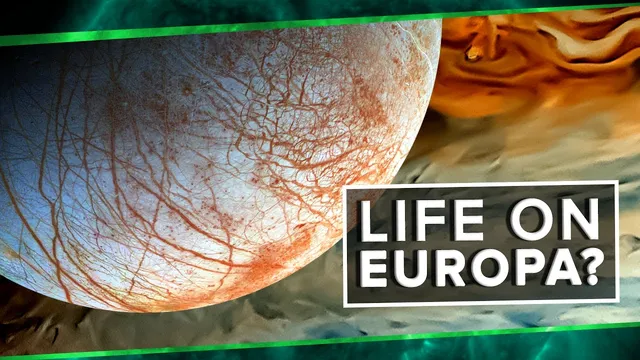
Life on Europa?
Based on PBS Space Time's video on YouTube. If you like this content, support the original creators by watching, liking and subscribing to their content.
Hubble ultraviolet imaging shows sporadic plume jets on Europa near the south pole, strengthening evidence for a subsurface water source.
Briefing
NASA’s latest Hubble observations of Europa’s ultraviolet “plumes” strengthen the case for a deep, global ocean beneath the moon’s icy crust—and raise the odds that the ocean could be habitable. As Europa passes in front of Jupiter, sporadic jets block some of Jupiter’s light, with the material appearing to erupt from the moon’s south pole. The same region has previously shown hydrogen and oxygen ions, linking the plume activity to water vapor escaping from below. That combination makes a liquid-water ocean even more likely, and Europa remains the leading target in the solar system for finding extraterrestrial life.
Europa’s habitability hinges on more than just water. The reddish-brown material on the surface is a key clue: it may be sea salt deposited by plume activity and then altered by Jupiter’s intense magnetic environment. If salts are indeed coming from an ocean, they imply that the liquid water must have interacted directly with the rocky interior. That matters because life needs energy and chemical building blocks, and a direct ocean–rock interface is a plausible route to both.
The energy source most often discussed is tidal flexing. Jupiter’s gravity continuously squeezes Europa, keeping its ocean from freezing and likely driving geologic activity in the rocky interior. That raises the possibility of hydrothermal vents—analogous to Earth’s deep-sea “black smokers”—where mineral-rich fluids mix with water and generate strong chemical gradients. One prominent framework for how life could start in such settings is the iron-sulfur world hypothesis, associated with Gunter Wachtershauser. On Earth, vent ecosystems thrive around hydrogen sulfide–rich emissions, with dense microbial communities supporting complex food webs. If similar chemistry and energy gradients exist on Europa, vents could provide both the raw materials and the metabolic starting points for life.
Europa is not the only icy moon with ocean prospects. Jupiter’s Ganymede likely has an ocean, Callisto may or may not, and Saturn’s Enceladus definitely shows active geysers that contribute to Saturn’s rings; Cassini data found salt in that ring material. But Europa stands out because plume evidence and surface chemistry together suggest a closer connection between ocean water and rock—an advantage for habitability.
Even so, the depth of Europa’s ocean—estimated around 100 kilometers—means direct access to any vents would be slow and difficult. If life exists, it could still leave detectable signatures: specific molecules, isotopic ratios, or even molecular chirality in the plume material or near the ice. Another potential habitat is the underside of the ice itself. Earth’s Antarctic sub-ice environments host dense microbial life in crevices, sustained by energy gradients created by cycles of melting and refreezing.
To test these ideas, NASA’s Europa Clipper—planned for launch in the 2020s—will map the surface and subsurface using imaging, radar, magnetic measurements, and plume/atmospheric composition sampling, guiding future landing missions. Congress’s 2016 budget added a lander requirement by 2022, complicating mission design and landing-site scouting. Meanwhile, Hubble-based spectroscopy could further identify plume molecules, tightening constraints on what chemistry Europa’s ocean might support.
Cornell Notes
Hubble observations of Europa’s ultraviolet plumes—jets that appear near the south pole as Europa passes in front of Jupiter—strengthen the case for a deep, liquid ocean beneath the ice. The reddish-brown surface material may be sea salt, which would imply ocean water has contacted the rocky interior, a key ingredient for habitability. Tidal heating from Jupiter likely keeps the ocean liquid and may power hydrothermal vents, where mineral-rich fluids and strong chemical gradients could support life; this connects to the iron-sulfur world hypothesis tied to Gunter Wachtershauser. Even without direct access to vents, life could leave detectable biosignatures in plume chemistry, isotopic ratios, or molecular chirality. Europa Clipper, launching in the 2020s, is designed to characterize plumes, surface deposits, and the subsurface to assess where a future lander could search for those signs.
What new Hubble evidence points to a liquid ocean under Europa’s ice?
Why does the reddish-brown material on Europa’s surface matter for life?
How does tidal heating connect Europa’s ocean to possible hydrothermal vents?
What is the iron-sulfur world hypothesis, and how does it relate to Europa?
Where else besides the ocean floor could life exist on Europa?
What measurements will Europa Clipper make to assess habitability?
Review Questions
- Which specific plume observations (including location and detected species) most directly support the idea of Europa’s subsurface ocean?
- Explain why direct ocean–rock contact would be advantageous for life, and identify the surface clue that motivates that inference.
- Describe two different Europan habitats discussed (ocean floor vs. underside of ice) and the energy sources that could sustain them.
Key Points
- 1
Hubble ultraviolet imaging shows sporadic plume jets on Europa near the south pole, strengthening evidence for a subsurface water source.
- 2
Hydrogen and oxygen ions detected in the same south-polar region connect plume activity to water vapor escaping from below.
- 3
Reddish-brown surface material may be sea salt, which would imply ocean water contacted the rocky interior—an important habitability condition.
- 4
Jupiter’s tidal flexing likely keeps Europa’s ocean liquid and may drive geologic activity that could produce hydrothermal vents.
- 5
Hydrothermal vents are central to the iron-sulfur world hypothesis associated with Gunter Wachtershauser, linking vent chemistry and energy gradients to possible origins of life.
- 6
Europa Clipper will map the surface and subsurface and analyze plume and surface chemistry to narrow where future landers should search for biosignatures.
- 7
Congress’s added lander mandate and launch timeline constraints could complicate mission design and landing-site selection for Europa Clipper.