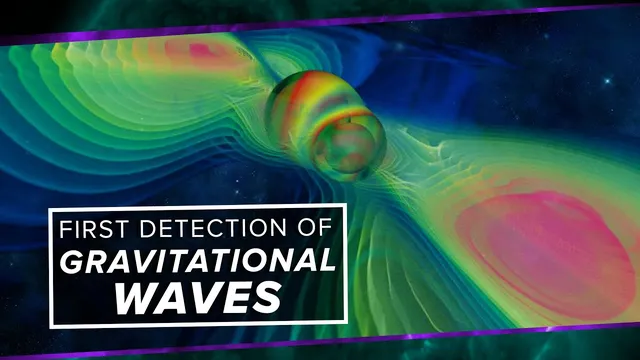
LIGO's First Detection of Gravitational Waves!
Based on PBS Space Time's video on YouTube. If you like this content, support the original creators by watching, liking and subscribing to their content.
Advanced LIGO’s first direct gravitational-wave detection came from the merger of black holes, confirming Einstein’s general relativity prediction that had not been directly verified for a century.
Briefing
Advanced LIGO has directly detected gravitational waves—spacetime ripples produced by the merger of black holes—marking the first time such waves have been observed and delivering a century-old prediction of Einstein’s general relativity with experimental force. The breakthrough matters because it doesn’t just confirm a key idea; it opens a new observational channel for studying extreme gravity, where theory can be stress-tested in ways that electromagnetic telescopes can’t match.
The detection became possible after Advanced LIGO restarted on September 18 following three years of upgrades. Its sensitivity is about ten times higher than before, enabling it to pick up the late-stage “chirp” from compact binaries—systems like stellar-mass black holes or neutron stars—that spiral together under energy loss to gravitational radiation. In earlier, wider phases of such orbits, the waves are too weak and too low in frequency for LIGO to detect directly. But as the objects draw close, the gravitational radiation intensifies dramatically, the inspiral accelerates, and the final merger unfolds over only minutes—long enough for LIGO to measure the resulting distortions in spacetime across vast distances.
For black hole mergers, the reach is enormous: up to roughly five billion light years. That scale is crucial because these events are rare, with an estimated observable merger rate of about once every 10,000 years per galaxy. Advanced LIGO effectively monitors a large fraction of cosmic volume—around 0.1% of the observable universe—translating to millions of galaxies surveyed at once. Neutron-star mergers are expected to be detectable over smaller distances; none had been seen yet at the time of the report, though they are anticipated eventually. The same sensitivity also extends to signals from neutron-star formation and supernova explosions, and potentially even the spin signatures of neutron stars.
The signals carry a distinctive structure: as the wave passes, spacetime stretches and squeezes at a rate matching the orbital motion of the binary just before merger. The frequency evolution can correspond to up to about 1,000 orbits per second in the final moments. That pattern provides more than confirmation—it enables detailed comparisons against general relativity’s predictions. If the observed waveform deviates significantly from expectations, it could hint that the theory is incomplete or point toward a deeper framework. The current detections show no obvious discrepancies, but researchers are expected to scrutinize the data closely.
Beyond testing Einstein, the measurements promise insights into how black holes grow and how their immediate environments behave near the event horizon. In the near term, combining gravitational-wave detections with electromagnetic observations across the spectrum—from radio to visible to X-ray—could reveal the astrophysical context of each merger. Looking further ahead, eLISA (the evolved Laser Interferometer Space Antenna) is expected to probe lower-frequency gravitational waves, enabling observations of different sources such as binary white dwarfs in our galaxy and the final inspiral of supermassive black holes in galactic centers. Together, these efforts are positioned as the start of gravitational-wave astronomy: a new window on the universe built for extreme physics and phenomena previously out of reach.
Cornell Notes
Advanced LIGO has made the first direct detection of gravitational waves from the merger of black holes, confirming a major remaining prediction of Einstein’s general relativity. The upgraded observatory, switched back on September 18 after major improvements, is about ten times more sensitive and can detect the high-frequency “chirp” produced during the final minutes of a compact binary inspiral. The waveform’s frequency evolution matches the orbital rate of the system, letting scientists compare observations against general relativity in an extreme-gravity regime. These detections also enable new astrophysical studies of black hole growth and the physics near event horizons. Future missions like eLISA will extend coverage to lower frequencies, opening access to sources such as binary white dwarfs and supermassive black hole mergers.
Why were gravitational waves hard to detect before Advanced LIGO, and what changed after the upgrades?
What kinds of astrophysical systems can LIGO detect, and why only some phases of their evolution?
How does the detected waveform connect to the physics of the binary system?
Why does the detection require monitoring so many galaxies?
What would a mismatch between observed signals and general relativity imply?
How will future detectors like eLISA expand the gravitational-wave “spectrum”?
Review Questions
- What observational feature of a compact binary’s inspiral makes the final minutes detectable by LIGO but not the earlier stages?
- How does the frequency evolution of a gravitational-wave signal relate to the orbital dynamics of the merging objects?
- Why does the rarity of black hole mergers force gravitational-wave observatories to survey extremely large cosmic volumes?
Key Points
- 1
Advanced LIGO’s first direct gravitational-wave detection came from the merger of black holes, confirming Einstein’s general relativity prediction that had not been directly verified for a century.
- 2
Advanced LIGO restarted on September 18 after upgrades, reaching roughly ten times greater sensitivity than its prior configuration.
- 3
LIGO can’t detect the early inspiral of binaries because the waves are too weak and too low-frequency, but it can detect the late-stage “chirp” during the final minutes before merger.
- 4
The measured waveform’s stretching/squeezing pattern and frequency evolution track the binary’s orbital rate, reaching up to about 1,000 orbits per second near merger.
- 5
For black hole mergers, LIGO’s reach extends to about five billion light years, requiring monitoring of millions of galaxies because events are rare (about once per 10,000 years per galaxy).
- 6
Neutron-star mergers are expected to be detectable at smaller distances; none had been seen yet at the time described, though they are anticipated.
- 7
eLISA will complement LIGO by probing lower-frequency gravitational waves from sources like binary white dwarfs and supermassive black hole mergers.