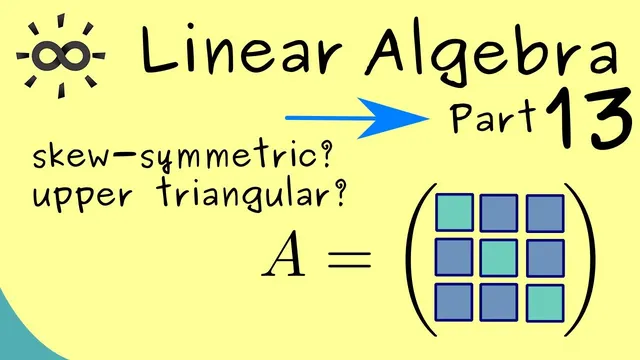
Linear Algebra 13 | Special Matrices
Based on The Bright Side of Mathematics's video on YouTube. If you like this content, support the original creators by watching, liking and subscribing to their content.
An m×n matrix in ℝ^{m×n} has m rows and n columns; square matrices occur when m=n.
Briefing
The core takeaway is that matrix “names” encode structural patterns—row/column shape, and specific zero/nonzero or sign relationships—that later make linear maps easier to analyze. The series starts by grounding notation: an m×n matrix is an element of ℝ^{m×n}, where m counts rows and n counts columns. When m=n, the matrix is square, a frequent special case because many properties (like symmetry) require matching row and column structure. Vectors fit naturally into this framework too: a column vector is an m×1 matrix, a row vector is a 1×n matrix, and even a scalar a can be treated as a 1×1 matrix.
From there, the discussion shifts to special matrices defined by where entries must be zero or how entries relate across the main diagonal. A diagonal matrix is the clearest example: only entries on the main diagonal can be nonzero, while every off-diagonal entry must be 0. Formally, a diagonal matrix satisfies a_{ij}=0 whenever i≠j, so the nonzero pattern forms the straight line from the top-left to the bottom-right. The diagonal concept is often introduced for square matrices, but the definition itself extends to general m×n matrices.
Next come triangular matrices, which impose a “one-sided” zero pattern relative to the diagonal. An upper triangular matrix is square and has zeros below the main diagonal: whenever the row index i is greater than the column index j, the entry a_{ij} must be 0. Conversely, a lower triangular matrix has zeros above the diagonal: entries must vanish whenever the column index j is greater than the row index i. These constraints create a recognizable triangular shape of potentially nonzero entries.
Finally, the series introduces two diagonal-reflection-based classes. A symmetric matrix is square and remains unchanged when reflected across the main diagonal. That means entries mirror across the diagonal: a_{ij}=a_{ji}. A skew-symmetric matrix also reflects across the main diagonal, but with a sign flip: a_{ij}=-a_{ji}. This forces diagonal entries to be zero, since the condition implies a_{ii}=-a_{ii}, which can only hold when a_{ii}=0. Off-diagonal entries can be nonzero in both symmetric and skew-symmetric matrices, but the required relationship across the diagonal determines whether the sign changes.
Overall, the naming scheme isn’t cosmetic—it’s a compact way to specify entry patterns (zeros, mirroring, sign changes) that will matter for computing and understanding linear transformations in later lessons.
Cornell Notes
Matrices are organized by shape and by constraints on their entries. An m×n matrix in ℝ^{m×n} has m rows and n columns; when m=n it’s square, and many key properties require this. Column vectors (m×1), row vectors (1×n), and scalars (1×1) all fit the same matrix framework. Diagonal matrices have nonzero entries only where i=j; upper triangular matrices have zeros below the diagonal (i>j), and lower triangular matrices have zeros above it (j>i). Symmetric matrices satisfy a_{ij}=a_{ji}, while skew-symmetric matrices satisfy a_{ij}=-a_{ji}, which forces all diagonal entries to be 0.
Why does the series treat vectors and scalars as special cases of matrices?
What exact condition defines a diagonal matrix?
How do upper and lower triangular matrices differ in terms of index conditions?
What does it mean for a matrix to be symmetric?
Why must a skew-symmetric matrix have zeros on the diagonal?
Review Questions
- Given an m×n matrix, what changes when m=n, and why does that matter for symmetry?
- Write the index condition for entries that must be zero in an upper triangular matrix.
- If a matrix satisfies a_{ij}=-a_{ji}, what must be true about its diagonal entries?
Key Points
- 1
An m×n matrix in ℝ^{m×n} has m rows and n columns; square matrices occur when m=n.
- 2
Column vectors are m×1 matrices and row vectors are 1×n matrices; scalars can be treated as 1×1 matrices.
- 3
Diagonal matrices have a_{ij}=0 for all i≠j, so only i=j entries may be nonzero.
- 4
Upper triangular matrices require a_{ij}=0 whenever i>j (zeros below the main diagonal).
- 5
Lower triangular matrices require a_{ij}=0 whenever j>i (zeros above the main diagonal).
- 6
Symmetric matrices satisfy a_{ij}=a_{ji}, reflecting cleanly across the main diagonal.
- 7
Skew-symmetric matrices satisfy a_{ij}=-a_{ji}, forcing all diagonal entries to be 0.