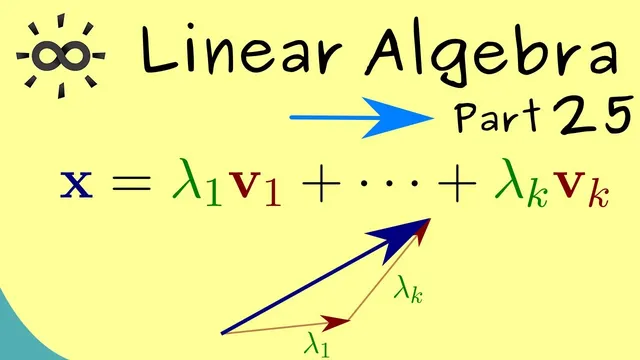
Linear Algebra 25 | Coordinates with respect to a Basis
Based on The Bright Side of Mathematics's video on YouTube. If you like this content, support the original creators by watching, liking and subscribing to their content.
A basis defines the coordinate “grid,” so the same vector can have different coordinate lists under different bases.
Briefing
Coordinates with respect to a basis turn the same vector into different coordinate lists—often making calculations easier—because a basis defines the “grid” used to describe vectors. In the familiar setting of R2, the standard basis uses the usual x- and y-directions, so a vector is described by how far to move right/left and up/down. Switching to a different basis replaces that orthogonal grid with a new one determined by two chosen basis vectors, which may be skewed or non-right-angled. The same geometric vector can then have simpler coordinates in the new system; for instance, a vector that needs fractional steps in the standard basis might become (1,1) when expressed using the new basis vectors.
This idea generalizes to any subspace U of RN. If B = {v1, v2, …, vk} is a basis of U, then every vector u in U can be written as a linear combination u = λ1 v1 + λ2 v2 + … + λk vk. The coefficients (λ1, …, λk) are defined as the coordinates of u with respect to the basis B. A key point is uniqueness: because the basis vectors are linearly independent, there is only one way to represent u as such a linear combination. That uniqueness guarantees the coordinates are well-defined, and there are exactly k coordinate numbers—one for each basis vector.
Once the coordinates are known, the original vector can be reconstructed from them, which motivates a compact notation: the coordinates are often stacked into a column vector. However, this column vector does not mean the original vector u literally has n components; it only encodes the coefficients relative to the basis. To avoid confusion, the basis is typically included in the notation (so the reader remembers the coordinates depend on B). In computations inside the subspace, working with these coordinate lists can streamline algebra, though the transcript notes that handling changes between different bases is a later topic.
Two worked examples make the definition concrete. In R3, a non-standard basis is used to find coordinates of u = (1, 2, −1). By matching components through the linear combination—using the third basis vector once to produce −1, the second twice to produce 2, and the first once to complete the combination—the coordinates come out as (1, 2, 1) relative to that basis. A second example takes u~ = (3, 0, 0), which is achieved by taking −1 times the first basis vector, yielding coordinates (−1, 0, 0). The takeaway is straightforward: “coordinates” are not intrinsic to the vector alone; they are the coefficients that express the vector in terms of a chosen basis, and choosing a better basis can make those coefficients easier to compute.
Cornell Notes
A basis of a subspace U provides a unique way to write every vector u in U as a linear combination of basis vectors. If B = {v1, …, vk} is a basis, then u = λ1 v1 + … + λk vk, and the numbers (λ1, …, λk) are the coordinates of u with respect to B. Linear independence guarantees these coordinates are uniquely determined, so the coordinate list is well-defined. Coordinates can be arranged into a column vector for convenience, but that column vector represents coefficients relative to B—not the original vector’s n-dimensional components. Because different bases define different “grids,” the same vector can have different coordinate lists under different bases, sometimes with simpler numbers.
Why do the same vector have different coordinates after changing the basis?
What exactly are “coordinates of u with respect to a basis B”?
How does linear independence affect the coordinate values?
Why is it potentially confusing to treat the coordinate column vector as if it were the original vector?
How were coordinates found in the R3 example using a non-standard basis?
What does the second R3 example show about expressing a vector using basis vectors?
Review Questions
- Given a basis B = {v1, v2, …, vk} of a subspace U, what conditions ensure that the coordinates of any u ∈ U exist and are unique?
- If two different bases are used for the same vector u, what changes and what stays the same?
- When writing coordinates as a column vector, how should the equality involving u be interpreted to avoid confusion?
Key Points
- 1
A basis defines the coordinate “grid,” so the same vector can have different coordinate lists under different bases.
- 2
If B = {v1, …, vk} is a basis of U, every u ∈ U can be written uniquely as u = λ1 v1 + … + λk vk.
- 3
The coordinates of u with respect to B are exactly the coefficients (λ1, …, λk) in that linear combination.
- 4
Uniqueness of coordinates comes from linear independence of the basis vectors.
- 5
Coordinate column vectors store coefficients relative to the basis and should not be mistaken for the original n-component vector.
- 6
Knowing coordinates allows reconstruction of the original vector by combining the basis vectors with those coefficients.
- 7
Choosing a more suitable basis can make coordinate values—and therefore calculations—simpler.