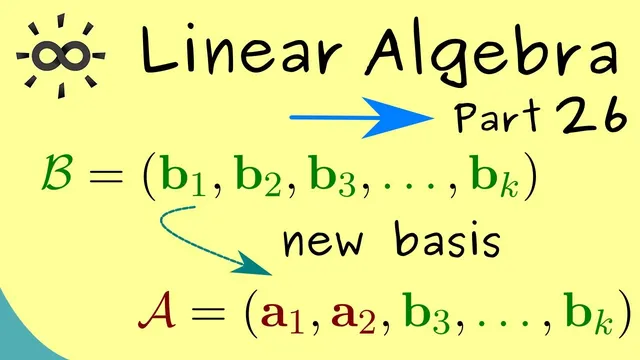
Linear Algebra 26 | Steinitz Exchange Lemma
Based on The Bright Side of Mathematics's video on YouTube. If you like this content, support the original creators by watching, liking and subscribing to their content.
Steinitz’s exchange lemma is the mechanism that makes the dimension of a subspace well-defined by proving all bases of the same subspace have the same number of vectors.
Briefing
Steinitz’s exchange lemma is the key tool for making “dimension” well-defined: it guarantees that any two bases of the same subspace contain the same number of vectors. That matters because the intuitive idea—lines need one basis vector, planes need two—only works if the count of basis elements cannot change when switching between different bases.
The setup starts with a subspace U of R^N and a fixed basis B = {v1, v2, …, vK}. Then a new collection of vectors A = {a1, a2, …, aL} is chosen from U such that the vectors in A are linearly independent. Steinitz’s exchange lemma says it’s possible to build a new basis of U by “exchanging” some vectors from B with the vectors from A. More precisely, after inserting the L independent vectors from A, the basis must still have K vectors total, so exactly K − L vectors from the original basis B remain, while the rest are replaced by vectors from A.
To justify the claim, the proof is first illustrated in the simplest nontrivial case L = 1. Here there is just one extra vector a1, and the combined family B ∪ {a1} has K + 1 vectors. Because B already spans U (it is a basis), the new vector a1 can be written as a linear combination of the basis vectors v1, …, vK. That immediately implies the enlarged family is linearly dependent. Since a1 is also not the zero vector (because A is linearly independent), at least one coefficient in the expression of a1 must be nonzero; call it the coefficient corresponding to vj.
Using that nonzero coefficient, the proof rearranges the linear combination to solve for vj in terms of a1 and the remaining basis vectors. This produces a new family C obtained by removing vj from B and adding a1. The argument then checks two properties.
First, C is linearly independent: any linear combination of C that equals the zero vector forces the coefficient of a1 to be zero (otherwise the equation could be rearranged to produce an alternative representation of a1 using fewer basis vectors, contradicting uniqueness of coordinates from the original basis). With that coefficient gone, the remaining coefficients multiply the original basis vectors, which are already linearly independent, so all coefficients must be zero.
Second, C spans U: take any vector u in U. Since B is a basis, u can be written using the v’s. Wherever vj appears, substitute the expression for vj in terms of a1 and the other v’s. This rewrites u as a linear combination of vectors in C. Therefore C is a basis.
For L > 1, the same exchange idea is reused, exchanging multiple vectors rather than just one. The payoff is foundational: the number of vectors in a basis of U is fixed, which makes the dimension of a subspace a meaningful invariant rather than a basis-dependent guess.
Cornell Notes
Steinitz’s exchange lemma ensures that a subspace U has bases with the same number of vectors, making dimension well-defined. Start with a basis B = {v1, …, vK} of U and choose linearly independent vectors A = {a1, …, aL} from U. The lemma guarantees a new basis can be formed by replacing exactly L vectors from B with the vectors in A, leaving K − L vectors from B. The proof is illustrated for L = 1 by showing that B ∪ {a1} is dependent, then solving for one basis vector vj in terms of a1 and the others. Replacing vj with a1 yields a set C that is both linearly independent and spanning, hence a basis. The general case repeats this exchange process.
Why does adding an extra vector a1 to a basis B automatically create linear dependence when L = 1?
How does the proof decide which basis vector vj to remove from B?
What is the core contradiction used to prove the new set C is linearly independent?
How does the proof show C spans U?
What changes when L > 1, and what stays the same?
Review Questions
- Given a basis B = {v1, …, vK} and a linearly independent set A = {a1, …, aL} in U, what does Steinitz’s exchange lemma guarantee about the number of vectors kept from B?
- In the L = 1 proof, why does choosing a nonzero coefficient λj allow solving for vj in terms of a1 and the other v’s?
- How does uniqueness of coordinates with respect to a basis enter the linear independence argument for the exchanged set C?
Key Points
- 1
Steinitz’s exchange lemma is the mechanism that makes the dimension of a subspace well-defined by proving all bases of the same subspace have the same number of vectors.
- 2
Starting with a basis B of U and linearly independent vectors A from U, one can construct a new basis by exchanging vectors between B and A.
- 3
In the case L = 1, the enlarged set B ∪ {a1} is linearly dependent because a1 can be expressed as a linear combination of the basis vectors.
- 4
A nonzero coefficient in the expression of a1 identifies a specific basis vector vj that can be solved for and removed.
- 5
Replacing vj with a1 produces a set C that is both linearly independent and spanning, so C is a basis.
- 6
For L > 1, the exchange process repeats, exchanging multiple vectors while preserving the total basis size K.
- 7
The fixed size of any basis is what ultimately justifies defining dimension as that number.