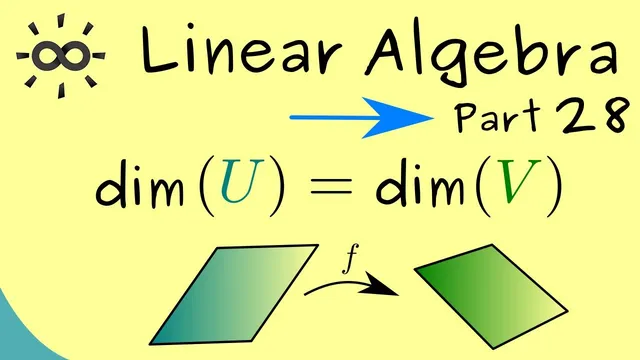
Linear Algebra 28 | Conservation of Dimension
Based on The Bright Side of Mathematics's video on YouTube. If you like this content, support the original creators by watching, liking and subscribing to their content.
Dimension of a subspace equals the number of vectors in any basis of that subspace.
Briefing
Dimension is preserved by bijective linear maps: if two subspaces U and V of R^n are connected by a linear transformation F: U → V that is one-to-one and onto, then dim(U) = dim(V). That matters because it turns a purely numerical invariant—dimension—into a rigid constraint: a bijective linear map can only “rename” vectors between subspaces, not change how many independent directions they contain.
The core claim is framed as an equivalence. First, if dim(U) and dim(V) are equal, a bijective linear map can be built. Choose a basis B = {u1, …, uk} for U and a basis C = {v1, …, vk} for V, where k is the common dimension. Define F by sending each basis vector ui to the corresponding basis vector vi. Linearity then forces F on every vector x ∈ U: once x is written as a linear combination of the ui, the image F(x) is determined by the same coefficients applied to the vi. Bijectivity follows by constructing the inverse map in the same way—send each vj back to uj—so the compositions return the original vectors.
Second, if there exists a bijective linear map F: U → V, then the dimensions must match. The proof uses the two parts of bijectivity. Start with a basis of U, B = {u1, …, uk}. Apply F to every basis vector to obtain a family {F(u1), …, F(uk)} in V. Injectivity guarantees this family stays linearly independent: if a linear relation among the images existed, applying the injective map would force the same relation among the original basis vectors, contradicting their independence. Surjectivity guarantees the family spans V: every y ∈ V equals F(x) for some x ∈ U, and x is a linear combination of the ui, so y becomes the corresponding linear combination of F(ui). With a linearly independent spanning family of size k, this family is a basis of V, so dim(V) = k = dim(U).
A further consequence handles nested subspaces. If U ⊆ V and dim(U) = dim(V), then U must equal V. The reason is structural: a basis of U consists of k linearly independent vectors that also lie in V. Since V has dimension k, those same vectors must already form a basis for V, meaning every vector in V is a linear combination of vectors from U. Because U is a subspace, those combinations stay inside U, forcing V ⊆ U and thus U = V. Put plainly: a proper inclusion of subspaces cannot keep the same dimension; strict containment requires strictly smaller dimension.
Overall, the discussion ties dimension to the behavior of linear maps: equal dimension enables a bijection, and a bijection forces equal dimension. That link becomes a powerful tool for later work, especially when translating geometric intuition about “number of directions” into algebraic invariants.
Cornell Notes
A bijective linear map F: U → V between subspaces of R^n preserves dimension. If dim(U) = dim(V), one can construct F by mapping a basis of U to a basis of V and extending linearly; the inverse map comes from reversing that basis correspondence. Conversely, if F is bijective, applying F to a basis of U produces a linearly independent spanning set in V: injectivity preserves linear independence, and surjectivity ensures every vector in V is hit. Therefore dim(U) = dim(V). As a corollary, if U ⊆ V and dim(U) = dim(V), then U = V, since a basis of U must already serve as a basis for V.
Why does equal dimension let one build a bijective linear map between subspaces U and V?
How does injectivity guarantee that F sends a linearly independent set to a linearly independent set?
How does surjectivity guarantee that the images of a basis of U span V?
Why does U ⊆ V together with dim(U) = dim(V) force U = V?
What does the phrase “dimension is conserved under bijective linear maps” mean in practice?
Review Questions
- If dim(U) = dim(V) = k, what specific rule on basis vectors defines a linear map F: U → V, and why does it become bijective?
- Given a bijective linear map F: U → V and a basis of U, which two properties of bijectivity are used to prove the images form a basis of V?
- For subspaces U ⊆ V, what dimension relationship is necessary for U to be a proper subset of V?
Key Points
- 1
Dimension of a subspace equals the number of vectors in any basis of that subspace.
- 2
If dim(U) = dim(V), a bijective linear map F: U → V can be constructed by mapping a basis of U to a basis of V and extending linearly.
- 3
A linear map defined by basis correspondence is automatically determined on all of U because every vector has a unique coordinate expansion in a basis.
- 4
If F is bijective, applying F to a basis of U produces a linearly independent spanning set in V, so dim(U) = dim(V).
- 5
Injectivity preserves linear independence under F, while surjectivity ensures the images span the target space.
- 6
If U ⊆ V and dim(U) = dim(V), then U = V; strict inclusion forces a strict dimension drop.
- 7
Bijective linear maps preserve the “number of independent directions” in subspaces, even though the vectors themselves may change.