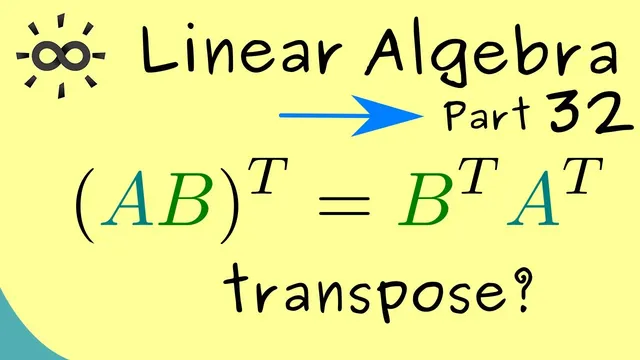
Linear Algebra 32 | Transposition for Matrices
Based on The Bright Side of Mathematics's video on YouTube. If you like this content, support the original creators by watching, liking and subscribing to their content.
Transposition swaps rows and columns, rearranging entries without changing their values.
Briefing
Matrix transposition is the operation that swaps a matrix’s rows and columns, turning an M×N matrix into an N×M matrix while preserving the same entries—just rearranged. For vectors, the same idea appears as turning a column vector into a row vector (and back again). This matters because many calculations, especially those involving inner products and matrix products, depend on how row/column orientation affects multiplication.
For a column vector a, transposition is denoted by a^T and converts it into a row vector. Applying transposition twice returns the original object, so (a^T)^T = a. The transcript extends this notation to matrices: if A is an M×N matrix, then A^T is defined to be an N×M matrix. The (i,j)-entry of A^T comes from the (j,i)-entry of A, which is why transposition can be pictured as reflecting the matrix across its main diagonal. Under this reflection, the j-th column of A becomes the j-th row of A^T, and the j-th row of A becomes the j-th column of A^T.
Concrete examples make the shape change clear. A 2×2 matrix transposes into another 2×2 matrix, so the matrix becomes “taller” or “wider” only when the original is rectangular. For a square matrix, the diagonal reflection stays within the same dimensions. The transcript gives an explicit 2×2 example where A^T = [[1,3],[2,4]] when A is arranged so that the off-diagonal entries swap positions.
A special case occurs when transposition leaves the matrix unchanged: if A^T = A, the matrix is symmetric. Symmetric matrices are exactly those whose entries mirror across the main diagonal, meaning the matrix looks the same after the reflection. The discussion highlights that this property is tied directly to the diagonal symmetry of the array of numbers.
Finally, transposition interacts with matrix multiplication in a way that affects how expressions must be rearranged. If A and B can be multiplied (so AB is defined), then the transpose of the product reverses the order of factors: (AB)^T = B^T A^T. This reversal follows from the row/column swap inherent in transposition and is presented as an important rule to remember. The transcript closes by pointing toward later material connecting transposition to inner products and symmetric matrices.
Cornell Notes
Transposition swaps rows and columns. For a vector a, the transpose a^T turns a column vector into a row vector, and doing it twice returns the original: (a^T)^T = a. For a matrix A with size M×N, the transpose A^T has size N×M, with entries flipped across the main diagonal: the j-th column of A becomes the j-th row of A^T (equivalently, (A^T)_{ij} = A_{ji}). Square matrices transpose into the same shape, and if A^T = A, the matrix is symmetric. A key multiplication rule is (AB)^T = B^T A^T, which reverses the order of factors because transposition swaps row/column roles.
What does transposition do to a column vector, and why does applying it twice return the original?
How is the transpose of an M×N matrix defined, and what happens to its dimensions?
How can you compute A^T from A without rewriting everything from scratch?
Why are transposes of square matrices especially straightforward?
What makes a matrix symmetric, and how does transposition characterize it?
What is the rule for transposing a matrix product AB?
Review Questions
- Given a 3×2 matrix A, what are the dimensions of A^T, and where does the entry A_{2,1} go in A^T?
- If A is symmetric, what equality must hold between A and A^T?
- For compatible matrices A and B, write the formula for (AB)^T and explain what happens to the order of factors.
Key Points
- 1
Transposition swaps rows and columns, rearranging entries without changing their values.
- 2
For vectors, a^T converts a column vector into a row vector, and (a^T)^T = a.
- 3
If A is M×N, then A^T is N×M.
- 4
The transpose is a diagonal reflection: (A^T)_{ij} = A_{ji}.
- 5
Square matrices keep the same shape after transposition, making computation simpler.
- 6
A matrix is symmetric exactly when A^T = A.
- 7
Transposing a product reverses factor order: (AB)^T = B^T A^T.