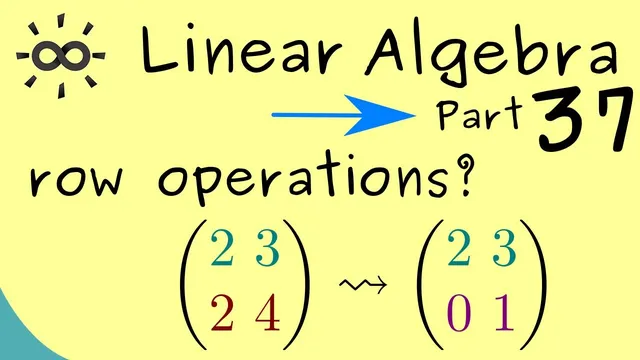
Linear Algebra 37 | Row Operations
Based on The Bright Side of Mathematics's video on YouTube. If you like this content, support the original creators by watching, liking and subscribing to their content.
Row operations can be modeled as left-multiplying by an invertible square matrix M: Ã = M A and Ã_B = M B.
Briefing
Row operations are the reversible matrix moves that make Gaussian elimination possible without losing any information about solutions. Starting from a linear system written as A x = B, the system’s full information sits inside the augmented matrix [A|B]. Any row manipulation can be represented as multiplying by an invertible square matrix M on the left, turning A into a new matrix à = M A and B into Ã_B = M B. Because M is invertible, the transformation can be undone, meaning no solution information is lost—only the form becomes easier to read.
The practical goal is to simplify A into a structure with zeros below the diagonal, creating the “triangle” pattern that makes solving for x straightforward. In the general setting, this simplification is achieved by combining three elementary row operations, each with a clean matrix representation.
First is adding a multiple of one row to another. For an M×N matrix A with rows labeled α_1^T, α_2^T, …, α_M^T, adding row i into row j with a scalar Λ can be encoded using a special matrix Z. Conceptually, Z is built from the identity matrix but with Λ placed in the (j,i) position (with i ≠ j). Multiplying Z A performs the row update: it replaces row j by row j + Λ·row i while leaving other rows unchanged. This Z is invertible because the operation can be reversed by subtracting Λ·row i from row j.
Second is exchanging two rows. Swapping rows i and j is represented by a permutation matrix P_{ij}. Like Z, P_{ij} is constructed from the identity matrix, but with the rows (and corresponding columns) rearranged so that α_i^T and α_j^T trade places. Permutation matrices are invertible, since the swap can be undone by swapping the same two rows again.
Third is scaling a row. Multiplying row i by a nonzero scalar D_i is represented by a diagonal matrix D whose diagonal entries are D_1, …, D_M. Invertibility requires every diagonal entry be non-vanishing; otherwise the transformation would collapse information and could not be reversed.
All row operations—whether row additions, swaps, or scalings—can be combined into a finite product of these invertible matrices. The key invariant is the kernel: for any matrix A, the kernel of M A equals the kernel of A whenever M is invertible. That means row operations do not change which vectors x satisfy A x = 0, and by extension they preserve the solution set structure for systems. The range may change, but the solution-relevant part (the null space) stays fixed. This kernel invariance is the foundational fact that Gaussian elimination relies on in later steps.
Cornell Notes
Row operations are reversible transformations of a linear system that preserve the solution set. For a system A x = B, left-multiplying by an invertible square matrix M turns it into (M A) x = (M B), keeping all solution information intact because M can be inverted. The simplification target is to reshape A into a triangular form with zeros below the diagonal, making solutions easier to extract. The three elementary row operations—adding a multiple of one row to another, swapping two rows, and scaling a row—each correspond to an invertible matrix (Z, P_{ij}, and a diagonal matrix D). Crucially, for invertible M, the kernel does not change: ker(MA) = ker(A).
Why must the matrix used for row operations be invertible?
How does adding a multiple of one row to another translate into matrix multiplication?
What matrix represents swapping two rows, and why is it invertible?
Why does scaling a row require a nonzero scalar?
What invariant do row operations preserve, and what does that mean for solving systems?
Review Questions
- In what way does left-multiplication by an invertible matrix M preserve the solution set of A x = B?
- Describe how the matrices Z, P_{ij}, and D correspond to the three elementary row operations.
- Why is ker(MA) = ker(A) the key fact behind Gaussian elimination?
Key Points
- 1
Row operations can be modeled as left-multiplying by an invertible square matrix M: Ã = M A and Ã_B = M B.
- 2
Reversibility (invertibility of M) prevents loss of solution information when transforming a linear system.
- 3
The goal of Gaussian elimination is to drive A toward a triangular form with zeros below the diagonal.
- 4
Adding Λ·row i to row j is implemented by a matrix Z formed from the identity with Λ in the (j,i) entry (i ≠ j).
- 5
Swapping rows i and j is implemented by a permutation matrix P_{ij}, which is invertible because swaps can be undone.
- 6
Scaling row i by a nonzero scalar D_i is implemented by a diagonal matrix D with nonzero diagonal entries to ensure invertibility.
- 7
Invertible row operations preserve the kernel: ker(MA) = ker(A), which keeps the solution-relevant null space unchanged.