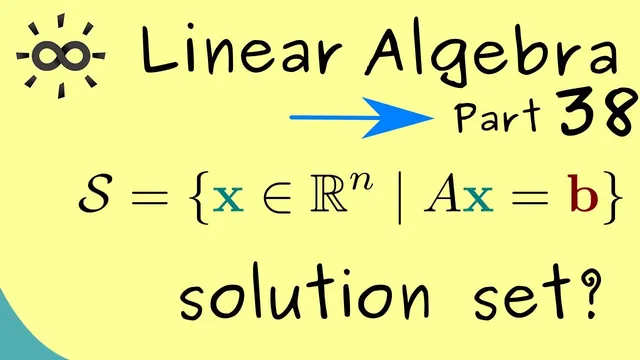
Linear Algebra 38 | Set of Solutions
Based on The Bright Side of Mathematics's video on YouTube. If you like this content, support the original creators by watching, liking and subscribing to their content.
A x = B has no solutions if B is not in range(A).
Briefing
For a linear system written as A x = B, the solution set is either empty or it forms an affine (shifted) subspace: once one solution exists, every other solution differs from it by a vector from the kernel of A. This matters because it turns the messy question “What are all solutions?” into two concrete tasks—find one particular solution and understand the kernel—both of which are accessible through standard linear-algebra tools.
The starting point is dimensional and geometric: A is an M×n matrix, so the linear map F_A sends vectors in R^n to vectors in R^m. The right-hand side B has M components, so hitting B is only possible if B lies in the range (image) of A. If B is not in range(A), there is no vector x that satisfies A x = B, so the solution set is empty.
When B does does lie in range(A), at least one solution exists. Pick one such solution and call it v0, meaning A v0 = B. The key observation is that the kernel of A—those vectors x0 with A x0 = 0—generates all the “ways to adjust” a solution without changing the left-hand side. Define any candidate solution as x̃ = v0 + x0. Substituting into the system gives A(v0 + x0) = A v0 + A x0 = B + 0 = B exactly when x0 is in ker(A). This yields a clean equivalence: x̃ solves A x = B if and only if x̃ can be written as v0 plus an element of ker(A).
As a result, the solution set S has the form S = v0 + ker(A) whenever solutions exist; otherwise S = ∅. In affine-subspace language, v0 + ker(A) is a translated linear subspace: it contains all vectors of the form v0 + x0 with x0 drawn from the kernel.
The discussion then connects this structure to row operations. Row operations correspond to multiplying the system on the left by an invertible matrix M, producing M A x = M B. These operations do not change the kernel of A, and they preserve the existence and form of solutions: if A v0 = B, then M A v0 = M B as well. Since both the kernel and the solvability condition remain intact, the entire solution set stays the same under row reduction.
That invariance is the bridge to Gaussian elimination. The method will be used to (1) check whether B lies in range(A) (deciding between S = ∅ and nonempty solutions), (2) produce one particular solution v0, and (3) determine a basis for ker(A). With v0 and ker(A) in hand, the full solution set S = v0 + ker(A) can be written down directly.
Cornell Notes
A linear system A x = B has solutions that are either empty or form an affine subspace. If B is not in the range of A, no x can satisfy the equation, so the solution set S is ∅. If B is in range(A), choose one solution v0 with A v0 = B. Then every solution can be written as x = v0 + x0 where x0 lies in ker(A), because A(v0 + x0) = A v0 + A x0 = B + 0 = B. Conversely, any solution must differ from v0 by a kernel vector, so S = v0 + ker(A). This structure also stays unchanged under row operations, motivating Gaussian elimination to find v0 and a basis for ker(A).
Why does the condition “B lies in range(A)” decide whether solutions exist?
How does one solution v0 generate all other solutions?
What is the exact relationship between the solution set S and ker(A)?
Why do row operations not change the solution set?
What three outputs does Gaussian elimination need to fully describe S?
Review Questions
- If B is in range(A), how can you construct every solution from one known solution v0?
- State the form of the solution set S in both cases: when solutions exist and when they do not.
- Explain why multiplying A on the left by an invertible matrix does not change the kernel and thus does not change the solution set.
Key Points
- 1
A x = B has no solutions if B is not in range(A).
- 2
If B is in range(A), at least one solution v0 exists with A v0 = B.
- 3
All solutions can be written as x = v0 + x0 where x0 ∈ ker(A).
- 4
The solution set is either S = ∅ or S = v0 + ker(A), an affine (shifted) subspace.
- 5
Row operations (left-multiplying by an invertible matrix) preserve ker(A) and therefore preserve the solution set.
- 6
Gaussian elimination is set up to find: solvability (B ∈ range(A)), one particular solution v0, and a basis for ker(A).