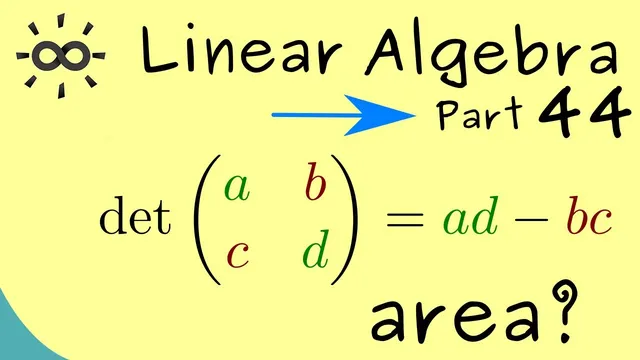
Linear Algebra 44 | Determinant in 2 Dimensions
Based on The Bright Side of Mathematics's video on YouTube. If you like this content, support the original creators by watching, liking and subscribing to their content.
For A = [[a11, a12],[a21, a22]], the determinant is det(A) = a11·a22 − a12·a21.
Briefing
A 2×2 determinant is introduced as the single number that decides whether a linear system has a unique solution—and it also turns out to be the signed area (the “oriented 2D volume”) of a parallelogram spanned by two vectors in R². That dual role matters because it links algebraic solvability to geometric meaning: the same expression, a11·a22 − a12·a21, both flags degeneracy in equations and measures how vectors “cover” area.
The development starts with a 2D linear system written as A x = B, where A is a 2×2 matrix and x and B are 2D vectors. Gaussian elimination is used under the assumption that a11 ≠ 0 so a11 can serve as the first pivot. The second row is replaced by (second row) − (a21/a11)·(first row), producing an echelon form where the lower-left entry becomes 0. After an allowed scaling of the second row by a11 (to avoid fractions), the key quantity on the left side becomes a11·a22 − a21·a12.
At that point the criterion is immediate: the system has a second pivot exactly when the lower-right entry is nonzero. For a square 2×2 system, having pivots in both rows means the solution is unique for any right-hand side B. Therefore, whether a11·a22 − a12·a21 equals 0 or not determines solvability in the strongest sense—unique solvability. This motivates the definition: for a general 2×2 matrix A = [[a11, a12],[a21, a22]], the determinant det(A) is defined as a11·a22 − a12·a21.
The same determinant then gets a geometric interpretation. In R², “volume” means area. Given two vectors u and v in R², they span a parallelogram, and the area of that parallelogram is the natural 2D volume. To capture orientation, the area is treated as signed: rotating u toward v in the positive mathematical direction yields a plus sign, while the opposite rotation yields a minus sign. This oriented area matches what the determinant produces.
To connect the sign convention to a concrete calculation, the method borrows the cross product from R³. Vectors in R² are embedded into R³ by adding a zero third component: u → (u1, u2, 0) and v → (v1, v2, 0). The cross product of these embedded vectors has only a single nonzero component, and its Euclidean norm becomes the absolute value of that component. That absolute value equals the parallelogram’s area, while dropping the absolute value yields the oriented area. The nonzero cross-product component is exactly u1·v2 − u2·v1, which is the determinant of the 2×2 matrix whose columns are u and v.
The takeaway is a central identity: the determinant of a 2×2 matrix equals the oriented 2D volume (signed area) of the parallelogram formed by its column vectors, and it also serves as the algebraic test for whether a 2×2 system is uniquely solvable.
Cornell Notes
For a 2×2 matrix A = [[a11, a12],[a21, a22]], the determinant det(A) is defined as a11·a22 − a12·a21. Using Gaussian elimination, the determinant appears as the condition for whether the second pivot is nonzero, which in turn decides whether the linear system A x = B has a unique solution. Geometrically, in R² the “volume” is area, and the determinant equals the oriented area of the parallelogram spanned by two vectors u and v. Embedding u and v into R³ lets the cross product compute this area: the cross product’s magnitude gives the absolute area, while the signed component matches the determinant directly. This links algebraic solvability and geometric measurement through one formula.
How does Gaussian elimination lead to the determinant formula for a 2×2 matrix?
Why does det(A) ≠ 0 guarantee a unique solution for A x = B (for any B)?
What does “oriented area” mean for two vectors in R²?
How can the cross product in R³ be used to compute a determinant-based area in R²?
How exactly is the determinant connected to the 2×2 matrix built from vectors?
Review Questions
- Given A = [[2, 5],[−1, 3]], compute det(A) and state what det(A) = 0 would imply about solutions to A x = B.
- Explain how the sign of the oriented area changes when the order of the vectors (u, v) is swapped.
- Describe how embedding vectors from R² into R³ makes the cross product compute the determinant-based area.
Key Points
- 1
For A = [[a11, a12],[a21, a22]], the determinant is det(A) = a11·a22 − a12·a21.
- 2
In 2×2 systems A x = B, det(A) ≠ 0 is the pivot condition that guarantees a unique solution for any B.
- 3
det(A) = 0 corresponds to losing the second pivot, so uniqueness fails.
- 4
In R², the determinant equals the oriented area of the parallelogram spanned by two vectors.
- 5
Oriented area uses a sign determined by whether rotating the first vector toward the second is in the positive or negative mathematical direction.
- 6
Embedding R² vectors into R³ (adding a zero third component) lets the cross product compute the same determinant value.
- 7
The absolute value of the determinant matches the usual (nonnegative) area; the determinant itself matches the signed (oriented) area.