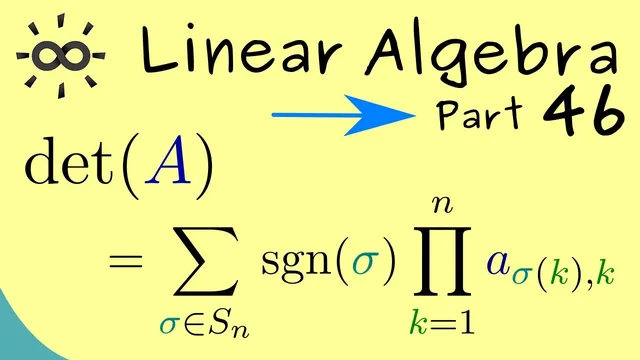
Linear Algebra 46 | Leibniz Formula for Determinants
Based on The Bright Side of Mathematics's video on YouTube. If you like this content, support the original creators by watching, liking and subscribing to their content.
The n-dimensional volume form is uniquely pinned down by linearity in each argument, antisymmetry under swapping, and normalization on the unit cube.
Briefing
A determinant can be built from a single geometric object: the n-dimensional volume form, which is linear in each input vector, flips sign when two inputs are swapped (antisymmetry), and assigns volume 1 to the unit cube. Once those three rules are fixed, the volume form is forced into a specific algebraic structure—an alternating sum over all permutations—leading directly to the Leibniz formula for determinants.
To derive the formula, the volume form is evaluated on n vectors chosen to match the entries of a matrix. Using linearity in the first vector, each input vector is expanded in the canonical basis (unit vectors), turning the volume form into a sum of terms where one basis vector appears in each slot. Repeating the same linearity step for every input vector produces n nested sums, one for each vector position, with coefficients taken from the matrix entries. At that stage, the antisymmetry rule becomes decisive: if any two input vectors coincide, the volume form becomes 0. In the expanded sum, that means any term where two indices match contributes nothing, so only terms with all indices distinct survive.
The surviving index patterns are exactly the permutations of {1, 2, …, n}. Instead of summing over all index tuples, the expression collapses into a single sum over the symmetric group S_n. For each permutation σ, the volume form evaluated on the permuted canonical basis vectors is no longer arbitrary: it is either +1 or −1. The sign is determined by how many swaps are needed to transform the permuted order back to the standard order—an even number of swaps gives +1, an odd number gives −1. This ±1 value is the sign of the permutation, often written sgn(σ).
With that, the volume form becomes a compact alternating sum: sgn(σ) times the product of matrix entries a_{1,σ(1)} a_{2,σ(2)} … a_{n,σ(n)}, summed over all σ in S_n. Since determinants are defined via this volume form, the same expression becomes the determinant formula. In practical terms, the determinant is computed by taking every way to pick one entry from each row and each column (so each row/column index appears exactly once), multiplying the chosen entries, and then adding or subtracting each product depending on whether the corresponding permutation is even or odd.
The result connects algebra to oriented volume: the determinant measures the signed (orientation-sensitive) volume of the parallelepiped spanned by the matrix’s column vectors. But the derivation also hints at a computational drawback: for large n, the permutation sum has n! terms, making direct evaluation expensive—setting up the need for more efficient determinant formulas in later work.
Cornell Notes
The n-dimensional volume form is uniquely characterized by three rules: linearity in each input vector, antisymmetry (swapping two inputs flips the sign), and normalization (the unit cube has volume 1). When the volume form is expanded using the canonical basis, antisymmetry kills every term where two indices match, leaving only index patterns that are permutations of {1,…,n}. For each permutation σ, the volume form on the permuted basis vectors equals sgn(σ), which is +1 for even permutations and −1 for odd ones. Defining the determinant through this volume form yields the Leibniz formula: det(A)=∑_{σ∈S_n} sgn(σ)∏_{i=1}^n a_{i,σ(i)}. This matters because it ties determinants to oriented volume and explains why the computation involves an alternating sum over n! terms.
Why do only permutations survive after expanding the volume form using linearity?
How does the volume form on permuted canonical basis vectors reduce to ±1?
What is the Leibniz formula doing combinatorially?
How does the determinant relate to oriented volume?
Why is computing determinants directly from the Leibniz formula impractical for large n?
Review Questions
- What role does antisymmetry play in reducing the index sums to a sum over S_n?
- How is sgn(σ) determined, and how does it affect the sign of each product term in the determinant?
- Write the Leibniz formula for det(A) and explain what each permutation σ corresponds to in terms of choosing matrix entries.
Key Points
- 1
The n-dimensional volume form is uniquely pinned down by linearity in each argument, antisymmetry under swapping, and normalization on the unit cube.
- 2
Expanding each input vector in the canonical basis turns the volume form into a sum over index choices.
- 3
Antisymmetry forces every term with repeated indices to vanish, leaving only tuples with all indices distinct.
- 4
The remaining index tuples are exactly permutations, so the expression collapses to a single sum over S_n.
- 5
For each permutation σ, the volume form on the permuted canonical basis equals sgn(σ), determined by whether σ is even or odd.
- 6
Defining the determinant via the volume form yields the Leibniz formula: det(A)=∑_{σ∈S_n} sgn(σ)∏_{i=1}^n a_{i,σ(i)}.
- 7
The determinant measures signed (oriented) volume, but the permutation-sum structure implies factorial-time growth in the number of terms.