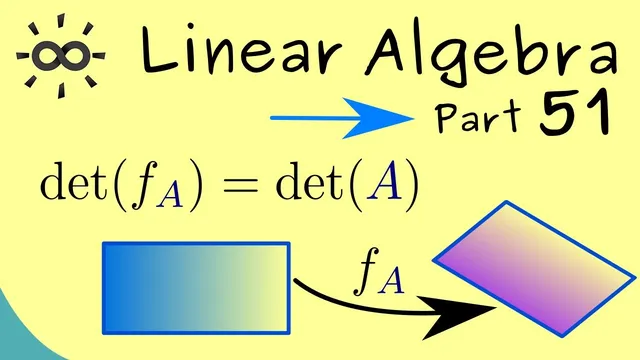
Linear Algebra 51 | Determinant for Linear Maps
Based on The Bright Side of Mathematics's video on YouTube. If you like this content, support the original creators by watching, liking and subscribing to their content.
A square matrix a defines a linear map f_a(x) = ax, and every linear map f: R^n → R^n corresponds to a unique matrix a.
Briefing
Determinants aren’t just a matrix trick—they measure how an abstract linear map changes n-dimensional volume. For a linear map f: R^n → R^n, the determinant of the associated matrix a tells how the oriented volume of the unit “box” (the unit cube) transforms under f. Geometrically, f can stretch, rotate, or reflect space; the determinant captures both the scaling of volume and the orientation change (via its sign). This matters because it lets volume change be computed for any linear transformation, not only for shapes described by coordinates in a particular basis.
The discussion starts by recalling the bridge between matrices and linear maps: every square matrix a defines a linear map f_a by f_a(x) = ax, and conversely every linear map f: R^n → R^n corresponds to exactly one matrix a. That matrix is built from the images of the canonical unit vectors e_1, …, e_n: the i-th column of a is f(e_i). With that identification in place, the determinant’s geometric meaning follows from what happens to the unit cube. The unit cube in R^n has oriented volume 1, and applying f turns it into a parallelotope whose oriented volume equals det(a). In one sentence, det(a) gives the relative change of volume caused by the linear map f.
From there, the determinant is lifted to the abstract level. Instead of defining det only for matrices, det is defined for linear maps by setting det(f) := det(a), where a is the unique matrix representing f. This makes the determinant a basis-independent quantity tied to the linear transformation itself. The multiplication rule also transfers cleanly: for linear maps, det(f ∘ g) = det(f) det(g), mirroring the matrix determinant rule for products.
Finally, the volume-change idea is extended beyond the unit cube. Any reasonable n-dimensional figure with a well-defined volume can be decomposed into finitely many pieces (like rectangles in 2D or their higher-dimensional analogs), and linear maps scale each piece in the same way. Because each small piece’s volume scales by det(a), the entire figure’s volume scales by the same factor. Orientation is included automatically: det(a) > 0 preserves orientation, while det(a) < 0 reverses it. A key takeaway is that det(a) = 1 means the transformation preserves volume—typically corresponding to pure rotations or combinations that don’t expand or contract n-dimensional volume.
In short, determinants provide a single number that encodes how a linear map scales and flips oriented n-dimensional volume, and that number behaves multiplicatively under composition—making it a powerful tool for analyzing linear transformations in any dimension.
Cornell Notes
For a linear map f: R^n → R^n, the determinant measures how f changes oriented n-dimensional volume. Using the one-to-one correspondence between square matrices and linear maps, f is represented by a unique matrix a whose columns are f(e_1), …, f(e_n). The unit cube (or unit parallelotope) has oriented volume 1, and after applying f its oriented volume becomes det(a), so det(a) is the relative volume scaling factor. This definition extends to arbitrary linear maps by setting det(f) = det(a). Under composition, determinants multiply: det(f ∘ g) = det(f) det(g).
How does a linear map f: R^n → R^n connect to a matrix a, and why does that matter for determinants?
Why does det(a) equal the oriented volume of the transformed unit cube?
How does the volume-scaling result extend from the unit cube to more general shapes?
What does det(a) = 1 imply about the linear map’s effect on volume?
Why does det(f ∘ g) = det(f) det(g) hold for linear maps?
Review Questions
- Given a linear map f: R^n → R^n, how would you construct the matrix a used to define det(f)?
- Explain how the sign of det(a) relates to orientation change under a linear map.
- How would you justify that an arbitrary well-defined-volume figure scales by det(a) under a linear transformation?
Key Points
- 1
A square matrix a defines a linear map f_a(x) = ax, and every linear map f: R^n → R^n corresponds to a unique matrix a.
- 2
The matrix a for a linear map is built from columns f(e_1), …, f(e_n), where e_i are canonical unit vectors.
- 3
The determinant det(a) gives the relative change of oriented n-dimensional volume caused by the linear map f.
- 4
Defining det(f) := det(a) lifts the determinant from matrices to abstract linear maps in a basis-independent way.
- 5
Determinants multiply under composition: det(f ∘ g) = det(f) det(g).
- 6
Any figure with a well-defined n-dimensional volume scales by det(a) under a linear map, because the figure can be decomposed into pieces whose volumes scale uniformly.
- 7
If det(a) = 1, the linear map preserves n-dimensional volume (with orientation preserved as well, since the determinant is positive).