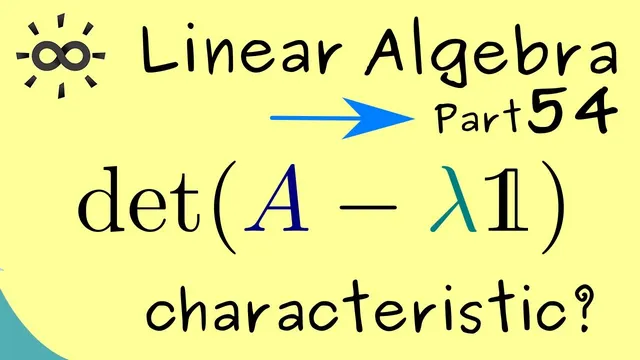
Linear Algebra 54 | Characteristic Polynomial
Based on The Bright Side of Mathematics's video on YouTube. If you like this content, support the original creators by watching, liking and subscribing to their content.
An eigenvalue λ exists exactly when the matrix A − λI has a nontrivial kernel.
Briefing
Eigenvalues can be found by turning a matrix problem into a single-variable polynomial: the characteristic polynomial. For a square matrix A, an eigenvalue λ exists exactly when the matrix A − λI becomes singular, meaning its determinant drops to zero. That link—nontrivial kernel ⇔ singular matrix ⇔ determinant equals zero—provides a systematic way to locate all eigenvalues at once, rather than hunting for eigenvectors one direction at a time.
The starting point is the eigenvalue equation Ax = λx for a nonzero vector x. This condition is equivalent to saying x lies in the kernel of A − λI. A kernel is nontrivial precisely when A − λI is singular, and a matrix is singular precisely when its determinant is 0. So λ is an eigenvalue if and only if det(A − λI) = 0. Once that equivalence is in place, the task becomes: compute det(A − λI) and solve for the values of λ that make it vanish.
A 2×2 example makes the method concrete. Take A = [[3, 2], [1, 4]]. Form A − λI by subtracting λ from the diagonal entries, giving [[3 − λ, 2], [1, 4 − λ]]. The determinant becomes a polynomial in λ (a quadratic in this case). Solving det(A − λI) = 0 yields two roots, 5 and 2, which are exactly the eigenvalues of A.
For an n×n matrix, the same construction works. The matrix A − λI subtracts λ from every diagonal entry and leaves all off-diagonal entries unchanged. Using the Leibniz formula for determinants, the result is always a polynomial in λ. The highest power term comes from the product of the diagonal entries, contributing (−λ)^n, so the characteristic polynomial always has degree n with leading coefficient (−1)^n. The remaining coefficients are collected into terms like c_{n−1}, c_{n−2}, down to a constant c_0.
The transcript then formalizes the definition: for a square matrix A, the characteristic polynomial p_A(λ) is the function λ ↦ det(A − λI). Its zeros are precisely the eigenvalues of A. In practice, finding eigenvectors becomes easier once eigenvalues are known, because eigenvectors correspond to the kernels of A − λI for each root λ. The key takeaway is therefore operational: compute the characteristic polynomial, then solve for its zeros to get the full eigenvalue set.
Cornell Notes
Eigenvalues of a square matrix A are exactly the values λ that make A − λI singular. That happens precisely when det(A − λI) = 0, because singularity is equivalent to having a nontrivial kernel. This turns the eigenvalue search into a polynomial root-finding problem: the characteristic polynomial p_A(λ) is defined as p_A(λ) = det(A − λI). For an n×n matrix, p_A(λ) is always a degree-n polynomial with leading coefficient (−1)^n. Once the zeros of p_A are found, they are the eigenvalues, and each eigenvalue can then be paired with eigenvectors from the corresponding kernel of A − λI.
Why does det(A − λI) = 0 capture the existence of an eigenvalue λ?
How is the characteristic polynomial constructed from a matrix?
What does the 2×2 example A = [[3,2],[1,4]] show about the method?
Why is the characteristic polynomial always degree n for an n×n matrix?
What is the leading coefficient of the characteristic polynomial?
Review Questions
- Given a square matrix A, how do you decide whether a number λ is an eigenvalue using only determinants?
- For an n×n matrix, what guarantees that det(A − λI) is a degree-n polynomial in λ?
- After finding the zeros of the characteristic polynomial, what matrix’s kernel should be used to compute eigenvectors for each eigenvalue?
Key Points
- 1
An eigenvalue λ exists exactly when the matrix A − λI has a nontrivial kernel.
- 2
A − λI is singular if and only if det(A − λI) = 0, linking eigenvalues to determinants.
- 3
The characteristic polynomial is defined by p_A(λ) = det(A − λI).
- 4
The zeros of p_A(λ) are precisely the eigenvalues of A.
- 5
For an n×n matrix, p_A(λ) is always a degree-n polynomial with leading coefficient (−1)^n.
- 6
Computing det(A − λI) reduces eigenvalue finding to solving a polynomial equation in λ.
- 7
Once eigenvalues are known, eigenvectors come from solving (A − λI)x = 0 for each root λ.