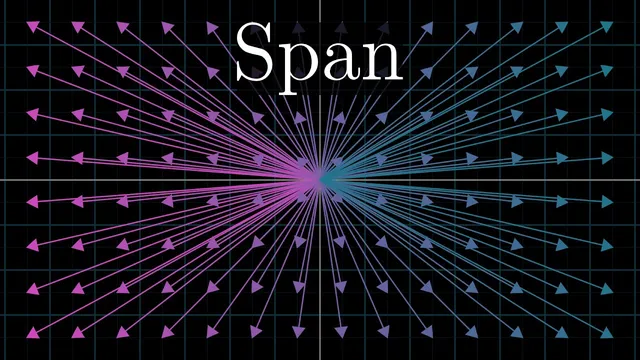
Linear combinations, span, and basis vectors | Chapter 2, Essence of linear algebra
Based on 3Blue1Brown's video on YouTube. If you like this content, support the original creators by watching, liking and subscribing to their content.
Any vector can be expressed as a linear combination of basis vectors by scaling each basis vector and adding the results.
Briefing
Linear combinations turn two (or more) vectors into a whole geometric “shape” of reachable results—and that shape is the span. In the 2D coordinate system, the unit vectors i-hat (pointing right) and j-hat (pointing up) act like the basic measuring sticks: any vector such as [3, -2] can be seen as 3 times i-hat plus -2 times j-hat. That viewpoint makes vector addition feel like stacking scaled directions, not just manipulating coordinates. Crucially, the same idea works even if a different pair of basis vectors is chosen: using any two suitably independent directions, scaling them by two numbers and adding produces every possible 2D vector, though the coordinates you get will differ from the usual i-hat/j-hat system.
The transcript then connects this to the meaning of “linear.” When one scalar is fixed and the other varies, the endpoint of the resulting vector moves along a straight line. Let both scalars vary freely, and most pairs of non-aligned vectors generate the entire plane: every point in 2D can be reached as an endpoint of some linear combination. But there are exceptions. If the two original vectors line up, their span collapses to a single line through the origin. If both vectors are zero, the span is just the origin. This leads directly to the definition: the span of a set of vectors is the collection of all vectors obtainable by scaling those vectors and adding them.
From there, the discussion reframes vectors as points in space. A single vector can be treated as an arrow from the origin; a set of vectors becomes a cloud of points whose endpoints lie somewhere in the plane (or space). In 2D, most spans fill the whole plane; aligned vectors produce only a line. The same geometry scales up. In 3D, two non-parallel vectors span a flat sheet: all linear combinations of the two sweep out a plane passing through the origin. Add a third vector, and two outcomes are possible. If the third vector lies within the plane already formed by the first two, the span doesn’t expand—everything stays trapped on that sheet. If the third vector points in a genuinely new direction (not in the previous span), the span opens up to fill all of 3D space.
This sets up the key terminology: vectors are linearly dependent when at least one of them can be written as a linear combination of the others, meaning removing it doesn’t shrink the span. They are linearly independent when each vector adds new dimensional reach. The culmination is the definition of a basis: a set of vectors that are linearly independent and whose span covers the entire space. The transcript leaves a puzzle for what comes next—how matrices and transformations will formalize these ideas—hinting that basis choice and span behavior will become even more concrete once linear algebra’s machinery enters the picture.
Cornell Notes
The core idea is that scaling vectors and adding them produces a geometric “reachable set.” In 2D, any vector can be written as a linear combination of i-hat and j-hat, and changing the basis to other independent directions still lets linear combinations reach every vector in the plane (though the coordinates differ). The span of vectors is the set of all vectors obtainable from all possible linear combinations. Most non-aligned pairs span the whole plane; aligned pairs span only a line; two zero vectors span only the origin. In 3D, two non-parallel vectors span a plane, and a third vector expands the span to all of 3D space unless it lies in the existing plane. Linear independence and dependence describe whether vectors add new directions to the span, and a basis is a linearly independent set that spans the space.
Why is writing [3, -2] as 3·i-hat + (-2)·j-hat more than a coordinate trick?
What exactly is the span of two vectors in 2D, and when does it become a line instead of the whole plane?
How does the “line” intuition for linear combinations generalize to 3D?
What does it mean for vectors to be linearly dependent, using the span idea?
What does linear independence guarantee about how vectors expand the span?
Why does a basis require both linear independence and spanning the whole space?
Review Questions
- In 2D, what geometric condition on two vectors makes their span a line through the origin rather than the entire plane?
- In 3D, how can you tell whether adding a third vector increases the span beyond the plane formed by the first two?
- Explain the difference between linear dependence and linear independence in terms of whether removing a vector changes the span.
Key Points
- 1
Any vector can be expressed as a linear combination of basis vectors by scaling each basis vector and adding the results.
- 2
The span of a set of vectors is the set of all vectors obtainable from all possible linear combinations of those vectors.
- 3
In 2D, two non-aligned vectors span the entire plane; aligned vectors span only a line through the origin; two zero vectors span only the origin.
- 4
In 3D, two non-parallel vectors span a plane through the origin; a third vector expands the span to all of 3D space only if it does not lie in that plane.
- 5
Linear dependence means at least one vector can be formed from the others, so removing it does not reduce the span.
- 6
Linear independence means every vector adds new reach to the span, increasing the dimensionality of what can be formed.
- 7
A basis is a linearly independent set of vectors whose span covers the entire space, providing a complete coordinate system.