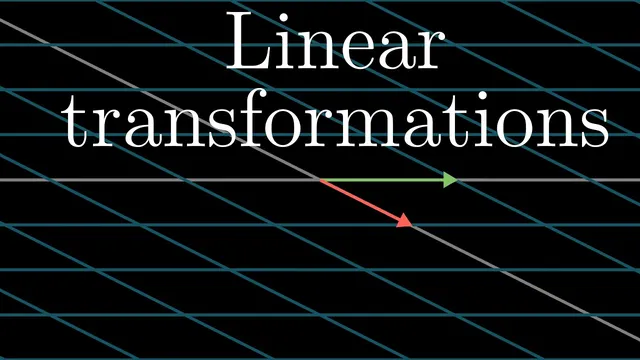
Linear transformations and matrices | Chapter 3, Essence of linear algebra
Based on 3Blue1Brown's video on YouTube. If you like this content, support the original creators by watching, liking and subscribing to their content.
A 2D linear transformation is characterized by keeping the origin fixed and preserving straight lines (grid lines stay parallel and evenly spaced).
Briefing
Linear transformations in two dimensions are completely determined by where they send the two basis vectors, and matrices are just a compact way to store that information. The payoff is practical: once the images of i-hat and j-hat are known, the destination of any vector follows automatically—no memorizing formulas or watching the transformation happen is required.
A transformation is just an input-output rule, but linear algebra focuses on a special class: linear transformations. In 2D, linearity has a visual meaning. The origin stays fixed, and straight lines stay straight—equivalently, grid lines remain parallel and evenly spaced. Nonlinear examples fail one of these conditions: some bend lines into curves, while others keep lines straight but move the origin.
The key insight comes from how linearity interacts with grid structure. Any vector v in the plane can be written as a linear combination of the basis vectors: v = x·i-hat + y·j-hat. Because a linear transformation preserves the “same linear combination” relationship, the image of v is x times the image of i-hat plus y times the image of j-hat. So the transformation’s effect on every point in the plane is forced once the two basis vectors’ landing spots are known.
This is illustrated with a concrete example. The transformation sends i-hat to (1, −2) and j-hat to (3, 0). For v = −1·i-hat + 2·j-hat, the destination must be −1·(1, −2) + 2·(3, 0) = (5, 2). The important part isn’t that the final coordinates can be read off from a picture; it’s that the same result can be deduced from the basis-vector images alone.
To describe this numerically, the four numbers that specify where i-hat and j-hat land are packaged into a 2×2 matrix. If the matrix is
[A B C D]
the first column (A, C) is the image of i-hat and the second column (B, D) is the image of j-hat. For a vector (x, y), matrix-vector multiplication computes the same linear combination: x times the first column plus y times the second column, yielding (Ax + By, Cx + Dy). Interpreting columns as transformed basis vectors makes the multiplication feel like geometry rather than rote algebra.
The method also produces familiar transformations. A 90° counterclockwise rotation sends i-hat to (0, 1) and j-hat to (−1, 0), giving columns (0, 1) and (−1, 0). A shear keeps i-hat fixed while moving j-hat to (1, 1), so the matrix has columns (1, 0) and (1, 1).
Finally, if the two transformed basis vectors are linearly dependent—one is a scaled version of the other—the transformation collapses the entire plane onto a line (the span of those dependent vectors). Overall, matrices become a language for moving space: every matrix corresponds to a specific linear transformation, and understanding that geometric meaning sets up later topics like matrix multiplication, determinants, change of basis, and eigenvalues.
Cornell Notes
Linear transformations in 2D keep the origin fixed and preserve straight lines, which means grid lines stay parallel and evenly spaced. Any vector (x, y) can be written as x·i-hat + y·j-hat, and linearity forces its image to be x·(image of i-hat) + y·(image of j-hat). A 2×2 matrix stores exactly those two images: its first column is where i-hat lands and its second column is where j-hat lands. Multiplying the matrix by (x, y) computes the correct linear combination automatically, giving (Ax + By, Cx + Dy). If the two columns are linearly dependent, the transformation squashes the plane into a line.
Why do linear transformations have a “grid” interpretation, and what two conditions define linearity in 2D?
How does knowing where i-hat and j-hat land determine where any vector lands?
What does a 2×2 matrix mean geometrically, and how does it produce the formula Ax + By, Cx + Dy?
How do rotation and shear fit into the “columns are transformed basis vectors” rule?
What does it mean when the columns of a 2×2 matrix are linearly dependent?
Review Questions
- Given a 2×2 matrix [A B; C D], what are the images of i-hat and j-hat, and how would you compute the image of (x, y)?
- Explain why moving the origin breaks linearity even if horizontal and vertical grid lines appear to stay straight.
- If a transformation’s two column vectors are linearly dependent, what happens to the area of shapes under the transformation?
Key Points
- 1
A 2D linear transformation is characterized by keeping the origin fixed and preserving straight lines (grid lines stay parallel and evenly spaced).
- 2
Any vector (x, y) can be written as x·i-hat + y·j-hat, and linearity preserves that linear-combination structure under transformation.
- 3
A 2×2 matrix stores the transformation completely: its first column is the image of i-hat and its second column is the image of j-hat.
- 4
Matrix-vector multiplication computes x times the first column plus y times the second column, producing (Ax + By, Cx + Dy).
- 5
Rotations and shears are easy to build once the images of i-hat and j-hat are known, since those images become the matrix columns.
- 6
If the matrix columns are linearly dependent, the transformation collapses the plane onto a line (the span of the dependent columns).