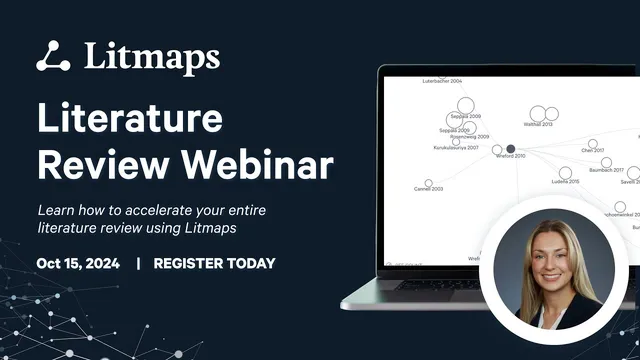
Litmaps for Literature Review, October 2024 Webinar
Based on Litmaps's video on YouTube. If you like this content, support the original creators by watching, liking and subscribing to their content.
Litmaps’ core search ranks suggestions using a citation-network algorithm that leverages references and citations from selected input papers, not just keyword similarity.
Briefing
Litmaps positions itself as an end-to-end literature-review workspace built around a transparent, citation-network search engine—designed to help researchers not just find papers, but map how a topic fits together, prioritize what to read first, and keep the review organized and citable.
At the center of the platform is a search method that goes beyond keyword matching. Instead of returning results based only on title or abstract similarity (as many databases do), Litmaps takes papers a researcher already knows—using their references (past work) and citations (future work)—and then searches the surrounding citation network for “top most interconnected” articles. The practical payoff is a set of suggestions that tend to be structurally important to the field: papers that connect to many parts of the local network rather than just being textually similar. For a single “seed” paper, Litmaps uses that paper’s references, citations, and co-citations to surface highly connected work; for multiple input papers, it relies on the interconnected network while (per the presenter’s note) co-citations are not used the same way. The interface visualizes this as a map where the original input papers sit in context and suggested papers appear as additional nodes, making it easier to see where a topic’s core literature lives.
Litmaps also differentiates itself through workflow features that support the full literature-review cycle. It offers alerts for relevant new papers, visualization and annotation of literature maps, and tools for organizing papers via tags and “Design mode,” where categories can be edited and the evolving structure of a topic can be labeled. Sharing is treated as part of the research output: maps can be embedded on websites, shared via public URLs, or shared with specific people, and maps can be exported for use in figures. For citations, Litmaps recommends citing it as a reference (including version/date and URL/screenshot details), and it encourages researchers to describe the algorithm when discussing how literature was gathered.
On the data side, Litmaps claims broad coverage—170 million-plus papers—with weekly additions sourced primarily from Semantic Scholar, plus OpenAlex and Crossref. It acknowledges that “coverage” isn’t just quantity, especially for niche fields, and points to an external analysis (Gusenbauer, 2022) suggesting strong relative subject coverage driven largely by Semantic Scholar. The presenter also notes the team is small, so Litmaps relies on existing coverage research and encourages users to validate fit through their own access to library resources.
The webinar then ties the tool to a standard literature-review process: defining a research question, searching, evaluating sources, organizing and synthesizing, writing, and citing. Litmaps is presented as most helpful in four areas—searching, evaluating/prioritizing, staying organized, and citing—especially when researchers feel overwhelmed by information overload. A recommended starting strategy is to begin with one or a few well-connected “starting articles” (found via keyword quick search), then iteratively expand the map by exploring related papers and adding highly connected suggestions. For comprehensive searches, Litmaps supports importing existing libraries (including via PubMed IDs or BibTeX) and then running network-based exploration on that set, with filters to narrow by date, keywords, authors, or journals.
Finally, the session addresses practical questions: Litmaps isn’t compulsory to use with a single seed paper (keywords can work as a starting point), citations vs. references are framed as past vs. future connections, and integration with Zotero is highlighted via synchronization so newly discovered papers can be tagged and synced automatically. The overall message is that Litmaps aims to reduce the friction between discovery and writing by turning citation structure into a navigable, editable map of a research field.
Cornell Notes
Litmaps is built around a transparent citation-network search that uses references and citations from papers a researcher selects, then surfaces other articles that are “interconnected” within the local network. That approach helps researchers prioritize what to read first and understand how a topic’s subareas connect, rather than relying only on keyword similarity. The platform supports alerts for new relevant papers, visualization/annotation, and organization through tags and Design mode. It also supports comprehensive searches by importing an existing library (e.g., BibTeX, PubMed IDs) and then exploring related work with filters for date, keywords, authors, and journals. These features aim to streamline the core literature-review steps: searching, evaluating, organizing, and citing.
How does Litmaps’ search differ from keyword-based databases like Google Scholar or PubMed?
What does “interconnected” mean in practice on a Litmaps map?
How can a researcher start a new literature review without knowing the field well?
How does Litmaps support comprehensive searching and staying current?
What organization and sharing tools are emphasized for literature-review work?
How does Zotero integration fit into the workflow?
Review Questions
- When would a researcher prefer Litmaps’ citation-network search over keyword-only search, and what signals on the map help with prioritization?
- Describe a step-by-step workflow for starting a literature review from scratch using Litmaps, including how and why papers are added as inputs.
- How do filters (date, keywords, authors, journals) change the purpose of a comprehensive search in Litmaps?
Key Points
- 1
Litmaps’ core search ranks suggestions using a citation-network algorithm that leverages references and citations from selected input papers, not just keyword similarity.
- 2
The map visualization helps researchers prioritize reading by showing connectivity and citation counts, often revealing “anchor” papers and newer, lower-citation work in context.
- 3
A recommended starting strategy is to begin with one or a few well-connected papers found via keyword Quick Search, then iteratively expand using “Explore related articles.”
- 4
Comprehensive searching can be done by importing an existing library (e.g., BibTeX or PubMed IDs) and running network-based exploration on that set, then narrowing results with filters.
- 5
Litmaps supports staying current through alerts for relevant new papers connected to a topic, reducing repeated manual reruns.
- 6
Organization is handled through tags and Design mode, which can be used to label subtopics and shape the narrative structure of a review.
- 7
Sharing and citation are treated as first-class features: maps can be embedded or shared via URLs, and Litmaps recommends citing it with version/date and access details.