Lorentz Transformations | Special Relativity Ch. 3
Based on minutephysics's video on YouTube. If you like this content, support the original creators by watching, liking and subscribing to their content.
An observer’s spacetime-diagram perspective is defined by having their worldline be a vertical line at x = 0 for all time.
Briefing
Special relativity’s core move is replacing ordinary “sliding” of spacetime diagrams with a specific kind of geometric transformation that keeps the speed of light the same for every observer. On a spacetime diagram, an observer’s own worldline is always a straight vertical line at x = 0. Changing to a moving observer’s perspective therefore can’t be done by merely shifting the diagram; the worldline of the moving object must rotate to become vertical, meaning the transformation must change angles—i.e., it must be a “boost.”
The first candidate is a shear-like transformation: slide each constant-time snapshot by an amount proportional to time so that the moving object’s worldline becomes vertical while the time coordinate of each event stays the same. This works mathematically for ordinary velocities: if a cat moves at speed v relative to one observer, the observer can be made to appear to move at the same speed v relative to the cat, matching the symmetry of relative motion. In the cat’s frame, the other observer’s velocity changes exactly as expected from the sliding rule.
But shear transformations fail a decisive experimental test: the speed of light in vacuum. Everyday objects obey velocity addition—light does not. Experiments show that light rays have the same measured speed no matter how fast the source or observer is moving. A shear transformation changes all velocities in a way tied to time-snapshot sliding, so even if it makes one worldline vertical, it would also alter the slope of light-ray worldlines. Since light’s speed must remain unchanged, shear transformations are ruled out.
That leaves the other geometric possibilities for turning an angled worldline vertical while preserving the angle between worldlines: transformations that behave like a “squeeze rotation,” where points are mapped to earlier or later times as part of the rotation-like adjustment. These squeeze-rotation boosts can keep one particular speed unchanged—and, crucially, can keep the speed of light unchanged in every direction. In the example with a slow-moving sheep and faster cats, sliding alone would spoil the cats’ speed when switching frames. A squeeze-rotation transformation instead preserves the cats’ worldline angles (their speeds) while also producing the correct new perspective for the sheep.
With the standard spacetime-diagram scaling—where one second is one tick vertically and 299,792,458 meters is one tick horizontally—the speed of light appears as 45° lines. Under a Lorentz transformation, spacetime is “squeezed” along one 45° direction and “stretched” along the other in a precise proportional way. The angles of non-light worldlines change, reflecting different perceived speeds, yet the 45° light rays stay fixed.
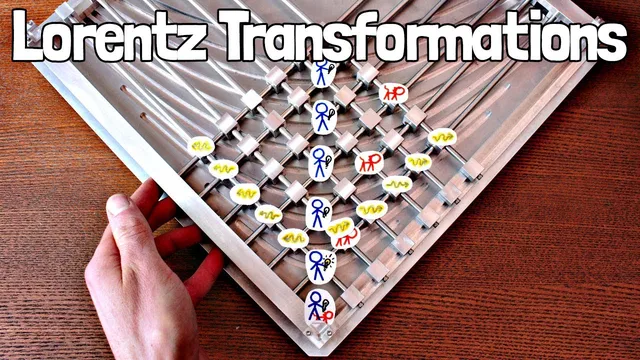
These squeeze-rotation boosts are the Lorentz transformations, named after early derivations by Hendrik Lorentz. They form the mathematical backbone of special relativity and set up the later results—time dilation, length contraction, relativity of simultaneity, and the twins paradox—by dictating how motion and causality look across different inertial frames. The episode also highlights a physical “time globe” device that implements Lorentz transformations mechanically, letting learners explore frame changes without starting from heavy algebra.
Cornell Notes
Spacetime diagrams represent an observer’s perspective by requiring that the observer’s worldline stay vertical at x = 0. Switching to a moving observer’s perspective must therefore rotate the moving object’s angled worldline to become vertical, which rules out simple shifting. A shear-style “sliding snapshots” boost can match relative-velocity symmetry for ordinary objects, but it fails the experimental fact that light’s speed is constant in all inertial frames. Lorentz transformations use a squeeze-rotation geometry that maps events so that light-ray worldlines keep their 45° slopes while other worldlines’ angles change. With the usual diagram scaling, this squeezing along one light direction and stretching along the other preserves the speed of light and produces the frame-dependent perceptions that power special relativity.
Why can’t changing perspective on a spacetime diagram be done by just sliding the plot?
What does the shear transformation accomplish, and why does it initially seem plausible?
How does the constant speed of light rule out shear transformations?
What geometric feature allows Lorentz transformations to preserve light’s speed?
In the standard spacetime-diagram scaling, what does “light stays at 45°” mean?
Review Questions
- How does the requirement that an observer’s worldline remain at x = 0 constrain the allowed transformations between inertial frames?
- Explain why preserving relative velocity symmetry for ordinary objects is not enough to determine the correct spacetime transformation.
- Describe, in geometric terms, how a Lorentz transformation differs from a shear transformation and why that difference matters for light rays.
Key Points
- 1
An observer’s spacetime-diagram perspective is defined by having their worldline be a vertical line at x = 0 for all time.
- 2
Switching to a moving inertial frame requires rotating worldlines, not merely shifting the diagram.
- 3
Shear-like boosts can reproduce the symmetry of relative motion for ordinary velocities but change the slopes of light rays.
- 4
The experimentally observed invariance of the speed of light eliminates shear transformations as the correct boost rule.
- 5
Lorentz transformations use a squeeze-rotation geometry that preserves light-ray worldlines (fixed 45° slopes under standard scaling).
- 6
With standard tick scaling, Lorentz boosts squeeze along one light direction and stretch along the other in a way that changes other speeds while keeping light’s speed constant.
- 7
Lorentz transformations are the foundational mathematical tool behind later special-relativity effects like time dilation and length contraction.