Luck Always Beats Hard Work
Based on Pursuit of Wonder's video on YouTube. If you like this content, support the original creators by watching, liking and subscribing to their content.
The hair’s arrogance comes from treating repeated wins as proof of personal superiority rather than as contingent outcomes.
Briefing
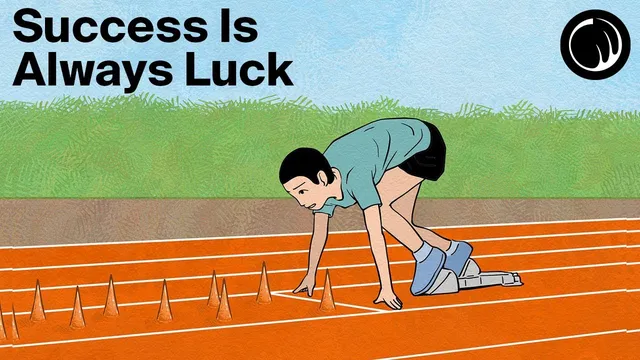
A fast hair humiliates a slow tortoise for years—until a race forces an uncomfortable question: is speed earned through hard work, or granted by luck and deeper causes beyond personal control? After the tortoise finally wins, the story pivots from moralizing about discipline to a philosophical claim that “being fast” is ultimately a product of arbitrary chance, even when hard work still matters.
For much of the forest’s time, the hair treats speed as proof of superiority. He repeatedly challenges other animals, wins, and uses that success to justify contempt—especially toward the tortoise, whose unhurried pace makes him unpopular. The hair’s message is blunt: if you want to be fast, you have to work for it. The tortoise, though annoyed by the hair’s arrogance, stays mostly unfazed—until the hair’s lecturing turns into a direct challenge. The race is set, the path is cleared, and the animals line up.
Before the start, the tortoise asks the hair how he got so fast. The hair credits daily running, discipline, focus, and sacrifices—less a matter of fate than a chosen lifestyle. He also traces his work ethic to his parents, describing a lineage of speed training and opportunity. But the tortoise keeps pushing, asking what made the parents that way, and then what made them that way, drilling backward through generations.
That questioning strips away the hair’s confidence in personal credit. The explanation eventually reaches the point where causes become so remote they stop feeling like “choices”: the hair’s kind of body, the life circumstances that shaped his parents, the evolutionary processes that produced the first hairs, and even the cosmic chain leading to Earth and the conditions for life. The tortoise’s conclusion lands like a philosophical trap: the hair is fast because of the Big Bang and the unfolding of time and space—not because he uniquely chose his outcomes.
When the race begins, the hair’s certainty collapses into passivity. He lies down while the tortoise steadily moves forward and wins. Afterward, the tortoise tells the hair that the result isn’t pointless—just not fully under the hair’s control. Speed is both chance and practice: hard work is necessary, but it’s still downstream of luck. The tortoise goes further, framing humans and animals as “pawns” in a universe governed by arbitrary causes.
The final message is not nihilism but a practical stance: accept that free will may be illusory, yet live as if agency exists. The hair, chastened, calls for a rematch—suggesting that even if outcomes are contingent, effort remains meaningful in the world as it’s experienced.
Cornell Notes
A fast hair spends years preaching that speed comes from hard work, mocking the tortoise as lazy. When the tortoise challenges him to a race, the hair credits discipline, daily practice, and parental training. The tortoise keeps asking “why” until the explanation reaches far beyond personal choice—evolution, the conditions for life, and ultimately the Big Bang—arguing that speed is rooted in arbitrary chance. The tortoise still wins, concluding that hard work is necessary and useful, but it operates within a universe where outcomes are not fully chosen. The takeaway: act with the belief in control, even if control may be an illusion.
Why does the hair’s success turn into arrogance, and how does that affect his treatment of others?
What does the hair claim made him fast, and how does the tortoise test that claim?
How does the tortoise’s line of questioning change the meaning of “hard work”?
Why does the hair stop running during the race?
What final philosophy does the tortoise offer after winning?
Review Questions
- How does the tortoise’s “why” questions transform the hair’s explanation from personal effort to cosmic causation?
- What does the tortoise mean by “hard work is necessary” if outcomes are still products of chance?
- Why does the story end with a rematch, and what does that imply about how to live with the possibility of no free will?
Key Points
- 1
The hair’s arrogance comes from treating repeated wins as proof of personal superiority rather than as contingent outcomes.
- 2
The tortoise challenges the idea that hard work alone explains success by tracing causes backward through generations.
- 3
The story argues that traits and opportunities are shaped by chance at multiple levels, from evolution to cosmic events.
- 4
Even if free will is questionable, effort still matters because practice is necessary for performance in the real world.
- 5
The race functions as a test case: the hair’s belief in control collapses into passivity, while the tortoise keeps moving.
- 6
The ending recommends a practical stance—live as if you have agency while recognizing that outcomes are not fully chosen.