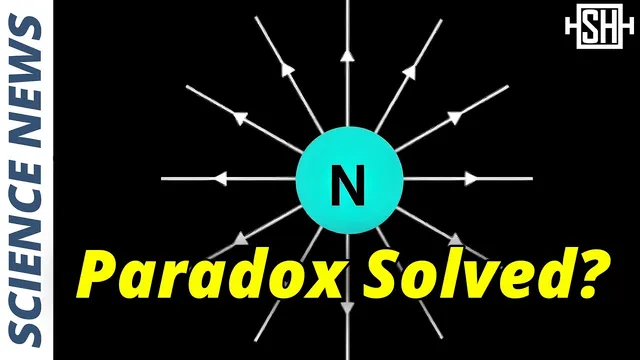
Magnetic Charges Could Actually Exist, Physicists Find
Based on Sabine Hossenfelder's video on YouTube. If you like this content, support the original creators by watching, liking and subscribing to their content.
Magnetic monopoles would add magnetic charge density and current to Maxwell’s equations, restoring a symmetry missing from the standard form.
Briefing
Magnetic monopoles—hypothetical particles carrying only a single magnetic pole (north or south)—have long been attractive because they would make electrodynamics more symmetric and could help explain why electric charge comes in discrete units. The new twist is a proposed fix to a longstanding objection: calculations previously suggested that monopoles would force “partial particles,” implying that matter could be split into fractions of a particle number, which would violate the idea that particles are indivisible units.
In standard Maxwell electrodynamics, electric and magnetic fields evolve from electric charge density and current, but there are no corresponding “magnetic sources.” That asymmetry is what motivated early theoretical work to add magnetic charges and currents alongside electric ones, making the equations mirror each other. Paul Dirac’s classic 1931 argument went further: if a magnetic monopole exists, quantum mechanics can accommodate it in a way that explains charge quantization. The electron behaves as a wave, and the wavefunction’s phase must match up consistently after encircling a monopole. That consistency condition works only if electric charge and magnetic charge are linked so that the relevant phase shift is an integer multiple of 2π—turning the discreteness of electric charge into a consequence of monopoles rather than an arbitrary feature.
Despite the appeal, monopoles have never been confirmed experimentally. After the Standard Model was completed in the 1970s, multiple searches reported candidate detections—one in 1975, another in 1982, and a third in 1985—but none held up under later scrutiny. The absence of reliable evidence pushed the idea into the realm of “maybe too rare or too hard to produce,” but it didn’t erase a deeper theoretical worry.
That worry centered on a paradox: when monopoles are included in calculations, the resulting quantum description appears to allow states that behave like “half a particle” (not half an electric charge, but half a particle’s worth of some quantum number). Physicists dubbed these unphysical possibilities “semiparticles,” and the implication was stark—if monopoles lead to fractional particle counting, then monopoles should not exist.
The new paper challenges that conclusion by reframing what the mathematics means. The authors argue that the fractional-looking terms are not physically real separate objects; instead, the “fractions” belong together and collectively describe a single, consistent particle state. In other words, the paradox dissolves once the bookkeeping is interpreted correctly. If that holds up, magnetic monopoles regain their status as more than a mathematical curiosity.
Monopoles would still matter for big-picture physics: they could reinforce unified field theories that naturally include monopoles, offer a potential component of dark matter, and—via Dirac’s mechanism—provide a principled explanation for why electric charge comes in discrete units. The remaining question is whether the revised theoretical picture survives further scrutiny and whether experiments can finally detect monopoles rather than statistical ghosts.
Cornell Notes
Magnetic monopoles—particles with only one magnetic pole—would make Maxwell’s equations symmetric by adding magnetic charge and current sources alongside electric ones. Dirac’s 1931 quantum argument links the existence of monopoles to charge quantization: the electron wavefunction’s phase must match after encircling a monopole, which forces an integer relationship between electric and magnetic charge. Searches in 1975, 1982, and 1985 reported possible signals, but none were confirmed. A major theoretical objection claimed monopoles create an inconsistency called a “paradox,” where calculations seem to allow “semiparticles” (fractional particle counting). The new work argues that those fractions are mathematical artifacts that combine into a single physical particle description, removing the paradox and strengthening the case for monopoles’ relevance to unification and dark matter.
Why did adding magnetic charges make Maxwell’s equations feel “more beautiful,” and what symmetry does it restore?
How does Dirac’s 1931 argument connect monopoles to the discreteness of electric charge?
What experimental evidence exists for magnetic monopoles, and why isn’t it considered conclusive?
What was the “paradox” that threatened the physical viability of monopoles?
How does the new paper claim to resolve the paradox?
If monopoles exist, what broader physics payoffs are highlighted?
Review Questions
- What specific symmetry in Maxwell’s equations is restored when magnetic charge and current sources are introduced?
- Explain Dirac’s quantization idea in terms of electron wavefunction phase consistency around a monopole.
- What does the “semiparticle” paradox claim, and what reinterpretation does the new work propose to remove it?
Key Points
- 1
Magnetic monopoles would add magnetic charge density and current to Maxwell’s equations, restoring a symmetry missing from the standard form.
- 2
Dirac’s 1931 quantum argument links monopoles to charge quantization through an integer phase-consistency condition for the electron wavefunction.
- 3
Reported monopole detections in 1975, 1982, and 1985 were not confirmed, leaving the experimental status unresolved.
- 4
A longstanding theoretical objection claimed monopoles imply unphysical “semiparticles,” meaning fractional particle counting rather than fractional charge.
- 5
The new paper argues the fractional-looking terms are not separate physical entities; they combine into a single particle description, dissolving the paradox.
- 6
If monopoles exist, they could support unified field theories and potentially contribute to dark matter.
- 7
The central remaining challenge is whether the revised theoretical interpretation withstands further scrutiny and whether experiments can detect monopoles reliably.