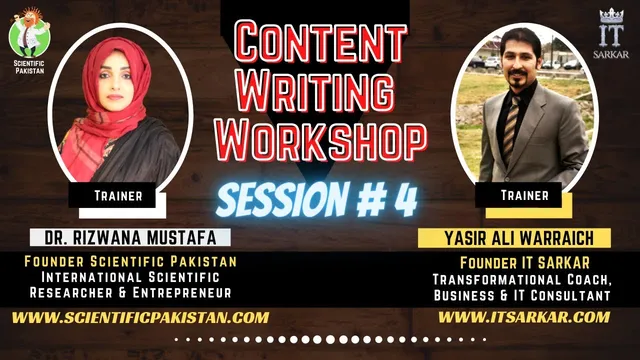
Make Money As A Writer || Content Writing || Complete Course || Session 4
Based on Dr Rizwana Mustafa's video on YouTube. If you like this content, support the original creators by watching, liking and subscribing to their content.
SEO is presented as a step-by-step process—keyword search, keyword optimization, content organization, and promotion—rather than a one-time action after writing.
Briefing
Content writing for income hinges on getting three things right in sequence: SEO-focused keyword work, clean content structure, and active promotion after publishing. The course frames SEO as a practical process—optimizing a website or post so people can find it through search engines—rather than a magic switch that automatically ranks content once it’s written. The core workflow starts with keyword search, then moves to keyword optimization, content organization, and finally content promotion.
Keyword research is treated as the most important step. Writers are told to narrow down from a broad topic to specific search terms people actually type into search bars. For example, “communication skills” becomes a keyword, and then the writer targets narrower phrases tied to improving communication. A keyword planner tool is recommended to identify high-search terms and to check search volume against competition, so the chosen keywords can attract traffic rather than vanish in crowded results. The practical takeaway: pick keywords that are both frequently searched and realistically competitive, then build the post around them.
Once keywords are selected, the next step is keyword optimization—placing those terms naturally in the blog so the content reads well while still signaling relevance to search engines. The guidance includes using the main keyword multiple times within the content (illustrated with “communication skills” repeated several times in a blog about communication skills). The emphasis is on natural integration: the keyword should fit the writing style and feel story-like, not forced.
Content organization is then presented as a structural requirement, not a matter of fancy writing. A typical blog is broken into three major parts: an engaging introduction (about 50 words), a middle section (roughly 200–300 words for a 500–600 word post), and a conclusion that leaves a lasting impression and clearly differentiates the writer’s point of view. Editing and rereading early are highlighted as crucial for making writing more mature, approachable, and powerful. For longer posts, the middle section should expand proportionally while still explaining the introduction.
After the post is published, promotion becomes the writer’s responsibility. Visibility grows through sharing on social networks, building links to the content, and using both internal and external sites to strengthen a profile. The course links ranking success to more work opportunities: the more a writer’s content ranks, the stronger the writer’s profile becomes, which increases chances of getting hired.
Finally, the transcript adds compliance and originality checks as part of the workflow. Writers are advised to run plagiarism detection before posting, using tools like plagiarism checkers to ensure text is 100% unique. Another tool is described for checking whether an article has already been submitted or published elsewhere, with the warning that copied content can lead to account blocks. The platform mentioned as a destination for writing and publishing is Scientific Pakistan, where writers can submit content related to science, business, lifestyle, counseling, and motivation. A minimum schedule is given: at least six months of activity and at least 10 published blogs, after which a certificate is offered.
Cornell Notes
Income-focused content writing is built on a four-part SEO workflow: keyword search, keyword optimization, content organization, and content promotion. Keyword research is treated as the most important step, using a keyword planner to find terms with strong search volume and manageable competition. Keyword optimization means integrating chosen keywords naturally into the blog so the writing stays attractive while improving ranking chances. Content organization follows a three-part structure—engaging introduction (~50 words), a middle section (~200–300 words in a 500–600 word post), and a conclusion that reinforces a distinct viewpoint. After publishing, writers must actively share and build links to increase visibility and strengthen their professional profile. Originality checks (plagiarism and duplicate-submission checks) are positioned as essential to avoid account issues.
Why is keyword research described as the most important SEO step, and how does a keyword planner help?
What does “keyword optimization” mean in practice, and what’s the balance between repetition and natural writing?
How should a blog be structured according to the course’s content organization rules?
What changes after publishing—what responsibilities belong to the writer?
Why are plagiarism and duplicate-submission checks emphasized, and what tools are mentioned?
What publishing platform and minimum participation requirements are described?
Review Questions
- If you had to choose between a high-search keyword with very high competition and a lower-search keyword with low competition, how would the keyword planner data guide the decision?
- How would you redesign the introduction, middle section, and conclusion if your blog length increased from 600 words to 1200 words?
- What steps should be taken before publishing to reduce the risk of plagiarism or duplicate-submission detection?
Key Points
- 1
SEO is presented as a step-by-step process—keyword search, keyword optimization, content organization, and promotion—rather than a one-time action after writing.
- 2
Keyword research should narrow from a broad topic to specific phrases people search, using a keyword planner to compare search volume and competition.
- 3
Keyword optimization requires integrating chosen keywords naturally in the content (with repetition as needed) so the post stays readable while improving ranking signals.
- 4
Content organization follows a three-part structure: engaging introduction (~50 words), a middle section sized to the total length, and a conclusion that reinforces a distinct viewpoint.
- 5
Promotion after publishing is the writer’s responsibility through social sharing and link building to increase visibility and strengthen a professional profile.
- 6
Originality checks are mandatory: run plagiarism detection before posting and use a duplicate-submission checker to avoid reposting content that already exists elsewhere.
- 7
Scientific Pakistan is positioned as a publishing destination with minimum expectations (at least six months and at least 10 published blogs) and a certificate for meeting them.