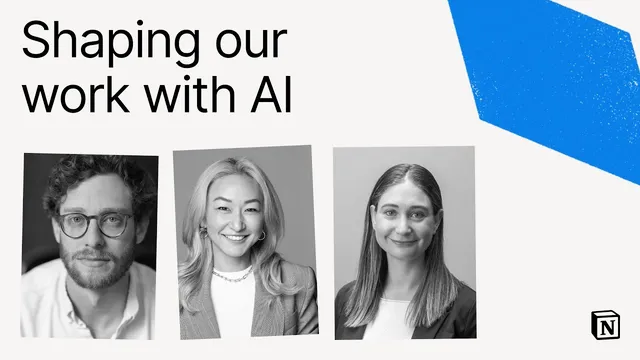
Make with Notion 2024: Shaping our work with AI (Dan Shipper, Sarah Guo, Daniela Amodei)
Based on Notion's video on YouTube. If you like this content, support the original creators by watching, liking and subscribing to their content.
Claude is framed as valuable for creative work partly because it handles administrative and repetitive tasks that drain attention.
Briefing
AI is reshaping creativity less by replacing human imagination and more by removing the “overhead” that drains attention—while also expanding who gets to participate in creative work. Across the conversation, Claude is positioned as a general-purpose assistant that handles administrative and tedious tasks (email triage, proposal review, drafting outreach), freeing people to focus on the interpersonal and aesthetic parts of their jobs. The practical payoff is immediate: creators spend less time on drudgery and more time on the work they actually care about.
That shift also changes who can create. Sarah Guo argues that creativity is widespread—everyone has taste and a point of view—but technical skill often blocks people from turning ideas into finished outputs. As AI tools lower the barrier to execution, more people can express ideas in writing, software, visual arts, and video without needing years of specialized training. A recurring example is scaffolding: someone who can’t code can still mock up a basic website, or someone stuck in a draft can use Claude as a “thought partner” to unstick the next step.
Dan Shipper and Daniela Amodei add a second layer: AI doesn’t just accelerate tasks; it can function like a companion in the creative process. Writers use Claude to get unstuck when they don’t know where a story should go next. Designers and other creatives use it to explore tone, recommend directions, and even help articulate what they like—turning vague taste into words that can guide future work. Amodei describes Claude as both a coach and an interactive partner, including for “unimpressive” personal creative pursuits, and notes that users often report a sense of companionship rather than mere utility.
The discussion then widens to how creative tools evolve. Guo highlights a “capability-first” pattern: builders start with powerful capabilities even when the user-facing experience can’t yet meet every expectation. As tools become easier and cheaper—sometimes dramatically—people stop trying to recreate the old “ideal” outputs and instead create what the new tooling makes feasible. That feedback loop pushes product teams to iterate toward more controllable, editor-like experiences, including regeneration and fine-grained editing.
Personality and interface design emerge as a key “ergonomics” theme. Amodei explains Claude’s approachable, quirky tone as a deliberate product choice: it’s meant to feel usable every day, like a comfortable tool, and to adapt to user context and examples. Guo points to the popularity of AI companions as evidence that humans respond to natural language and social interaction cues. Still, the group draws a line between friendly assistance and problematic anthropomorphism, arguing that the right level of personality depends on use case—customer service, therapy, or creative work all demand different boundaries.
Finally, the panel frames adoption as a learning curve that keeps shrinking. As models improve and developer tools become more capable, even people who once felt “this isn’t for me” find new ways to use them. The shared conclusion: the biggest winners are those who stay open-minded, treat AI as a partner in practice, and use it to translate taste, context, and intent into outputs they couldn’t produce before.
Cornell Notes
AI is expanding creativity by cutting the administrative and drudgery that steals time, and by lowering the skill barrier that keeps many people from expressing their ideas. Claude is described as both a time-saver for backend tasks and a “thought partner” that helps writers, designers, and other creatives get unstuck, iterate on tone, and explore directions. Builders are also learning that capability-first tools change user expectations—people create what the tooling makes possible, then demand more control through editor-like workflows. Personality and interface ergonomics matter: users engage with natural language and friendly assistants, but the degree of anthropomorphism must be managed by use case. Adoption accelerates as capabilities diffuse and more users learn to “reason as if capability will improve.”
How does AI change the creative workflow beyond speeding up output?
Why does “taste above skill” matter for who becomes a creator?
What does “capability-first” mean, and why does it reshape user expectations?
How does Claude’s personality fit into product design, and what’s the risk?
What kinds of creatives benefit most, according to the discussion?
How are investors and builders thinking about personalization and consent-driven targeting?
Review Questions
- What specific kinds of “overhead” tasks does the panel say AI can absorb, and how does that change what humans focus on?
- How does capability-first development alter user expectations, and what product changes follow from that shift?
- Where does the panel draw the line between a friendly AI assistant and harmful anthropomorphism, and why does use case matter?
Key Points
- 1
Claude is framed as valuable for creative work partly because it handles administrative and repetitive tasks that drain attention.
- 2
AI lowers the “taste vs. skill” barrier, enabling more people to turn ideas into outputs without years of specialized training.
- 3
Creative tools evolve through a capability-first loop: broad access changes what users want to make, then drives demand for more control and editor-like workflows.
- 4
Personality and natural language improve software ergonomics and engagement, but the amount of personality must be calibrated to avoid excessive anthropomorphism.
- 5
Claude is described as a thought partner and coach that helps writers and designers iterate on tone, direction, and next steps when they feel stuck.
- 6
Personalization is portrayed as consent-driven—helping users articulate taste and values—rather than purely targeting behavior for transactions.
- 7
Adoption accelerates when users adopt an “open-minded” stance that capability will improve, even if tools start incomplete.