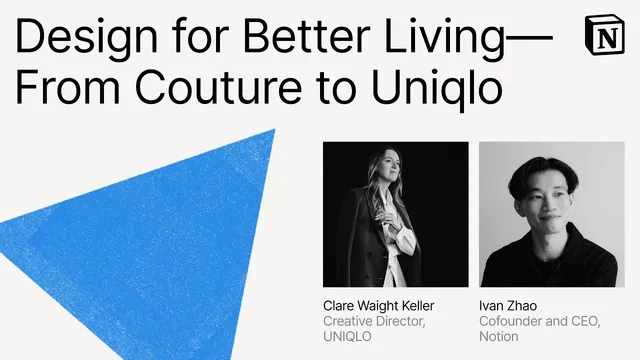
Make with Notion 2025: Design for Better Living - From Couture to Uniqlo (Clare Waight Keller)
Based on Notion's video on YouTube. If you like this content, support the original creators by watching, liking and subscribing to their content.
Clare Waight Keller credits early Calvin Klein branding tactics—controversy and downtown street casting—with proving how attention can be engineered even when campaigns are banned.
Briefing
Clare Waight Keller’s career arc—from Calvin Klein’s early-’90s minimalism and controversy-driven branding, through Ralph Lauren’s luxury menswear—lands in a central idea at Uniqlo: mass-market clothing can still be designed with the rigor of a fashion house, but the trade-offs shift from runway impact to everyday function.
At Calvin Klein, Waight Keller joined in 1993 as the brand pivoted toward the “heroine chic” and waif era that helped define 1990s minimalism. The work wasn’t just aesthetic; it was branding strategy. Calvin Klein’s designer jeans and underwear were treated as commodities that could be made “cool and super desirable,” and controversy became a deliberate marketing engine—most notably through the Brooke Shields campaign, which was banned yet amplified attention. She also points to CK1 perfume and its street-casting approach, using downtown New York imagery that broke with luxury’s elitist tone. The lesson she carries forward is that strong branding can become recognizable even without visible logos—like the Coca-Cola bottle’s shape.
Ralph Lauren offered a different model: a luxury “startup within a giant corporation,” with a tiny team working directly with Ralph Lauren himself. Waight Keller describes long, hands-on sessions focused on fabrics, color, and concepts, and emphasizes how creative freedom still had to stay inside each house’s aesthetic DNA. That framework shaped her view of craft and training. She specialized early, then built technical knitwear expertise at the Royal College of Art—industrialized knitting with machine programming—giving her a rare skill set. Craft, she says, is not just making; it’s understanding how to cut, knit, and industrialize materials, then using that knowledge to experiment within constraints.
Her move to European houses and later to Uniqlo introduces the biggest shift in design priorities. At Uniqlo, she trades away certain luxury signals—no sequins or embroidered dresses—because they don’t match the brand’s language or values. In return, she gains a scale and a feedback loop she finds deeply rewarding: people who once admired her couture from afar now buy multiple pieces and wear them daily.
The balancing act at Uniqlo is explicit. Price sets limits, but the more frequent tension is function versus pure aesthetic. She gives an example of a coat detail—extra pockets and zip styling—that looked good but risked irritating wearers. The founder’s question boiled down to whether a global customer would find the feature annoying or love it, leading to a tweak rather than a full removal. She also describes a Japanese meeting culture of “thinking deeply,” where decisions may take weeks.
Designing for regions adds another layer. Luxury brands often design for runway messaging; Uniqlo designs for what people wear every day, adjusting for climate and fit across Southeast Asia, Europe, and beyond. She even cites data analysis of global body-shape distributions, noting how immigration patterns can make American fits resemble Asian ones.
Finally, she frames her creative forecasting as a puzzle solved through instinct plus cultural signals—street style, younger generations, and the arts—while planning 18 months ahead. A Uniqlo hoodie and sweatpant success illustrates the method: a modern fabric choice and a relaxed silhouette with structure helped the product sell out repeatedly. She believes fashion cycles return across roughly 25 years, reinforced by generational nostalgia, and names Armani and Ralph Lauren as examples of designers who ride waves by staying true to a vision until the timing comes back around.
Cornell Notes
Clare Waight Keller’s Uniqlo leadership reframes fashion craft for mass-market life. Her earlier roles at Calvin Klein and Ralph Lauren taught her that branding power can be recognizable without logos and that creativity must stay within a house’s aesthetic DNA. At Uniqlo, she trades away luxury-only signals like sequins and embroidery to match the brand’s values, while prioritizing function, comfort, and global wearability. Decisions often hinge on whether details will irritate or delight customers, and regional design work uses climate and fit differences informed by data. Her forecasting for seasons 18 months out blends instinct with cultural shifts, and she sees fashion’s recurring cycles as partly driven by generational nostalgia.
How did controversy and street casting become part of Calvin Klein’s brand power in the early ’90s?
What does “brand DNA” mean in practice, according to her experience at luxury houses?
Why does she treat craft as more than aesthetics or “improvising”?
What trade-offs define Uniqlo design compared with couture and luxury runway work?
How does Uniqlo handle regional differences in climate and fit?
How does she forecast trends 18 months ahead without relying purely on formal analysis?
Review Questions
- What specific examples does she give of how controversy and street casting can strengthen a fashion brand’s desirability?
- How do her descriptions of craft training (especially technical knitwear) connect to the way she makes design decisions at Uniqlo?
- Which trade-offs—function vs. aesthetic, luxury signals vs. brand language, runway messaging vs. everyday wear—appear most often in her Uniqlo framework?
Key Points
- 1
Clare Waight Keller credits early Calvin Klein branding tactics—controversy and downtown street casting—with proving how attention can be engineered even when campaigns are banned.
- 2
Luxury house creativity still operates inside a defined aesthetic “DNA,” which she says customers can recognize even without visible logos.
- 3
Technical knitwear training at the Royal College of Art gave her industrial production knowledge (including machine programming), shaping how she treats craft as scalable design capability.
- 4
Uniqlo design requires trading away couture-only elements like sequins and embroidery to stay aligned with brand values and customer expectations.
- 5
At Uniqlo, function often overrides pure aesthetic; details are evaluated by whether they will irritate or delight a global customer.
- 6
Regional product design is adjusted for climate and fit, supported by data analysis of global body-shape distributions.
- 7
Trend forecasting for seasons 18 months ahead blends gut instinct with cultural signals from street life and the arts, and she expects fashion cycles to recur across generations.