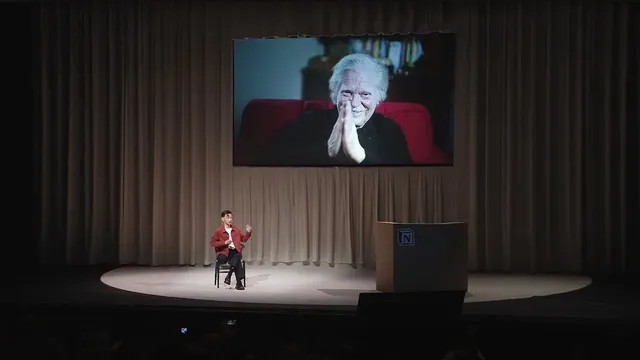
Make with Notion 2025: How to Build Tools That Shape Civilizations (Alan Kay & Ivan Zhao)
Based on Notion's video on YouTube. If you like this content, support the original creators by watching, liking and subscribing to their content.
New technologies reshape the environment people live in, and that environment then reshapes what people consider normal and acceptable.
Briefing
Tools don’t just help people do tasks—they reshape the environment people live in, and that environment then reshapes how people think, behave, and even what they consider “normal.” Alan Kay frames this through Marshall McLuhan’s idea that “we shape our tools and thereafter our tools shape us,” arguing that the biggest changes come not from the tool itself but from the human accommodation to the new environment the tool creates.
Kay illustrates the mechanism with mass media. Television, for example, started as a packaged alternative to movies and radio-like programming, but it quickly became a cultural force: people watched it more than they went to theaters, and daily life adjusted around what television made available. Over time, norms shifted downward—reality television made previously “impolite” or “uncivilized” behavior feel ordinary. Kay links that cultural drift to political outcomes, suggesting that public figures can become products of the media environment that trained audiences to accept certain kinds of content.
A second example comes from scale and imitation. When new media borrows the style of older media, audiences may misread it because the scale is different. Kay points to Orson Welles’ 1938 “Martians” broadcast, which used real-time news conventions to present a hoax as if it were happening live. Millions took it seriously because it was the first time a mass medium delivered something with the immediacy of real-time radio—showing how audience interpretation depends on expectations built from earlier media.
Kay then widens the lens from media to human cognition. He argues that perception is not a direct feed from the world; people reconstruct reality from limited sensory signals and what they already know. That makes people “numb” to their environment: they notice differences, not the full structure that produces them. He describes how removing external feedback—like isolation tanks—reveals that the brain can generate experience on its own, turning everyday life into a kind of waking hallucination. The practical takeaway is that people need reminders and training to recognize what they’re accommodating to.
That leads to a key warning about tool-building. Kay credits Doug Engelbart with an early observation: a tool doesn’t teach “reasonable use” by itself. A hammer teaches hammering, and without education it can be repurposed for harmful ends. Engelbart’s concern was that powerful new computer tools, used without training and ethical education, become “formational equivalents of hydrogen bombs”—dangerous not because the tool is inherently evil, but because humans with old mental habits will use it.
Kay contrasts the original research culture at Xerox PARC and ARPA with later commercialization. In the 1980s and beyond, training and education about consequences were deprioritized, while industrial-scale distribution turned tools into environments that people acculturate into. He argues that modern abundance of media exploits human biological preferences for sweet and salty stimuli—only now applied to information and storytelling—without built-in safeguards against overconsumption.
Finally, Kay offers creativity heuristics for building better tools and ideas: protect time for generating ideas without immediately naming or solving them, use “compartmentalization” (a sane room for order and a crazy room for raw ideation), and keep ideas at arm’s length by writing them down without forcing early evaluation. He also criticizes orthodox gatekeeping, noting that progress in computing accelerated under ARPA’s funding approach that tolerated mistakes rather than relying on peer review. The central tension is clear: incentives that prioritize profit can conflict with the goal of shaping civilization responsibly.
Cornell Notes
Alan Kay ties McLuhan’s “we shape our tools and thereafter our tools shape us” to a practical warning for tool builders: new technologies become environments, and people adapt to those environments until the new “normal” feels natural. Mass media shows the pattern—television shifted norms and even politics by renormalizing what audiences accepted, while the 1938 “Martians” radio hoax demonstrated how audiences misread new media when it imitates older forms at a different scale. Kay argues that human perception is reconstructive and people become numb to their surroundings, so tools must be paired with education and training. He credits Engelbart’s idea that tools don’t teach safe or reasonable use, making consequence-aware training essential to avoid harmful outcomes.
How does McLuhan’s idea (“we shape our tools and thereafter our tools shape us”) translate into a concrete mechanism for change?
Why does Kay emphasize “scale” when discussing new media?
What does Kay claim about human perception that makes people vulnerable to tool-driven environments?
What is Doug Engelbart’s warning about tools, and why does Kay connect it to computing?
How does Kay contrast early research culture with later commercialization?
What practical heuristics does Kay offer for generating better ideas and avoiding premature evaluation?
Review Questions
- What does Kay mean by “accommodation,” and how does it explain why television could shift social norms over time?
- Why does Kay think tools require education and training rather than assuming users will learn safe use automatically?
- How do Kay’s “sane room / crazy room” and “don’t name it early” heuristics help counter the tendency to evaluate ideas too soon?
Key Points
- 1
New technologies reshape the environment people live in, and that environment then reshapes what people consider normal and acceptable.
- 2
Mass media can renormalize behavior downward over time by making once-taboo content feel ordinary.
- 3
Imitating older media formats at a different scale can cause audiences to misinterpret what they’re seeing or hearing, as shown by the 1938 “Martians” radio hoax.
- 4
Human perception is reconstructive, so people become numb to the structures shaping them and often notice only differences.
- 5
Powerful tools require education and training to guide “reasonable use,” because tools alone don’t teach safe or ethical application.
- 6
Commercialization can turn tools into always-on cultural worlds while reducing attention to consequences and user preparation.
- 7
Idea generation improves when evaluation is delayed—using compartmentalized thinking spaces and writing prompts instead of early naming and problem-solving.