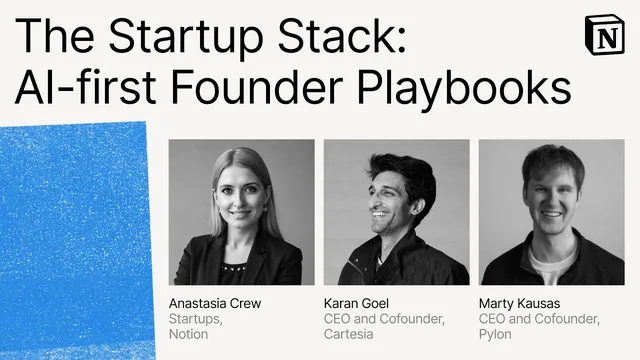
Make with Notion 2025: The startup stack: AI-first founder playbooks (Karan Goel, Marty Kausas)
Based on Notion's video on YouTube. If you like this content, support the original creators by watching, liking and subscribing to their content.
Operational velocity improves when startups collapse software sprawl into one shared system of record early, reducing context switching and missed coordination.
Briefing
AI-first startups are scaling faster by treating their operating system as a single source of truth—collapsing “software sprawl” into one workspace where product, engineering, go-to-market, and customer-facing teams can all move with the same context.
The session opened with a problem statement: modern startups often juggle 112+ tools just to run day-to-day work, creating constant context switching, slower execution, and missed opportunities. The proposed fix is operational consolidation—using Notion early so teams capture customer notes, product requirements, and fundraising progress in one place. That shared context is framed as a direct driver of lower costs, faster shipping, and a longer runway.
Marty Kausas, CEO and co-founder of Pylon, tied that operating principle to a company built for speed. Pylon focuses on B2B customer support and related functions—customer success, solutions, professional services, and account management—using an AI-native platform. After a period of “pivot hell,” the company found traction quickly: entry into YC, first customer within weeks, and rapid ARR growth, followed by multiple funding rounds including General Catalyst and later Andreessen Horowitz. Today, Pylon is shipping at a high cadence—about 100+ PRDs per week and two feature launches every day—while publicly tracking progress on LinkedIn.
The operational backbone behind that pace is a Notion-based feature and launch system. Pylon organizes every shipping item in a single database table with fields for internal and external launch dates, engineering and marketing owners, and the feature details themselves. Multiple views let different teams slice the same information: engineering tracks ownership and timelines, sales and customer success answer “when is it coming?” questions, and product marketing separates internal launches from public ones for coordinated campaigns. The team also uses Notion’s Ask AI to answer ad hoc questions with the right launch context, reducing the need to hunt across tools. Pylon’s content engine—roughly 750 posts in the past year—runs on the same alignment process, and the company even shares a replicated “feature update playbook” template.
Karan Goel, CEO and co-founder of Cartisia, described a different startup built from research to production: voice AI systems and interactive conversational models. Coming out of Stanford’s Hazy Research Lab, Cartisia aims at long-lived AI collaborators and companions that can retain context over time. The company launched its first model product, Sonic (text-to-speech), and later expanded with Sonic 2, while also building audio understanding and transcription capabilities.
Cartisia’s Notion usage emphasizes knowledge centralization and workflow flexibility for a mixed team: about 40% research, 40% engineering, and 20% go-to-market, recruiting, and bizops. Notion supports daily standups via a company-wide page that evolved into team-level standup docs as the company grew. It also powers onboarding directories so new hires can quickly find answers in their first week—using Notion AI to navigate links, pages, and “who to talk to” guidance. Beyond internal coordination, Cartisia uses Notion templates to package model evals and benchmark collateral for customers and partners, keeping documents “living” as feedback arrives.
Across both companies, the shared takeaway is practical: Notion becomes the system that turns AI-driven speed into repeatable execution—providing scale, clarity, and accountability without adding more tools to manage.
Cornell Notes
Pylon and Cartisia use Notion as a single operating layer to keep fast-moving teams aligned on the same context. Pylon runs a launch pipeline in one database—tracking internal vs. external dates, owners, and feature details—then uses Notion views and Ask AI so engineering, sales, and customer success can answer “what’s shipping and when?” instantly. Cartisia uses Notion to centralize research and operational knowledge, run daily standups, accelerate onboarding with directories and Notion AI Q&A, and package living benchmark collateral for customers and partners. The common thread: collapsing software sprawl into one workspace improves velocity while preserving clarity and accountability as teams scale.
How does Pylon keep shipping speed high without losing coordination as the company grows?
Why does Pylon’s approach matter specifically for B2B support and customer-facing teams?
What role does Notion play in Cartisia’s culture and day-to-day operations?
How does Cartisia use Notion AI to speed onboarding?
How does Cartisia turn internal research into customer-facing materials using Notion?
Review Questions
- What specific fields and views does Pylon use in its Notion launch database to support engineering, sales, customer success, and product marketing?
- How do Cartisia’s daily standup pages and onboarding directories change as the company grows beyond the founding stage?
- In what ways do Pylon and Cartisia use Notion to reduce “time-to-answer” for internal questions and customer-facing questions?
Key Points
- 1
Operational velocity improves when startups collapse software sprawl into one shared system of record early, reducing context switching and missed coordination.
- 2
Pylon’s launch database in Notion tracks internal vs. external launch dates, feature details, and functional owners so every team works from the same timeline.
- 3
Ask AI can answer cross-team questions (like shipping dates for specific features) when the underlying launch context lives in a structured Notion system.
- 4
Cartisia’s Notion workflows support a mixed team structure (research, engineering, and go-to-market/bizops) by centralizing knowledge and enabling shared access.
- 5
Daily standups implemented in Notion can scale from a single company page to team-level docs while preserving a consistent coordination ritual.
- 6
Onboarding directories plus Notion AI Q&A can shorten the first-week learning curve by routing new hires to the right pages and people.
- 7
Notion templates can package model evals and benchmark collateral as living documents that customers and partners can comment on, keeping research-to-production communication tight.