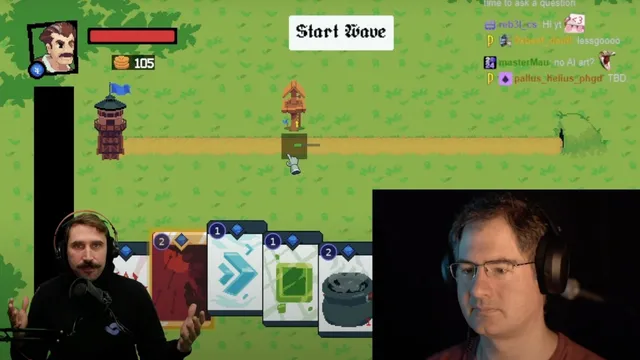
Making A Game GOOD - The Standup EP 3
Based on The PrimeTime's video on YouTube. If you like this content, support the original creators by watching, liking and subscribing to their content.
Polish is primarily micro-level responsiveness: hover feedback, click confirmation, and satisfying action timing—not just adding animations.
Briefing
A card-based roguelike tower defense game can’t become “good” just by solving mechanics and adding content; it has to feel great at the moment players interact—hovering cards, selecting targets, and watching upgrades resolve. The central push in this episode is that “polish” is mostly micro-level responsiveness: audiovisual feedback, clear affordances, and satisfying action timing that keeps players engaged long enough for deeper systems to matter.
The discussion frames the game’s core loop as two interactive phases: (1) picking a card and placing it into the world, and (2) starting a wave where tower-defense outcomes unfold. Even if the meta layer—economy, costs, skill trees, and card effects—is solid, the player’s enjoyment hinges on second-to-second execution. Hovering over cards should feel “magical,” with responsive motion, sound cues, and clear confirmation when a card is chosen. Likewise, the target-selection step must communicate which towers or map locations are valid, how the choice changes the situation, and what the click accomplishes—ideally with immediate, readable feedback such as towers visibly upgrading.
A major practical theme is that polish is constrained by budget, especially for indie teams. Instead of assuming every card needs bespoke animation or heavy 3D work, the episode argues for maximizing the number of “experiences” created from limited art time by separating layers and recombining them. One concrete example: draw a card’s background and emblem as separate layers so the background can move differently (slower parallax, different scale, or subtle scrolling) when the player hovers or selects. That small structural change can create both better feel and extra gameplay variety—like swapping a rare background while keeping the same emblem—without requiring new full-card art or complex shader expertise.
The conversation also reframes asset reuse using a combinatorics mindset: if artists produce N backgrounds and M foreground elements, compositing them yields roughly N×M combinations, effectively expanding content without expanding cost linearly. The same logic appears in 3D character customization, where hats and bodies are modeled separately so many combinations are possible.
Beyond visuals, the episode stresses that the most important action in the loop—placing a card and seeing its result—must feel “awesome,” because players must stay engaged through repeated learning. That engagement is what makes later balance work (scarcity, economy tuning, progression pacing) worth doing. It’s also why experimentation matters: developers need to tweak motion curves, timing, and interaction feel through iterative playtesting, and they need flexible code so new ideas don’t become expensive rewrites.
The episode ends by connecting these lessons to ongoing development: UI coherence, event handling, animation stacking, and preventing accidental interruptions (like starting a wave mid-interaction). The takeaway is blunt but actionable: make the basic interactions satisfying first, then refine balance and systems—because players won’t care about the rest if the fundamental clicks and hovers feel dull or unreliable.
Cornell Notes
The episode argues that “making a game good” depends less on high-level systems and more on micro-level polish: how card hovering, selection, and target placement feel moment-to-moment. Polish means responsive audiovisual feedback, clear affordances, and satisfying timing—especially for the primary action of placing a card and seeing its effect. Because indie teams have limited art and engineering budgets, it recommends maximizing results by separating card art into layers (e.g., background vs. emblem) and recombining them to create many variants without full new animations. It also emphasizes iterative tweaking—adjusting motion curves and interaction feel through playtesting—while keeping code flexible so experiments don’t require major rewrites. Finally, it links engagement to later design work like economy scarcity and balance tuning.
Why does “polish” matter more than meta systems once mechanics are working?
What does polish look like for a card picker with a two-step action?
How can limited art budgets still produce rich card interactions?
What does “afford” mean in the context of game polish?
Why does separating layers increase the number of possible card variants?
What development practices help teams iterate on interaction feel?
Review Questions
- What specific micro-interactions (hover, click, upgrade feedback) must feel good before balance and meta systems can matter to players?
- How does splitting card art into background and emblem layers reduce production cost while increasing perceived polish and variant count?
- Why does flexible code architecture matter for iterative “feel” tuning in interactive UI systems?
Key Points
- 1
Polish is primarily micro-level responsiveness: hover feedback, click confirmation, and satisfying action timing—not just adding animations.
- 2
A card-based tower defense loop has two critical interactive phases—card selection and target placement—and both need clear affordances and rewarding feedback.
- 3
Indie budgets require maximizing results through compositing and procedural effects, such as separating card background and emblem layers for parallax-like motion.
- 4
Separating assets increases combinatorial variety (roughly N×M) without linearly increasing art production, similar to modular 3D customization.
- 5
The primary action (placing a card and seeing its effect) must feel “awesome” because player engagement determines whether deeper design work is even experienced.
- 6
Interaction design needs careful event handling so animations and state changes don’t get interrupted or conflict (e.g., preventing wave start during an unresolved placement).
- 7
Iterative playtesting and motion tweaking are essential; flexible code prevents experiments from turning into costly rewrites.