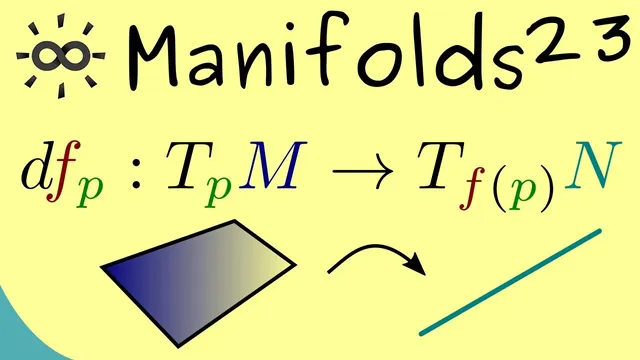
Manifolds 23 | Differential (Definition)
Based on The Bright Side of Mathematics's video on YouTube. If you like this content, support the original creators by watching, liking and subscribing to their content.
The differential for a smooth map is a linear map that depends on the base point .
Briefing
A differential for smooth maps between manifolds is built by pushing tangent vectors forward along the map—turning the familiar “derivative” idea into a coordinate-free linear approximation. For a smooth map and a point , the differential is a linear map from the tangent space to . Concretely, a tangent vector is represented as an equivalence class of curves through , and sends that class to the equivalence class of the composed curve through . This construction matters because it provides the manifold version of the “best linear approximation” that underlies calculus, now valid on curved spaces.
Getting to that point requires assembling tangent spaces across an entire manifold. At each point , there is a tangent space , and collecting all of them produces the tangent bundle , formed as a disjoint union of the fibers over all points . The transcript emphasizes that using a true disjoint union is important: tangent spaces at different points are distinct even if they are isomorphic as vector spaces. It also notes that the tangent bundle can be given a smooth manifold structure with dimension doubled relative to , matching the intuition that it behaves like a Cartesian product locally.
With tangent spaces in place, the differential becomes the manifold analogue of the derivative. The map is “fixed at ”—that dependence is why the notation includes the subscript. The differential is then interpreted as the linear approximation to near , paralleling how the derivative approximates functions in ordinary calculus. In this framework, the differential also induces a global map that assigns to each point its corresponding linear map .
The transcript then grounds the abstract definition using embedded submanifolds of . When and sit inside , the tangent spaces can be treated concretely, and the differential can be computed using ordinary derivatives. A key result emerges: the differential acting on a tangent vector corresponds to the directional derivative of along that vector. In coordinates, this directional derivative is expressed through the Jacobian matrix of at , combined via the chain rule with the derivative of the curve representing the tangent vector. The upshot is that the manifold differential generalizes the Jacobian / total derivative from multivariable calculus, while reducing to the same familiar objects in the submanifold setting.
Overall, the differential is presented as the coordinate-free mechanism that turns smooth maps between manifolds into linear maps between tangent spaces, preserving the calculus intuition of linearization—while making it work on curved domains and targets.
Cornell Notes
For a smooth map and a point , the differential is a linear map . Tangent vectors are equivalence classes of curves through , and sends the class of to the class of . This makes the manifold version of the derivative’s linear approximation near . For embedded submanifolds of , the construction becomes concrete: matches the directional derivative, expressed using the Jacobian matrix and the chain rule. The differential therefore generalizes the Jacobian/total derivative from multivariable calculus to arbitrary smooth manifolds.
How is the differential defined using tangent vectors and curves?
Why does the tangent bundle use a disjoint union rather than an ordinary union?
What geometric meaning does carry?
In the embedded submanifold case, how does the differential relate to directional derivatives?
How does the Jacobian matrix appear in the manifold differential?
Review Questions
- How does the equivalence class of a curve through determine a tangent vector, and how does act on that class?
- Why is the tangent bundle constructed as a disjoint union of over , and what goes wrong with an ordinary union in some contexts?
- In the submanifold-in- setting, how does the chain rule connect to the Jacobian matrix and directional derivatives?
Key Points
- 1
The differential for a smooth map is a linear map that depends on the base point .
- 2
Tangent vectors are equivalence classes of curves through , and is defined by composing those curves with .
- 3
Collecting all tangent spaces across a manifold produces the tangent bundle as a disjoint union, keeping fibers at different points separate.
- 4
The tangent bundle can be given a smooth manifold structure whose dimension is twice the dimension of .
- 5
For embedded submanifolds of , the differential matches the directional derivative along the chosen tangent vector.
- 6
In coordinates, the differential reduces to Jacobian-matrix multiplication via the chain rule, generalizing the multivariable total derivative.